TBY Lost Afterparty III - 1947
Dag Stenvoll and Michael Lavocah · 2021-02-03 · 2:45:26
The third 'lost afterparty', revisiting 1947 ten months after the original two-hour show and playing everything that didn't fit the first time. Where 1944 was beauty and lyricism, 1947 is darker and more complex: the Golden Age has passed its peak and censorship is starting to bite, a year before the government bans Pugliese's orchestra and folk singer Atahualpa Yupanqui outright. The orchestras skipped first time round get their turn — Tanturi (now missing singers Castillo and Campos), D'Agostino (newly split from Ángel Vargas), and an unusually sophisticated late run of Canaro recordings with guest singer Nelly Omar. The second half belongs to the year's two giants, Troilo and Pugliese, including a 1947 Radio El Mundo recording of Troilo's 'Los Despojos' that was never commercially issued, and Pugliese's 'Bolero', which jokes about Latin dance music's growing threat to tango.
What this episode gave Tangopedia
Facts said in the episode, each now cited to the minute it is said.
Piazzolla's orquesta típica — his only one; later groups were never típicas — was formed in 1946, playing complex arrangements from a book of around 120 songs for cafés and hipsters rather than dancers.
Marino's voice is easier to hear on his post-Troilo solo recordings because Troilo deliberately kept him further from the microphone to balance the singer against the band.
No version of La Cumparsita was recorded at all in 1947.
By 1947 Tanturi no longer had his former singers Alberto Castillo or Campos; the new pair, Osvaldo Ribó and Roberto Videla, replaced them.
Remembranza is usually associated with Pugliese and singer Alberto Massiel, but Massiel first performed it with the Gobbi orchestra before bringing it to Pugliese.
Records played · 29
Transcript
Transcribed by machine from the audio, then punctuated; names may be misheard. Tap any line to hear it. The episode is in English, and so is its transcript.
Comic opener Lavocah predicts will be the night's last laugh before 1947 turns serious.
That was Feliciano Brunelli with Mi Vaca La Cera welcoming you to the 1947 Tango by Year after party. Only 10 months after the original. You had your time to prepare. I had time to prepare.
Hello, Dag. How are you? I'm good. Yeah, I was enlightened by your pre-Cortinas here. You've got a shiny new shirt there. Yeah, I got one through the mail this morning. Wow. 1947 shirt. It's at its first milonga.
So, as usual, I try to pretend that we're just following right on from Dag's beautiful introductory, well, not introductory. But of course, back in April last year, we were still trying to keep the show to two hours. Right. So it's simply not possible to play all the music. So there's lots of music left to play.
It's quite interesting for me doing the set of four programs again, 41, 44, 47, 51, because it's kind of recapping most of the golden age in a short time. And there's a really big change, isn't there, from 44. Two weeks ago, the last lost after party with 44, we listened to so much beautiful music. Really a year of beauty and lyricism and sensitivity. And 47, well, of course, there is beautiful music, but it's not really like that. It's more complex. It's more serious. I think Mi Vaca La Cera is going to be the last laugh we're going to get tonight. There's not so many waltzes, not so many female vocalists.
Let's have a look at your playlist. So you played for us only 10 months ago, you began with Di Sarli, who's got Durramba. Of course Podestá comes back just for the carnival dances, Otra vez Carnaval, La Canción Más Triste, and the lovely milonga, the rare milonga Pueblera. Then you had a little tour around Caló and his orchestras, Plomo from Caló with Raúl Iriarte. A crazy one of Maderna, Fantasia in Tiempo de Tango, Fantasy in Tango Time. Two of Francini Pontier, which surprised me. One a duo with Podestá and Raul Baron of Adios Marinero, and the other with Rufino, Dejame No Quiero Verte Mas, which means I'm not. Vocalists. I mean, yeah, what a list of vocalists. Yeah, amazing.
So Francini Pontier clearly was an orchestra that the vocalists wanted to sing with, even if it's not our top favourite today. Popular at the time with the musicians in particular. So we won't hear any other version of Dejame No Quiero Verte Mas tonight because I managed to narrow my playlist down to only 50 tracks. And experience is established. There will only be time for 30.
So after that little Caló tour, we moved on to D'Arienzo with some really nice and unusual songs. Y entonces llorarás with La Borré and Contra Luz, a very little known instrumental. Then a little Gobi, only a little, because it's a short show and there isn't that much Gobi, but they were very nice and interesting. La Viruta of Gobi, really complex and fascinating arrangement, and then the waltz Latin Treriana. Then we moved into the heavy stuff. Three from Pugliese. El Mareo, that's a duo with Chanel and Morán. Very rare, the duos in the Pugliese Orchestra. And then a milonga, Anda che tu corre lola. Very few milongas. Both the tracks that Laurens recorded in 1947. There's only two, so I can't play anymore.
One track from Piazzolla's Típica. So Piazzolla had started his Típica in 1946, making leading edge music that was popular with hipsters, played just in cafes, didn't play for dancers. One track of Marino as a soloist. He'd left Troilo and gone solo and was doing very well. And the nice thing about those recordings is that you can hear his voice better because with Troilo, Troilo wanted to balance with the whole band and he kept Marino a bit further back from the microphone. But as a soloist he's closer to the mic and you can really hear how good his voice is. So we'll here's some more Marino tonight. I think we shall, but anything could happen.
Chapter · 7:26
The Singer Troilo Kept Quiet
Troilo never let a singer get louder than the band. One of them got fired for turning up his own microphone.
Then three from Troilo for the climax. Yo te bendigo with Rivero's voice. Troilo with Rivero, 47. It's really special. The milonga, Gadela Rezzano, also called El Morrocho e l'Oriental. And then finally, Moramanso de Barrio, a waltz that slays me. And Confession also I played before that. Oh, and Confessionals too. Sorry. Which is also a very heavy one. I don't think it gets... It doesn't get any heavier. It's a dark year often for tango, right? Yeah, it is. Dark and emotional, I noted in my sheet, yeah.
“Dark and emotional, I noted in my sheet, yeah.”
And then you pointed out that there were no comparsitas recorded in 1947, so we got one from December 46. Francini Pontier. Luckily, I'm not going to feel obliged to play a comparsita tonight. So what I suggest is we start off with the orchestras that weren't played. We were trying to keep to our show. It wasn't possible to play all the orchestras. And let's just give you a quick idea which orchestras we didn't hear.
We didn't hear any Tanturi last time. Ricardo Tanturi, OK, he doesn't have Castillo and Campos any longer. They're both gone. But he has a really nice pair of vocalists, Ribó and Videla. We didn't hear any D'Agostino. There isn't much and it's not D'Agostino Vargas anymore. It's still interesting. Vargas himself of course is a soloist. We didn't hear any De Ángelis who in the late 40s was, according to some, the most popular orchestra in the city. We didn't hear any Canaro which is a pity even if you're not a big Canaro fan because he has Nelly Omar singing with him for a few recordings. Castillo. Did you play any Castillo? I don't think you did. Or maybe you played one. No, you didn't. Castillo's also a soloist. So there's that too. Biagi, just a few tracks. Didn't hear any of that either. So I don't know how we're going to cope with all this because, of course, I still want to play you some Pugliese and Troilo. It's going to be a long night. It's going to be a long night.
Why don't we start with Tanturi? Because I think Tanturi was the biggest loss. Now, when you listen to Tanturi in the 40s, it's good to keep in mind how much overlap there is between his repertoire and the repertoire of the Pugliese orchestra. For example, in 47, the tango Amiga is performed both by Tanturi and by Pugliese with Chanel. Now, I will start with one, again, performed by Pugliese, but not too much later. Remembranza. If I say Remembranza, you think Pugliese-Massiel. Yeah? Or Gobbi. But yes, Massiel brought it to Pugliese from the Gobbi Orchestra, where he performed it around this time. But Tanturi has a very nice version. Let's listen to these.
And with much better transfers. When we first heard Tanturi from the late 40s, 10, 15, 20 years ago, the transfers were really poor and it was quite hard to enjoy the music. These are the transfers of Tango Tunes and you can hear much more of what's going on. Sometimes the syncopation's a bit subtle. I'd be really interested to get your feelings about it. Here we go. Remembranza.

Played to cover the Tanturi gap from the original show; compared with the better-known Pugliese-Massiel and Gobbi versions.
Danced to it · 5 of 7


♪ Music · 2:25 · The lyrics, on the song's page
I like. It's nice. It seems, I mean, it's holding the tones like this for a long, long time. It's a bit fashionable at this period, isn't it? But Di Sarli does it also a lot. Well, I guess it's in the mould, certain mould of singer that is going to become epitomised in somebody like Jorge Maciel, especially with the Pugliese Orchestra. A different style of voice, a kind of voice you didn't really get. Maybe Ruffino is on the road to a voice like that. You start with Ruffino, then you go through Morán, and then finally you get a voice like this. Something like that.
Now, there's two singers with the orchestra. That's Osvaldo Ribó. He's more like the Jorge Maciel type and then the other voice is a more typical traditional tango voice, a darker voice, a bit more real compadre, more of a street voice, and that's the voice of Roberto Videla. Now I'm really, really interested to get your feedback. The next track, Tanturi with Videla, is San José de Flores. Again, if I say San José de Flores, if you know your repertoire, you're going to think of Pugliese and Pugliese with Morán in 51, I think, but also of a tango that's just impossible to dance in the Pugliese version. It's broken the bounds of dance structure, but here not. Here this is still inside the dance framework. So here's a San José de Flores. Flores is a barrio, not in the downtown area, further to the north, just thinking which way, north, no west, further to the west from the city centre. And San José de Flores, it's a church, a churchyard in that barrio. See what you think about this, a danceable version of a song that would be very difficult to dance in the Pugliese interpretation, much better known.

A fully danceable reading of a tango that, in Pugliese and Morán's later version, breaks out of dance structure entirely.
Danced to it

How many people have danced to that? It's not when you hear it, the milongas, is it? No. And there's so much of the syncopation in the background that it doesn't give you so much of a walking feeling. But I'd like to have the opportunity to dance to it and then I'd know really what I think. But the way he sings reminds me about a Canaro, I mean, not the voice itself. Yes, there's something with the way he phrases. Yeah, is that on Tanturi or what, I don't know, but I have the same feeling that you do. Yeah, I'd really agree with that.
Okay, let's listen to some more orchestras that didn't make it into the first part of the program. One waltz from De Ángelis, this is a Magaldi. Now, Magaldi was one of the great cantor nacional, the great singers of music of whatever kind, like Gardel. Gardel died in 1935, and then Magaldi, who was seen as the number two representative of that kind of music, he died in 1938. And the lyric of this waltz says, Por qué te fuiste, hermano? Why did you go, brother? I'll post it in the chat window. Have a listen to this.
A tribute waltz mourning singer Magaldi's 1938 death, chosen to fill the De Angelis-shaped gap in the original show.
I love that. I love that. And it has a little bit of weight to it. It's not just frothy and light. Yeah, I mean, the lyrics, winter morning, the sun has gone down, denying us its rays, perhaps it's gone. I can relate to that as a person who grew up in the north. But now it's February, so the sun is coming back, folks.
So now let's pass on to another orchestra that's not too fashionable any longer, which is the Orchestra of Canaro. And I'm not going to start with a Nelly Omar track. There is some good Canaro. I mean, there's 3,800 tracks. So, sort through them, even in those later years, and you can find some interesting things. Here's a tango called Vieja Cumparsita with the voice of Enrique Lucero. And then after that, we'll pass on to some tracks with Nelly Omar, which of course will be wonderful. We'll chat about that in a moment. So first, Vieja Cumparsita.

Proof there was a Cumparsita connection in 1947 after all: the melody quotes La Cumparsita throughout.
♪ Music · 3:28 ·
Someone's called it un-Canaro-ish in the chat window, which I think is meant as a compliment. I know what I mean, but there's also some Canaro feel to it. It's both things, I think. Yes, yeah. And you can hear there are some quotes from La Cumparsita. So there is a Cumparsita from 47, after all. Yeah, I like it. You know, when the composition is from? I think it is from 47. All right. Yeah.
So let's pass on to the stuff that we know everyone's going to love, which is Nelly Omar. As so often with the women singers, they weren't full-time members of Typica's because of the strange environment and timetable you led if you were a working member of an orchestra Typica. It was all right for the man of the house to be out till four in the morning, six nights a week, but not for the woman of the house. But through Canaro's intervention, Nelly Omar makes 10 recordings or so with him, over quite a long period actually, over 46 to 48, over two years. And happily for us this evening, quite a few of them are in 1947.
Chapter · 27:58
Why There Were So Few Women Singers
A tango orchestra worked until 4am, six nights a week. No married woman was allowed to do that.
Now the first two that we're going to hear are both from the Canaro factory. The first one is Sentimiento Gaucho. Now if you go and look it up in the databases, it says Francisco Canaro, but actually it was his brother Rafael who wrote it. And it won the competition for Best Tango in 1925 and was a huge, huge hit. And after it won, first of all, Francisco Canaro added his name to the piece. So when it entered the competition, it said Rafael. And then after it won, it became Rafael and Francisco. And then it became Francisco and Rafael. And then finally, like a cuckoo in the nest, Rafael's name was completely expunged. He was asked about this and he said, oh no, I couldn't put it under my name in the competition because I already had the number in there.

One of ten recordings Nelly Omar made with Canaro's orchestra over 1946-48; Lavocah says a great singer 'raises the level' of any tango she sings.
Chapter · 28:37
The Vanishing Co-Writer
He wrote a tango that won Buenos Aires's top prize. Then his own brother erased his name from it.
Yeah, yeah. They have a good brotherly relationship, the Canaros. All I can say is that Francisco's brothers referred to him as the Kaiser or the Tsar. As a compliment? You just draw your own conclusion on that, ladies and gentlemen.
“You just draw your own conclusion on that, ladies and gentlemen.”
Now, what I find is that Nelly Omar raises the level. But it's like when someone like Corsini or Ciarlo sings. They just raise the level of whatever they participate in up one notch. So Sentimiento Gaucho, which is a very nice melody that we like. When you hear Nelly Omar singing it, you think, oh, wow, this is a great tango. And I think the same goes for Noblesa de Arabal, which in this case is by Francisco Canaro himself, which we'll play straight on afterwards. And when we get into that second piece, notice around the middle of the piece how it shifts suddenly to a abanera rhythm.
Buddhism in tango. The first line of the chorus. Sabe que condición de un varón es sufrir. Know this, the condition of man is suffering. Isn't that the first noble truth? I think it is. That wasn't written by Canaro or one of his brothers. The lyric was written by Juan Andrés Curuso. So let's go straight on with Noblesa de Arabal, another old Canaro number.
Second of the Nelly Omar/Canaro pair played back to back; listen for the mid-song shift into habanera rhythm.
What you always get with Canaro is great dialogue. He's really good at this call and response thing. And there it starts off quite early, doesn't it, between Nelly Omar's voice and the clarinet. These ten songs that Nelly Omar records with Canaro, the arrangements are a little bit more sophisticated than the rest of the material that Canaro is pushing out in the 1940s. And I wondered, was there a different arranger? And then I discovered that many other people had wondered the same things. Did they get a different arranger in? And Carlos Puente confirmed to me, because he asked Mariano Mores directly that it's the same arranger as everything else that Canaro does. Mores himself, the pianist, the band's pianist. Here, he's allowed.
This is the story of the Canaro Orchestra right through. The musicians could do complex stuff, but mostly Canaro's restraining them to keep it into what he, well, not thinks, what he knows is commercial and will sell the most records. But when allowed to, they can do more sophisticated stuff. How come they were allowed on these tracks has to do with Nelly Omar. It's to do with the presence of Nelly. Exactly. It's crazy time, you can do whatever. Woman singer. Yes, and these are not 10 tracks that are released together. They release one here and two there, so it's not dominating his output at any one time, so each one is a little special moment in the discography. Nice.
Let's go on and listen to D'Agostino. And in 1947, D'Agostino, who, for my money, has something in common with Tanturi in these years. I don't know why. It's something about the way Tanturi has slowed down. I start to hear something similar in the piano, which I can't quite explain. Maybe I'm talking nonsense. Anyway, he records a version of Alma de bohemio, which we associate with other orchestras. We associate it with Alberto Podestá, who sings it with Laurens and then he takes it into Francini Pontier. But D'Agostino does a version. Now, when D'Agostino performs anything, he always performs it very spaciously. So that long opening note is going to be stretched out even longer than normal. Have a listen to this.

D'Agostino's spacious, stretched-out phrasing on a song usually associated with Alberto Podestá and Francini-Pontier.
And who's singing, Michael? It's a guy called Tino García, a different voice to the voice of Ángel Vargas.
Lovely. I've never heard this before. The piano is so spacious. Yes. Piano is very, very spacious. The bit I like the most, it's not when he stretches out the note, but it's his opening phrase when he sings Peregrini Sognador. And when he sings Sognador, which means dreamer, he sings it so softly in a dreamlike way. I think it's very nice interpretation. He's not Alberto Podestá, but still a very nice interpretation.
Let's pick the speed up with a milonga from the voice that used to sing with D'Agostino, which is Ángel Vargas. They've split up not really out of rancor, although things weren't that smooth, but what happened was the band, D'Agostino Vargas Orchestra, was offered a tour in the interior and Vargas didn't want to go on tour. He liked going to the nightclub with his friend Endika Kidicamo every evening and if they went on a tour he couldn't do that. So he said, no, I'm not going. I'm retiring. So he retired and Angel Vargas kind of took the band, which is then led by Eduardo del Piano, who's a bandagnon player. Don't be confused. Eduardo del Piano is a bandagnon player. Have you got that? Confused the hell out of me.
And then they went on the tour and they came back. And then D'Agostino thought, what happened to my band? And then he started another band. That's how they separated. It's better for Vargas because he's earning more money now that he's a soloist, whereas when he was, we say D'Agostino Vargas, as though the band was called the D'Agostino Vargas orchestra, but it wasn't, it was the D'Agostino orchestra and Vargas was the singer, and he didn't earn as much as he thought he should have done, because what was the D'Agostino Vargas band without Vargas? Not very much really.
An unusually tender milonga wishing Gardel, dead since 1935, had lived to grow old instead of dying at his most famous.
This is a milonga called Milonga para Gardel, Milonga for Carlos Gardel. And Gardel died in 1935. And then Gardel's mother died in 1943. This milonga is, I think, written in 1947. And the lyric is really quite surprising to me. It says, I would have liked to have seen you getting old, Carlos. Because Gardel dies at the peak of his fame. And, you know, when he's at his most handsome, thus allowing him to be commemorated forever as a myth. But this tango says something different, this milonga. I'd like to have seen you growing old. That's a beautiful thought, actually. Not one you often hear articulated in tango. Let's hear it.
“I'd like to have seen you growing old. That's a beautiful thought, actually. Not one you often hear articulated in tango.”
Unexpectedly tender for a milonga at the end. I'd like to see you old, to have you old, but to have you, to have you, to have you.
Milongas are normally for entertainment, not for nostalgia. It's really unusual. I love it.
And as someone pointed out in the chat window, there's something a bit different about D'Agostino milongas. If we take the polarity between a very rhythmic band like D'Arienzo and a very melodic band like Di Sarli, I guess we're going to have to play those two now, aren't we? So D'Arienzo's milongas, they just go along like a racehorse. And then Di Sarli's milongas maintain the feeling of phrasing that his tangos have. And D'Agostino's ones also have some of that element of phrasing, particularly El Portagnito, which is what, 1945, I think. Very clear swing in the phrase, and you get a little bit of the feeling of that as well. So they're phrased milongas, but not strongly phrased as the Di Sarli ones. And that's what gives them their special feeling, I think.
Not the easiest milongas to dance, I think, the D'Agostino ones. Somebody else is saying that. I don't agree. I think they're absolutely wonderful to dance to.
Maybe, but they're not easy to dance to. No? If you know them, I mean, maybe because they're less played. They captivate me. I wonder why that is. I wonder what's tricky about them. It'd be interesting if we can unpick that. We'll be interested to hear your thoughts in the chat window.
Meanwhile, let's move swiftly on to those two giants, Di Sarli and D'Arienzo, both of whom are recording still quite prolifically in 1947. 1947, tango has passed its peak, hasn't it? We're past peak tango. Censorship is beginning to bite, and 1948 is going to be tango's worst year as the government crushes all the communists and all the socialists. Pugliese is banned, Atahualpa Yupanqui is banned, Ken Hamilton is banned, and people are put in prison and tortured, and the censorship still isn't lifted at the beginning of the year. So we're not there yet, but we're on the way, and we're going to hear some clues about that. But D'Arienzo and Di Sarli, they don't care, because they just carry on doing the same thing that they've always done.
Let us start with one waltz of Carlos Di Sarli, a waltz he recorded twice. This recording, as well as a later one with Oscar Serpa in 52 or 53. This is the waltz De Vuelta. I love this one. Amor, amor, de vuelta voi. Love, love, I'm coming back. What a wonderful, happy, positive thought for a dark winter night.
Di Sarli recorded this waltz twice; this earlier version is chosen over the later remake with Oscar Serpa.
♪ Music · 2:10 ·
The night gave me his encaixe, the night gave me his poem in gris, and the valley was his best place to take you. La nube me presto su encaje, la tarde su poema en gris, y el valle su mejor paisaje para llevarte a ti. I like this phrase, only he who has suffered from absence know what it's like to return. It's so true, isn't it?
Yes. You have to feel that absence. Yes, yes. And then at the end, La tarde su poema en gris. The afternoon is a great poem. And the valley lends me its most beautiful landscape to bring me back.
I really like the relationship between the violins and the voice. So a lot of the time behind the singer, the violins were playing on the 2-3 of the waltz 1-2-3. 1-2-3. They were going, which creates a wonderful uplift in the music. That's Di Sarli. It's always more complicated on the inside than it sounds on the outside.
Now, I want to play two instrumentals, but there isn't time, so I'm only going to play one. So El Pugito is in the bin and we get to listen only to La Rachela, which is very beautiful, not very well known. And of course, at the end, there's an exquisite violin counter melody with a weeping phrase. He does it best.
A little-known instrumental chosen over El Pollito for lack of time; prized for its weeping violin counter-melody at the close.
♪ Music · 2:50 ·
It's so simple and it's so beautiful. This very simple counter melody at the end. The violins come in, they split into two lines, then they make that weeping descending melody. Ah, perfect.
Now I figure I'm allowed one Di Sarli tango. Again, I would have liked to have played more than one, but I'm only allowed one because there's so much music to play. Look, an hour has gone already. So I'm going to play Dinero, Dinero, Money Money, and it's not about how good money is. There are lots of tangos which tell about how the girl is lured away from the beautiful life that she has in the poor barrio with the poor but honest and hard-working boyfriend and then she goes up to the big city and gets ruined. I mean, in a way, this is kind of related, but it's a different story. She's with a guy and they're quite happy together, but then he becomes rich and the money ruins the relationship. And he says, I prefer the richness of love to the richness of wealth. And he sings, Dinero, Dinero, money, money, you don't get me what I want. How true is that? So Podestá, he's the only singer in this year, 1947, Dinero, Dinero.
Podestá is Di Sarli's only singer this year; the refrain 'money, money' turns into a complaint that wealth ruined a happy relationship.
Like the Abba song, wasn't it? Money, money, money. It's a rich man's world, but for him, it's not.
Tough stuff. Yes.
Right, let's move straight on because there's so much music to get through and I want to play a little bit more of the Típica of Astor Piazzolla. So this is really Piazzolla's only Típica. He forms many other lineups later on but none of them will be Orquestas Típicas. This is the only one. People sometimes call it the 1946 orchestra because that's when it's formed. He's of course got great musicians, but he's got himself as arranger. The arrangements are really complex. They had a very large book of music. I think they had something like 120 songs ready to go and they're complex arrangements. And it's nice especially to listen to them now because you don't hear them very often in the milonga because they are very complex and they change colour quite a lot. And although Piazzolla is writing for a típica, we know that he didn't prioritise the needs of the dancers. So long as the musicians were smiling, he was happy. But here we're sitting listening, so I think we're going to find this more interesting than we would at the milonga. Let's play El Rápido, The Express. And if you like it enough, I'll play one more.

From Piazzolla's only true orquesta típica (formed 1946); complex, colour-shifting arrangements built for listening, not the dance floor.
How about that? Genius! Genius! It's so clever and witty. Really intelligent music. But yeah, not prioritising the dancers, but fascinating to listen to. And I noticed that in the first five seconds, there were three or four comments going, fantastic, but they were all from musicians. So maybe some of the non-musicians are sitting very quietly but I think it's great. I'm not thinking, I'm not thinking about do I like it or not. I recognize it as tango and I find it really intelligent music. Let's listen to one more from 1947.
Chosen to demonstrate marcato en ocho — eight accents per bar instead of tango's usual four.
Taconeando. Taconeando is an old Pedro Maffia number performed by Laurence. There aren't enough versions of it. It's a really wonderful tango and if I recall correctly this is one of the numbers in which we hear what we would have to call marcato en ocho. So normally tango goes one two three four which you can count one two three four or one and two and depending on how you feel. So in Spanish we would say marcato en cuatro, marking marcato en cuatro, in four, one two three four. And then sometimes, especially with Troilo, you get instead of just two beats to the bar. Troilo does that a lot to create pauses. Marcato in dos. And then when they play compound time, you get marcato in tres. Three beats to the bar, three against four. But sometimes Piazzolla, he just can't express everything he has to say with only four beats to the bar. So he puts in eight. Marcato in ocho. Have a listen. See what you think of this one.
Did we go too far with that one? It's okay, Michael. We can go way too far in these after parties. That's it. It's an after party. I don't want to dance to that one. I don't want to dance to that one. But most of us aren't dancing, are we? We're sitting at home alone on our sofa with a glass of wine. I think that's really interesting to listen to, but not really dance music.
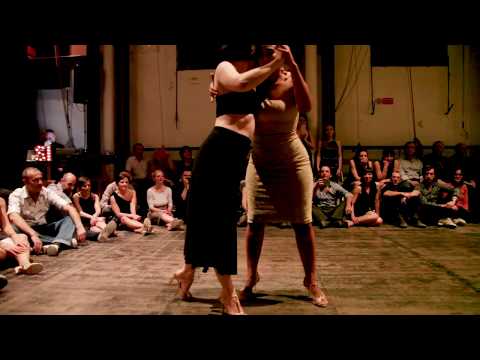
Shall we calm things down a bit with just a little touch of Miguel Caló? Now he's only got Raúl Iriarte. The songs don't have the power that they did in the earlier part of the 40s. And Iriarte doesn't have the power of the earlier voices, but it's still very harmonious and pleasing. This one is Rebeldía, rebelliousness.

By 1947 Caló has only Iriarte left and the songs have lost some earlier power, but it's still harmonious and pleasing.
Danced to it · 5 of 104



♪ Music · 3:01 ·
Lots of people going, oh, that's better. Now, from a dance point of view, it's much better. But for those of you who didn't look at the lyric, what would you have said that tango was about? Because when I listen to the sound of that tango, I just have a very romantic, oh, isn't it, lovely feeling. But that's not what the lyric says. Let's have a little look. The first thing he says is, hands red from squeezing the heart, stifling a muffled cry. So I love that. I think it's very beautiful. I play that as a DJ. But it's a little bit like Troilo hasn't happened, isn't it? The whole project of uniting the sound of the music with the sound of the lyric is not present in this number. Only comment to make, because it's 1947 now, it's not 1941 or 1937, when it was fine for these two things to be apart.
There's another nice Caló track from 1947 called Extrania, which, strange, it's about a couple meeting on a boat and having an affair, but she's really tortured and she leaves him at the end and doesn't want to stay in touch. And what a strange experience, strange, extraña. And in that one, you have much more of a feeling of the relationship between the words and the music. They're connected. Also very nice. But here I feel they're not connected. Still beautiful to dance.
Right. Here's something that I really don't know how you're going to react to. From the vocalist Carmen Duval with arrangements by Argentino Galván. Argentino Galván is one of the top two or three professional arrangers worked a lot with Troilo. Some people call him Troilo's favourite arranger in the middle part of the 1940s. So here he is writing arrangements and conducting a backing orchestra for a female vocalist called Carmen Duval. This is Barrio Pobre, poor barrio, poor neighbourhood.
Arranged and conducted by Troilo's favourite arranger, Argentino Galván, sounding so Troilo-like Lavocah says you'd believe it a Troilo copy.
♪ Music · 1:21 · The lyrics, on the song's page
Beautiful, isn't it? Beautiful. Quite Troilian sounding.
If I'd said to you, oh, this is a copy of something by Troilo, you'd all have believed me. Because Galván fits like a hand in glove with the Troilo style, so he's arranging in the way that he likes to do and knows to do. Full of emotions. The strings given a nice part. The use of the strings is very much the same as it is in the Troilo band.
But it seems we're no longer living in the era of the female vocalists. Someone like Carmen Duval is no longer able, even with that quality, to be at the first level. So back in the 20s, when tango was not exclusively a dance phenomenon, when many people went to the theatre to listen to tango, then it was possible easily for the women to be as famous and rich and successful as the men because they could do it in the theatre. And that was true all through the 20s and through the first part of the 30s.
But once you get the dance revolution, it's actually removing work opportunities for women because in 1937, a woman is not allowed to work in a cabaret till four in the morning on the stage. It's just not done. I don't know, maybe it's much more complex than that, but it's certainly something you see. There are still singers with great quality, but they make far fewer recordings, the era of the soloists. And it's not just the women, people like Ignacio Corsini as well, almost not making any recordings any longer. It's like their time has gone.
But I thought that's lovely. I'd love to have heard her singing with Troilo. When I listened to that, you can imagine it, can't you, that voice with Troilo? Because she's got colour, colour in the voice, which is what you need to sing with Troilo.
Yes, and Ruth commented how unusual the ending was, but that was very much Galván, this very romantic touch in the strings at the end.
Now, getting towards the big guns, let's just lighten things up with one milonga from Alberto Castillo, and it's a milonga candombe. So remember, Alberto Castillo was the singer with Tanturi when he made it into the big time in 41 or so. And they split quite bitterly in 1943. Tanturi said to Castillo, you'll starve. And really, he said, you'll starve. We can imagine him going, and I hope you do.
And Castillo hired some Afro-Argentine drummers and dancers for a stage show and was so successful that very soon he was stopping the traffic because so many people were crowding to get into the theatre. And he pursued that repertoire a lot right through his recordings. You can see him performing Milonga Candombe. When I say Milonga Candombe, I mean Milonga with the Candombe flavour. We should never call them candombes because the candombe is not a dance or music performed with an orchestra. Candombes are for drums and singers. That's how it is. Go to a rumba in Cuba and you'll see. So when you hear a drum with an orchestra tipica, it doesn't make it a candombe. There are no candombes recorded by orchestra tipicas. There are malongas with candombe flavour. Have a listen to one, Baile de los Morenos.
A milonga candombe, part of the Afro-Argentine-styled stage repertoire Castillo built after his bitter 1943 split from Tanturi.
♪ Music · 4:20 ·
But he's still selling a lot of records. He's just not dominating the scene the way he used to. Sales are still very healthy. And because of his popularity, he's able in many ways to ignore the ban on Lufardo lyrics. If you put Lufardo lyrics in your song, or even in the title of the song, it won't be played on the radio. But D'Arienzo doesn't care. If he wants to record a Lufardo song, he does it anyway. It will get banned, but people will still buy it. That's how established he is.
And there's a very interesting one, which I'm not going to play today. Oh, gosh. What's the title? There's one about fixing an election. Dios te salve, mi hijo. God save you, my child. And the lyric says, it's election day and the two opposing parties. It takes place in the countryside, and it's about how the local caudillo, like the local warlord, fixes the election. First of all, he bribes everyone, and then if you don't take the money, you get stabbed. So that's a really interesting and unusual lyric that D'Arienzo could afford to record, but as a tango, it's not the most interesting, so I'm not going to play it now. You can listen to it afterwards.
But Laborde is the singer of choice in 1947. Let's start off with a milonga, a duo with the joint voices of Armando Laborde and Alberto Echagüe. El viento me cuenta cosas. The wind is telling me things.

A rare duo between D'Arienzo's two singers of the era.
Danced to it · 5 of 14




♪ Music · 2:22 · The lyrics, on the song's page
Yeah, nothing outstanding. Now, something real curiosity. All these D'Arienzo tracks are from the TTT edition of Yenzingo and Benedict. There are some good tracks available from another source, but that was the Audio Park Epoca di Oro CDs, and not all of those were good. But now this new edition of TTT, it's really a standard. And all the transfers have got really good detail. And for a lot of us, I think that's letting us appreciate these late 40s recordings a lot more.
I want to play an instrumental before we play a tango with Laborde. And the reason I want to play it is because it's a Di Sarli number. Now, here's D'Arienzo over here, Mr Beat, Señor Compas. And here's Di Sarli over here, El Rey de la Melodia, Mr Melody. Not an obvious overlap, you would have thought. But in 1947, Hector Varela wrote an arrangement of El Pollo Ricardo, an old tango, so that makes it easier. But nevertheless, a Di Sarli number, a number from the Di Sarli repertoire in the D'Arienzo repertoire. It's really odd. But providing you can turn off the bit of your brain that tells you that it shouldn't exist, I think it's really quite good. So I'm really curious to get your reactions.
A tune from Carlos Di Sarli's own repertoire, rearranged by Héctor Varela for D'Arienzo's very different, rhythm-first band.
♪ Music · 3:04 ·
El Pollo Ricardo, Di Sarli recorded it twice, I think, 1940. The 1940 recording, which is upbeat and fast, is just amazing. And there's a second one from 46, I think, not very well known. Have a listen to this.
That's something a bit different, isn't it? So, as always, and I talk for myself, I prefer to listen to music with other people. When I listen to music with other people, I hear more than when I listen by myself. And what I noticed listening to that with all of you is that the way Di Sarli and D'Arienzo handle the climax is different. So with D'Arienzo you do get a climax, but it's about excitement, it's just about going faster, playing more notes, whereas with Di Sarli the climax is about emotion. It's an emotional climax, the strings come and add intensity of feeling. D'Arienzo doesn't do it. You get a climax, but it's not an emotional climax. Still very nice, very nice track.
So now we'll move on to Laborde. And Laborde, I mean, you know me, I've said this two or three times on this show, Echagüe is a fantastic singer with D'Arienzo, but in the first period, which is what, 37 on record, 38 until the end of 1939. Quite a short period, just two years on record. And then when he comes back, the music has shifted and his hard style is not really suiting the more romantic nature of the times. Although in the 44 and 45 programmes, we have heard some very good tracks of D'Arienzo and Echagüe in the second period. And there is a third period as well, much later. But after 45, D'Arienzo with Echagüe is beginning to sound a bit strange.
Oh gosh, I've just remembered a track I thought of. I'm not going to play a track called Cartón Junao. One of the top Japanese collectors, and the Japanese collectors know this music very, very well because they started collecting in the 50s. Not like us, you know. I think I've been collecting a long time and I've only been collecting 25 years. I'm a beginner for Japanese standards. And one of the top Japanese collectors names Cartón Junao as one of his top five D'Arienzo tracks of all time. And Cartón Junao, I'll let you go away and look at the lyric. It's in my D'Arienzo book, if you want to get some commentary on it.
“I think it's an awful, nasty tango, and I'm not playing it on my show. There we go. And if the Argentines want to disagree with me, feel free, it's a democracy.”
And it's about a career criminal. And it's not just a career criminal who, you know, is a bit dodgy and robs rich people. No, he'll do anything for money. He'll murder people. He'll procure illegal abortions. He'll beat people up, burglary, anything. He presents a long list. And it's a very popular tango because, oh, isn't it nice? They use all these old-fashioned Lufardo words. I think it's an awful, nasty tango, and I'm not playing it on my show.
There we go. And if the Argentines want to disagree with me, feel free, it's a democracy. Type your comments in the chat window. I think it's beyond the pale. But we don't have to listen to it because there are fantastic tangos of D'Arienzo and Laborde. Let's start off with Y entonces llorarás, which means you'll be sorry. Actually, it means you're going to cry.

Shows unusual-for-D'Arienzo sophistication: stop-time pauses, echoing Troilo, drop Laborde into a hushed half-voice before the band returns at full power.
Danced to it · 5 of 14


♪ Music · 3:43 · The lyrics, on the song's page
So a bit of discussion in the chat window about just what a tough lyric it is. And I agree it's a tough lyric. But what I wanted us to feel, to understand, from sharing the track with you is the sophistication of that performance and the relationship between the music and the delivery of the lyric, which had elements that we associate from Troilo.
So every time we got to the... there's a hook. And every time we get to that point, you get stop time. The band stops dead. This space opens up and Laborde comes in and sings in a mezzo voice. He sings at half power before he returns to full power. So there's contrast and dynamic, which is not something that we always get with D'Arienzo. That's what's special about this period with D'Arienzo.
The second part of the 40s, when Varela is arranging for him, you start to get this sense of dynamic. Not so much romance, but then romance was an earlier part of the 40s. Let's listen to one more in a similar vein. This one will be Dos Amores. Two Loves.

A second Laborde number in the same more dynamic, Varela-arranged vein.
Okay folks, time for the big two. Time to get into Troilo and Pugliese, who are really the big orchestras in this time. Now censorship is affecting everybody, but it doesn't really bite until the end of the year. But factors are coming in that are going to depress tango music. One of those factors is other Latin music, for example Boleros.
There are one or two songs, tango songs, which in the lyric talk about the influence of other music and how disappointing it is for them. Now you can't expect everything to be totally closed off, but during the war years there wasn't very much commerce. Yes, Argentina was a neutral country and there were still touring bands coming down in the boats, but it wasn't very easy to tour by boat because you might get sunk by a submarine. So there was less of that and Argentina was left to develop on its own, and that's partly responsible for the great flowering of tango music that we have.
Then after the war, the country opens up, so more foreign music is coming in, more South American bands from the Caribbean, for example, are touring into Argentina. And there's a tango written about that called Bolero, for which we have a very beautiful recording of Pugliese with Chanel. And the guy says, oh, I met this girl and she's really nice and I'm going to see her. And then he goes to see her and he sees her in her house with the parents. So, you know, that's something when you meet the family and she sits down at the piano and she says, oh, shall I play something, and he says, oh yes please, and she plays a bolero, and then after that she plays another bolero and then she plays another bolero and she doesn't play any tangos, and he realizes this is not the girl for me, and that's what the lyric's about. And I think it's good to know that because with Pugliese it can be quite hard to know, you know, everything's super intense, so we're going to start off with this Chanel number, Bolero.
Chapter · 1:52:51
The Tango That Lost to a Bolero
He goes to meet her family. She sits at the piano. She doesn't play a single tango.

A suitor realises mid-courtship his girl plays only boleros, never a tango — a joke about Latin dance music's postwar inroads into tango's turf.
It's quite cheeky, isn't it? The opening of the tango is so dark and yet there's something quite comical about the lyric in that second part, the second verse. What is he says? So after this disastrous meeting, he sends a letter to her saying, beloved, if you want me to be your boyfriend, then I need you to learn the following tangos immediately, which I'm sending you with this letter. Catamarca, La Cachila, El Arranque, Mano a Mano, and Adiós Bartli. Oh, and one more thing. On the wedding, our first dance, and please don't take this badly, it has to be La Cumparsita, not a bolero in other words. And we never find out what reply he gets. Oh, goodness gracious me.
Right then, let's stay with Chanel. With Ojos Maulas. Maula is a great Argentine word which you need to know. It means betrayal and treachery. Ojos Maulas are lying eyes.
Nine o'clock. We've been together for two hours. Remember, this is an after party. It's not meant to be a long night. It's meant to be a short night, just to keep you going through these long, dark winter nights until we get back to the main show next week. So it's, for me, I really prefer the main shows because it's more interactive between myself and Dag, and that's when I do my best work and here it feels a little bit more one way, but I'm still so happy to share music with you. And it's February and it's winter for most of us. I know there are one or two of us here from the southern hemisphere, so you know, great for you, but for the rest of us up here it's snowy outside and dark, so I'll keep playing.
Okay, so this gives me an excuse to play the Yo te bendigo of Pugliese and Chanel. Yo te bendigo is one of the tracks of the year of 1947 and Dag played the Troilo River in the original 1947 show all the way back last April. Now because there's so much good tango generally speaking we don't play two versions of one song, but on this occasion I'm going to break our rule. Now the same interpretation though we never play that twice, but we'll play the Yo te bendigo and you can go back and compare with the Troilo River version, because Troilo River and Pugliese Chanel at this period, you get two great interpretations of a piece which still have their different flavours.

Directly compared with the Troilo-Rivero version of the same 1947 song, played in the original April 2020 show; Pugliese can be heard stamping his foot to count the band back in before the Chan Chan.


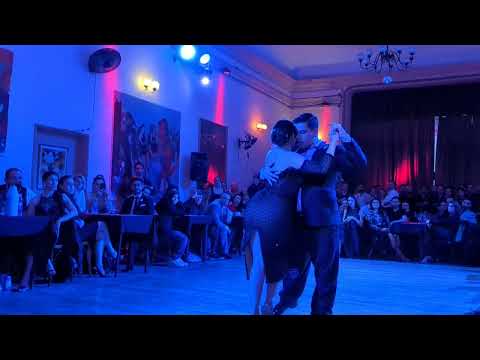


Yo te bendigo. I could talk about this for hours. When Chanel makes his entrance. Da paladien el gajo. Gajo, the cockerel. The cockerel, the cockroves. It says, he gives the dawn. That's the phrase. From far, far away, a dog barks in answer, and the barrio is slowly waking up. This is very Pugliesian describing barrio life. And then you get to the chorus. The band stops dead and Chanel sings, Rompe el silencio el bordonear de una guitarra. Rompe... The silence was broken by the bordonear, the strumming of a guitar, as this guy sings. I bless you despite the injury that you've caused me, even though now other arms are embracing you and caressing you.
There's so much we could say about that, but just staying with the music, did you hear Pugliese count the band in at the end? So it's down in the bass notes, but Chanel hangs that note out. And then you hear bang, bang. And that's Pugliese stamping his foot on the floor to count the band in after this big pause so that everyone comes in together for the Chan Chan. Very beautiful interpretation. Very different to the Troilo Rivera interpretation.
Let's go on and listen to a few instrumentals. Now, maybe only one. We can't play everything. I want to play Jueves. Now, Jueves is one of the tangos of the Guardia Vieja, of the old guard, of which there are many, many interpretations. What's interesting often about Pugliesian interpretations is how they go further than the original. What do I mean? I mean, a composer creates a piece and he has a conception of the music. And then from the composer, it passes to an interpreter. And the interpreter is trying to bring out and interpret all the things that the composer, the originator, has put into the music. So it's like there's this idea, this perfect conception idea of the composer, and then it's translated into an interpreter. So the maximum that the interpreter can do is to bring out everything that the composer put in, right? No, it's not really like that, is it? I can't explain it. I can't even understand it, but I see that that's how it is.

An old Guardia Vieja tango reharmonised so thoroughly that Lavocah says Pugliese 'hears things in the original that the composer himself did not hear'.
Danced to it · 2 of 5


And this is very obvious with the Pugliese Orchestra. And it's very obvious in the instrumentals, particularly in the 50s and 60s. The classic example is La Mariposa. When you listen to La Mariposa of Pugliese, he's hearing things in La Mariposa. Because you don't listen to La Mariposa of Pugliese and go, what's he doing? That's so wrong for the music. No, you listen to it and you are 100% convinced that this is a coherent, intelligent exposition of the original music. But it isn't. Pedro Maffia heard Pugliese's Mariposa and didn't understand it. So it's as though here's the idea, this perfect idea that the composer has, and then Pugliese has a bigger idea. He doesn't have a different idea, he has a bigger idea. He hears things in the original that the composer himself did not hear.
Chapter · 2:09:19
The Composer Who Didn't Recognise His Own Song
Pugliese played a tango so differently that its own composer couldn't follow what he'd done to it.
“He doesn't have a different idea, he has a bigger idea. He hears things in the original that the composer himself did not hear.”
Now this is something you hear really in the 60s and a little bit in the 50s, but you can hear it now in 1947 in the arrangement of Jueves. This is something you never hear in the milonga, I don't know why. Listen to the opening.
I'm so happy to see how much you appreciated that. It's astonishing, isn't it? So there are other nice Pugliese instrumentals, but after Jueves, Jueves is just astonishing. So let's leave it there and move on to Morán, shall we? No one's gonna complain about a little bit of Alberto Morán. There's a couple of really nice Morán tracks from 1947. We are only going to listen to one. The one that was rejected from the playlist was Café Tine. The one that survived is Desilusión. Disillusion. The calm down, the point you realise you were dreaming.

Chosen over another 1947 Morán/Pugliese track, Café, as Morán's single feature of the night.
Danced to it

♪ Music · 2:07 ·
Do you have a favourite Chinelo Morán? I mean, it's easy to like Morán, I guess they're different occasions, aren't they? Whichever one we're listening to at that moment is our favourite. When I listen to Chanel, Chanel is my favourite. When I listen to Morán, Morán is my favourite.
Okay, so now we build a bridge to Troilo and then that will be the end of our evening. And to build a bridge, we will enlist the help of the singer who has left him and gone solo. Alberto Marino. Now, Marino can never replicate the backing orchestra that he had with Troilo as a soloist. But what we do get is his voice. Troilo didn't ever want the singer to be too loud. Baron, in the 50s, was fired because he turned up the volume on his microphone. Just like that. Happened at a live gig. Troilo said to Baron, the sound is too loud on your microphone, please turn it down. So he turned it down and then when Troilo went away again he turned it back up again. Of course Troilo heard it immediately, that's it, you're out. Because he was concerned with the balance between the instruments.
Now when you listen closely to the sound of Marino with Troilo, you can't hear him as well as you want to. But as a soloist you can. To me, the implication is clear. As a soloist, he's standing close to the microphone and when he's singing as the cantor de la orquesta, he's made to stand away from the microphone and we can't really appreciate the qualities of his voice. And I'm really looking forward to playing you a particular song in the 1949 after party, which I'm pretty sure Dag won't play during the show, which demonstrates his voice superbly. But we can still hear his voice pretty well tonight. Let's listen to something quite surprising. A tango that's normally an instrumental. Organito de la tarde.
Normally an instrumental; this version is sung. As a soloist act within the band, Marino is finally close enough to the mic to show off his voice.
♪ Music · 0:46 · The lyrics, on the song's page
OK, it's Ayeweather time. So what were the event photos for tonight's show? I changed it didn't I? The first photograph was a poster for the 1947 carnival dances at Club Independiente. This is a football club. There were five, I say were, that's wrong, there are, there are five huge football clubs in Buenos Aires, one of which is Independiente. And at carnival time the football clubs were a very important venue.
Chapter · 2:20:51
Two Clubs, Two Dance Floors, Four Bands
One carnival poster, four orchestra names. How did Buenos Aires's football clubs fit them all in?
So on the poster you saw four big orchestras and it gave the names of the tango orchestras Troilo and Pugliese and there were two jazz orchestras as well. How did they manage that? There were two venues. First of all there was the social club, the football club. All the big football clubs had a social club, a big building where you could get maybe a thousand people dancing indoors. I say a thousand people, there were a thousand people, but they were packed much more tightly than in Almalongas, probably one square meter per couple. So a thousand square meters dance floor. So that was the small dance floor.
And then the big one was at the football club. They put a floor down on top of the pitch and they would have 5,000 couples dancing on the pitch. And it was the same at all the five big clubs. Racing Club, Independiente, Boca Juniors, Atlanta and so on. So if you've got two venues, then you need four orchestras because each one you have a tango orchestra, a tipica alternating with a jazz orchestra. So carnival, five, six, seven nights. The orchestras would alternate. So some nights Troilo would play the big venue, the football pitch, and Pugliese would be in the social club, only a thousand couples, and other times they'd swap over.
So that was the first photograph. But then I thought of another influence in the music, and I changed the picture. Who can tell me who was the face in the second photograph that we showed. And it relates to a melonga that was recorded by both, well by several bands, including Troilo in October of 1947. Not so difficult, but I guess we don't know the face. And what's interesting about it, what I wanted to bring out, is how it's about an external influence because the melonga is Los ejes de mi carreta, the axles of my cart. And yes, it's Atahualpa Yupanqui.
So when I change the photograph, the new photograph is Atahualpa Yupanqui because he's the composer, the author of Los ejes de mi carreta. But he's going to be banned at the end of the year. On the 21st of December, something like that, Atahualpa Yupanqui went into the studio and recorded three numbers. So the first number was on one record, which was printed, and then the record company was planning the next two for maybe one month later, say for January 1948. But that's the time that censorship really hit. And that record wasn't printed until 1953, until five years later. And he never got to record Los ejes de mi carreta in 47 or 48.
Chapter · 2:23:55
The Record Censorship Buried for Five Years
He recorded three songs in one session. Only one ever got pressed on time.
But we can listen to the Troilo version. It's a very beautiful piece of music. The perfect introduction. Have a listen to this.
Okay, so there are more nice tracks from Rivero but it's time to move on to Floreal Ruiz and I think the first one will be a surprise because I'm going to play a track that was never issued on Shellac and the track in question is Los Despojos. Los Despojos is one of the great tangos of 1947 and the only recording that we have officially released is from Miguel Caló but it was in the repertoire of the Troilo band and performed on radio and a lot of the radio programs on Radio El Mundo were recorded on acetate discs. Now the quality of these varied and it was often quite poor and it's very difficult to extract the sound but in the edition Pichuco 100 years in 2014 a lot of effort was placed into extracting the music and we got one or two songs that we've heard before in better quality than we've heard. So this is from a radio, a live radio broadcast from 1947. Troilo with Floreal Ruiz playing Los Despojos.
“They had 120 songs ready to go without music. They recorded 20 a year.”
Chapter · 2:32:00
The Tango Troilo Never Got to Record
Troilo's band played it live on the radio in 1947. Nobody heard it properly again until 2014.
From a live 1947 Radio El Mundo broadcast, never issued on shellac and recovered for the 2014 'Pichuco 100 años' reissue; the only studio version on record is by a different orchestra, Miguel Caló.
♪ Music · 2:49 · The lyrics, on the song's page
So extremely beautiful, we could talk about that. But quite apart from the beauty of that, that is a track in the band's repertoire that wasn't recorded. So listening to that, would you say that was A, better than the other repertoire, B, about the same, or C, not as good yeah was it not one of the ones chosen to be recorded because it wasn't very good no it wasn't no anyway there's only one answer to that question and the answer is no so everything in the repertoire was really good and you could only afford to record a certain number so when we listen to that that gives us an insight into what the quality was like of the rest of the repertoire.
So the Troilo band worked full time. It was playing six nights a week, sometimes seven nights a week. They had 120 songs ready to go without music. They recorded 20 a year. So, of course, they recorded the most popular 20, but that doesn't mean that the next 20 weren't very good. They were as good as that. We're missing a lot. Let's not get sad about it, let's just enjoy what we can hear. So Ruiz is going to take us to the conclusion, now the waltz, Flor de lino.

The closing waltz of the night.
Danced to it · 5 of 57




♪ Music · 2:41 · The lyrics, on the song's page
So, folks, another night comes to an end. Slightly shorter tonight, only three hours. So happy to see so many of you still here with us. Next week, the year is 1938, a really exciting and fresh year for tango music. There'll be a lot to listen to in the conventional format with Dag choosing the music and me responding. Thank you very much for joining us.
Thank you to our sponsors, Tango Abrazo in Bergen, Tango Norfolk and the Argentine Tango Society, the owners of a Maramu nightclub in Buenos Aires playing us out, Troilo Ruiz, with a smoking tango, Y la perdí. See you next week.
The play-out track as the hosts sign off.
♪ Music · 4:57 ·
Tango By Year is Dag Stenvoll and Michael Lavocah's, published here with their permission. The audio plays from SoundCloud.