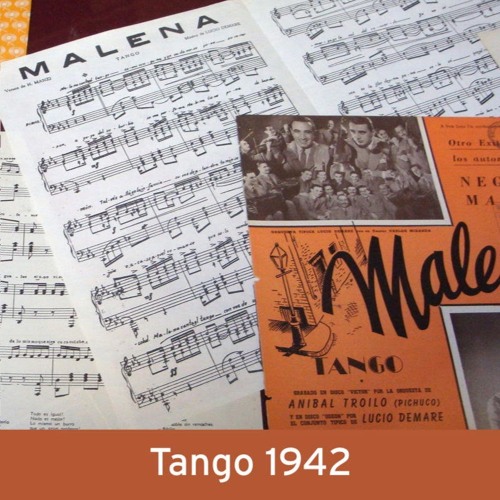
Tango 1942
Dag Stenvoll and Michael Lavocah · 19 Aug 2020 · 3:51:00
1942 is the year lyricism takes over tango, led by Troilo's arrangement of Malena — the first proper vocal arrangement written for his orchestra, after a run of vocal numbers delivered almost spontaneously — and matched by D'Agostino, Caló, Di Sarli and even D'Arienzo reaching for more romance and space. Miguel Caló has his commercial breakthrough with Al compás del corazón, a song its own singer Raúl Berón almost refused to record, while Carlos Di Sarli poaches 18-year-old Alberto Podestá straight out of Caló's band. It is an unusually prolific year for dance tango — D'Arienzo alone makes around 33 recordings, Troilo 27 — and, Lavocah and Stenvoll agree, almost all of it will already be familiar to dancers. Formal censorship is still a year away (it begins in mid-1943 under Perón), but self-censorship is already visible, as in two competing takes of Malena's third line; the war in Europe surfaces obliquely too, in older songs like Biagi's Bélgica and in the closing, deliberately non-tango choice of We'll Meet Again.
0% heard
3:51:00 left
Up next, as released
Tango 1952Episode 17 · 2 Sept 2020 · 3:29:41What this episode gave Tangopedia
Facts said in the episode, each now cited to the minute it is said.
Troilo's 1941 arrangement of Malena, written by bandoneonist Héctor María Artola, was the first proper vocal arrangement made for his orchestra — before that his singers delivered vocal numbers almost spontaneously.
D'Agostino's and Di Sarli's milongas pay more attention to the phrase than to a repeated beat, giving them an unusually lyrical swing (cadencia) compared with most milongas.
Al compás del corazón was written by bandoneonist Domingo Federico, who was still playing in Caló's own orchestra when he brought the tune to the band.
Singer Raúl Berón initially refused to sing Al compás del corazón; when Caló was late to a gig, violinist Enrique Francini sang it instead, the crowd loved it, and only then did Berón take the song on.
Berón started as a folk singer, not a tango singer, which gave him his soft crooning style; Lavocah compares him to the young Frank Sinatra of the early 1940s, before Sinatra's big-band fame.
Chapter · 2:32
Tango's Most Important Arrangement?
One arrangement, Michael Lavocah says, might be the most important ever written in tango.
Opens the show with a lesser-known D'Agostino/Vargas number about boys playing cards.
Only in the episode

A playful milonga paired with A la carta; Lavocah notes D'Agostino's rare piano solo in it.
Watch it danced · 7
Chapter · 12:40
The Singer Who Said No to His Own Hit
The song that defined him almost didn't have him on it.

Caló's big commercial breakthrough of the year, written by his own bandoneonist Domingo Federico.
The lyrics, on the song's page
Watch it danced · 53

A second Caló track Dag calls simply 'another milonga'; title never spoken, inferred from the lyrics about an old jockey.
The lyrics, on the song's page
Watch it danced · 42
Chapter · 22:36
The Doctor Who Had to Quit Medicine
A gynecologist by day, a tango star by night — until his patients found out.

First of this year's Tanturi/Castillo pair, from the band nicknamed 'the medical orchestra'.
♪ Music · 0:08 ·
Watch it danced · 7

Paired waltz; Dag guesses Marisabel is just the woman's name in the lyric.
Watch it danced · 18

Demare finally getting more releases after years stuck in his Odeon contract.
The lyrics, on the song's page
Watch it danced · 63

Paired waltz played straight after.
Watch it danced · 1
A brutally sad 1925 Gardel number about a woman who kills herself over her looks, revived by García's conservatoire band.
Only in the episode

Played as the arrangement that defines the year's turn to lyricism.
The lyrics, on the song's page
Watch it danced · 21

Another very sad Troilo/Fiorentino number, built from an old Cobián melody with a new Cadícamo lyric.
The lyrics, on the song's page
Watch it danced · 2

Instrumental showcase for pianist Orlando Goñi's bass-note crescendo.
Watch it danced · 26

One of Dag's favourite Firpo waltzes; notable for an unexpected Hammond organ.
Watch it danced · 1

An older, WWI-era tango about Belgium that resonated again with Belgium's WWII invasion.
Watch it danced · 51

Introduced as a waltz for 'all those waltz lovers'; discussed afterward by its piano variación.
Watch it danced · 79
A milonga from the Uruguayan Sica orchestra, sung by Romeo Gavioli (also mentioned alongside a second singer, Freddy).
Only in the episode
Chapter · 1:18:38
The Love Triangle That Blew Up a Happy Orchestra
A singer introduced his girlfriend to the bandleader. It ended in tragedy.

One of Donato's saddest tangos, recorded right as his orchestra was collapsing.

First of a Buzón/Moreno pair.

Second Buzón/Moreno track played straight after.
Watch it danced · 2
Dag calls Lomuto an underrated 1942 waltz orchestra but never names the track on air.
Only in the episode

Played from Fresedo's entirely new 1942 lineup, briefly including violinist Elvino Vardaro.
The lyrics, on the song's page
Watch it danced · 1
A milonga about Buenos Aires's old water-sellers, tied to Afro-Argentine history.
Only in the episode
Chapter · 1:48:01
The Water Sellers' Drum
Before the ice-cream van's jingle, there was the water seller's drum.

First Di Sarli track played, with newly-poached singer Podestá.
The lyrics, on the song's page
Watch it danced · 58

Second Di Sarli track, with his other 1942 singer Rufino.
The lyrics, on the song's page
Watch it danced · 46
Chapter · 1:50:50
The Card That Made Him Sing Like Never Before
A waiter handed an 18-year-old singer a business card mid-show. It changed his life.
A Di Sarli waltz praised for its violin counter-melodies, again with Podestá.
Only in the episode
♪ Music · 2:08 ·

One of three D'Arienzo singers this year; Dag plays this before the instrumental Loca.

An old instrumental that Lavocah suspects actually dates from D'Arienzo's pre-1940 band.
The lyrics, on the song's page
Watch it danced · 165

D'Arienzo's main 1942 singer, called by Lavocah the best of his three that year.
Watch it danced · 4

Paired waltz, same session as Barranca abajo.
First of a Laurenz pair; Dag's title is badly garbled on the recording.
Only in the episode
♪ Music · 0:13 ·

Second Laurenz track; Dag notes this singer surnamed Podestá is unrelated to Alberto Podestá.
The lyrics, on the song's page
Watch it danced · 73

First of this year's two La Cumparsita readings, Di Sarli's instrumental.
The lyrics, on the song's page
Watch it danced · 25

Biagi/Ortiz version with a spoken glosa partway through, tied to the song's lyric lawsuit.

Played for a guessing game: Brunelli, an accordionist, was the first Argentine artist to get a gold disc.
Only in the episode
♪ Music · 2:03 ·
Chapter · 2:44:16
The Gold Disc Before D'Arienzo
Before D'Arienzo. Before Di Sarli. Tango's first gold-disc star played the accordion.

Demare's own version of the song he wrote, played in the afterparty to compare with Troilo's.
The lyrics, on the song's page
Watch it danced · 35

A track with Demare's other 1942 singer, Roberto Arrieta.
♪ Music · 2:42 · The lyrics, on the song's page

One more Fiorentino number, an older tango about the city.

More Tanturi/Castillo in the afterparty; Castillo's taunting verse reportedly started real fights.
The lyrics, on the song's page
Watch it danced · 59

A Discépolo-lyric Tanturi/Castillo number.
Watch it danced · 2

A third 1942 Tanturi/Castillo track whose opening lines reference Afro-Argentine history.
Watch it danced · 7
Chapter · 3:10:23
Hidden History in a Copper Coin
A 1942 tango's opening lines hide a brutal piece of Argentine history.

A second, instrumental Lomuto track played in the afterparty.
Watch it danced · 4


Another Firpo waltz from the year, played in the afterparty.

First of a short closing D'Arienzo/Mauré run.
The lyrics, on the song's page
Watch it danced · 29
Announced straight after Mírame en la cara; the lyrics that follow don't clearly match this title.
Only in the episode

Third of the closing D'Arienzo run, also unconfirmed by the audible lyrics.
The lyrics, on the song's page
Watch it danced · 75

First of a closing three-track Laurenz run in the afterparty.
Watch it danced · 1

A Pedro Maffia composition from the 1930s, played second.

Billed by Dag as one of the greatest waltz arrangements ever recorded; closes the Laurenz run despite his having said a different third title.
The lyrics, on the song's page
Watch it danced · 10
A deliberately non-tango swing closer, chosen for its wartime resonance.
Only in the episode
Follow through every episode
Tango By Year is Dag Stenvoll and Michael Lavocah's, published here with their permission. The audio plays from SoundCloud.