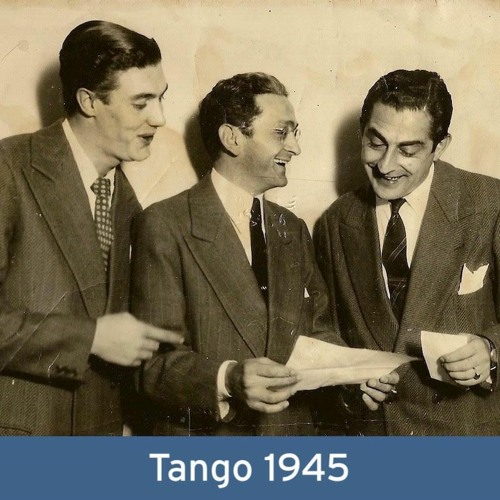
Tango 1945
Dag Stenvoll y Michael Lavocah · 10 de jun de 2020 · 3:35:51
Dag Stenvoll (broadcasting from a fjord municipality south of Bergen) and Michael Lavocah treat 1945 as tango at its zenith, the point where the fast early-40s style has opened out into a melodic golden age. Three of the big four orchestras change their main singer: Alberto Morán arrives at Pugliese, Armando Laborde replaces Héctor Mauré at D'Arienzo, and Di Sarli swaps Podestá for the baritone Jorge Durán. The war ends, which slowly cuts Argentina's wartime export income that had fuelled the tango boom, and shellac shortages finally start to hurt record sound quality. Pugliese is still romantic, with his harsher signature style 'bubbling under' for 1946 and after; Troilo has a year Lavocah calls full of quality; Piazzolla's early orchestra accompanies Fiorentino. The show ends with an afterparty of Lavocah's picks (D'Agostino, De Angelis, Demare, Biagi, Tanturi, Di Sarli, Pugliese) and the note that there is no La cumparsita from 1941 or 1945.
0% escuchado
faltan 3:35:51
Lo que sigue, como se publicó
Tango 1932Episodio 11 · 17 de jun de 2020 · 3:17:02Lo que este episodio dio a Tangopedia
Datos dichos en el episodio, cada uno citado al minuto en que se dice.
Morán joined Pugliese in 1945 and took the orchestra to a level of success it had not had before; Pugliese poached him from Cristóbal Herrera's orchestra.
In 1945 Di Sarli exchanged Alberto Podestá, who was on his second stint with the band, for the baritone Jorge Durán, who then stayed with him to the end.
Around 1943 Pugliese heard Durán singing with a folk group and wanted him, but the group's leader asked 5,000 pesos for him, a fortune Pugliese did not have; Lavocah calls it one of tango's great what-ifs.
Di Sarli made only two milongas; the other, Pueblera, was covered in the 1947 programme.
Di Sarli's milongas are about melody and phrasing, the Argentine 'cadencia', rather than a beat-beat-beat rhythm, so they are danced in a more melodic way than a D'Arienzo or Canaro milonga.
Capítulo · 3:54
The 5,000 peso singer
Pugliese wanted this voice and could not afford him.

Opening Di Sarli with his new baritone, a sea song; Dag picks up where the last show's 1958 programme ended, and the lyrics about the ocean confirm it.
♪ Música · 2:45 ·
Verlo bailado · 37

A Di Sarli instrumental Lavocah finds timeless: unlike the Durán vocals he cannot guess the year from the sound, and he is more cautious about mixing it with vocals.
La letra, en la página del tango
Verlo bailado · 104

A bubbling, playful Di Sarli milonga, one of only two he made; a Di Sarli and Héctor Marcó composition, re-recorded twice, the other time with Serpa in 1953.
♪ Música · 3:17 ·
One of Fresedo's 1945 sides with Serpa, played to show his romanticism; the sound on all of them is poor. Dag says the song is better known from Di Sarli's 1944 recording.
Solo en el episodio
♪ Música · 2:39 ·

A groovy instrumental that Dag thinks is not typical Fresedo; Lavocah loves its melody until a sudden drum roll.

A waltz Dag believes is unique to Caló; played because Caló has lost many of his good musicians and usually loses when compared with Troilo.
♪ Música · 2:37 · La letra, en la página del tango
Verlo bailado · 7

A restrained Federico instrumental with two strong arrastres, chosen as a quieter alternative to the instrumental heard more often in his sets.
♪ Música · 2:51 ·

The vocal Federico side Dag likes in 1945; also recorded by Rodríguez a few years earlier.
Capítulo · 43:39
Berlin 45
A bartender in Buenos Aires invented a cocktail the day Berlin fell.

A bizarre 1920 tango about military service that starts normally and breaks into a fast milonga; Dag calls it perhaps the least danceable D'Agostino ever, kept for its crystalline piano.
♪ Música · 3:10 ·
Verlo bailado · 3
A slower, darker Lomuto instrumental that keeps his 'elephant-like' heavy beats; Lavocah says it sounds only partly like the earlier Lomuto and likes him better two or three years earlier.
Solo en el episodio
♪ Música · 2:35 ·

Laborde's darker voice and an arrangement with unusual space, phrases that end softly in an almost Di Sarli way instead of D'Arienzo's big stop.
♪ Música · 3:10 · La letra, en la página del tango
Verlo bailado · 36
A D'Arienzo instrumental from the softer, more decorated second-half-of-the-40s style, which Lavocah says DJs rarely pick.
Solo en el episodio
A powerful, macho Echagüe vocal; Dag prefers Laborde to Echagüe in this period, though Echagüe was probably the more popular singer then.
Solo en el episodio
♪ Música · 3:45 ·

A rare D'Arienzo vocal duet (Echagüe and Laborde); the first of such duets was Aparcero, and both singers' presence makes the milonga heavy on lyrics for dancing.
Verlo bailado · 1

One of Campos's last recordings with Tanturi, about being stood up from six to seven at the cafe; Lavocah is moved by the creamy violins.
♪ Música · 2:38 ·
Verlo bailado · 17
A solo Castillo side (he left Tanturi in 1943 and made 15 recordings in 1945) with D'Alessio's orchestra; chosen as something not heard at the milonga, showing his phrasing.
Solo en el episodio
♪ Música · 3:11 · La letra, en la página del tango
Dag's pick as the best milonga ever recorded; Lavocah says the music rises out of the floor like thundering hooves in a cowboy film.
Solo en el episodio
♪ Música · 1:41 ·
Capítulo · 1:27:06
Castillo and the handkerchief
Why does Castillo's voice drift in and out?
An intimate, introverted milonga for bandoneón and guitars, a tribute to the payador José Betinotti; Ortiz was a big influence on Troilo's introverted impulse.
Solo en el episodio
♪ Música · 2:18 ·

Recorded in June 1945, exactly 75 years before the broadcast; Troilo opens it with a three-second violin and gives the band no chamber-music solos, unlike Caló.
La letra, en la página del tango
Verlo bailado · 32
A heartbreaker in which Marino moves from loud to quiet with perfect articulation thanks to bel canto training; Lavocah tells the full lyric (a seamstress, a fortune-telling parrot, tuberculosis).
Solo en el episodio
Capítulo · 1:43:00
The lucky parrot
A tango about a fortune-telling parrot ends in a deathbed.

One of the Troilo instrumentals underplayed because of the vocals; Dag says it is very rarely played, with a Di Sarli version also worth hearing.
♪ Música · 2:50 ·
Verlo bailado · 5
A beautiful Troilo waltz with Floreal Ruiz, played second of the two; the piano is José Basso, not Gogni.
Solo en el episodio
A heartbreaking song about a dark alley sung by Lamarque, notable for her low register, which is rarely heard.
Solo en el episodio
♪ Música · 2:58 ·
Fiorentino as a soloist with Piazzolla's orchestra, an interesting version of a song better known from Pugliese and D'Arienzo.
Solo en el episodio
♪ Música · 3:10 ·
Lavocah calls it, for dancers, the most successful interpretation of Piazzolla's early orchestra, though that band was not danced to.
Solo en el episodio
A curiosity from one of only two 1945 Marcucci recordings, with a poor-quality source; Dag says it is playful and fun.
Solo en el episodio
♪ Música · 2:14 ·
Capítulo · 2:09:40
Three years, six years, nine years
Pugliese's three classics each took years to record.

A football tango about a lad dreaming of scoring the winning cup-final goal, sung by Chanel's 'street voice with class'.
♪ Música · 3:20 ·
Verlo bailado · 23

An instrumental played for its pairing of aggression and beauty in the violins.
La letra, en la página del tango
Verlo bailado · 60
Capítulo · 2:18:10
Violence and beauty
Pugliese doesn't suggest. He demands.

An exceptionally complex instrumental, better recorded than the 1951-52 version; Lavocah says Canaro never attempted it because it was too complex for his conception.
♪ Música · 3:10 · La letra, en la página del tango
Verlo bailado · 6

Morán at full dynamic range, which a chat listener compared to a weapon of mass destruction.
La letra, en la página del tango
Verlo bailado · 7
Capítulo · 2:31:12
The empty year on La cumparsita
Two years in 40 have no recording of the world's most famous tango.
Afterparty: Lavocah plays it for D'Agostino's one-note piano introduction, which he calls one of the most perfect solos in tango.
Solo en el episodio
♪ Música · 3:30 ·

Afterparty: a second D'Agostino and Vargas side from a year full of good ones.
Verlo bailado · 53

Afterparty: Lavocah defends 1945 De Angelis, before his later violin excesses, with Dante lured out of retirement from an oil company job.
La letra, en la página del tango
Verlo bailado · 4
Afterparty: a contrasting side with the young singer Julio Martel.
Solo en el episodio

Afterparty: Lavocah sets a quiz that its opening melody is plagiarised from another tango.
La letra, en la página del tango
Verlo bailado · 36

Afterparty: the tango with 'the most demonic ending in the history of the universe', which Lavocah says is too vicious even for dancers who were warned.
♪ Música · 2:54 ·

Afterparty: the changeover from Campos to Videla at Tanturi, with a recommendation for a recent Tango Tunes release of the 1945-46 Tanturi recordings.
La letra, en la página del tango
Verlo bailado · 3
Afterparty: one of 'about 55 star tracks' with Durán; Lavocah points to the violins under the voice.
Solo en el episodio
Capítulo · 3:10:17
A tango named for green ink
Nobody named this tango. It was the sheet written in green ink.

Afterparty: unusual because it keeps a violin solo (Roberto Guisado) in 1945, after Di Sarli had otherwise banned solos from every instrument but the piano.
♪ Música · 3:10 ·
Verlo bailado · 40
Afterparty: a closing Di Sarli vocal; the lyric begins 'La dicha es un castillo con un puente de cristal'.
Solo en el episodio

Afterparty: not complex but very joyful, the lightest of the three Pugliese instrumentals Lavocah orders by intensity.
♪ Música · 2:23 ·
Verlo bailado · 79

Afterparty: light and joyful but structurally complex, which Lavocah gives as the reason it is rarely played at milongas.
Verlo bailado · 7
Afterparty: confirmed by the lyrics ('esta noche tengo ganas de olvidarla'); Lavocah had said Morán could not have sung it before because it was not yet written.
Solo en el episodio
Afterparty play-out: the young Portuguese singer, known to most listeners from the 1950s to early 70s.
Solo en el episodio
♪ Música · 4:11 ·
Seguir por todos los episodios
Tango By Year es de Dag Stenvoll y Michael Lavocah, publicado aquí con su permiso. El audio se reproduce desde SoundCloud.