Tango 1958
Dag Stenvoll and Michael Lavocah · 2020-06-03 · 3:11:16
1958 is presented as the last year the series would cover, two generations on from the first episode (1941), because by the hosts' own account there is little new tango music left to explore past this point. The golden age is agreed to have ended around 1955: dancer numbers have collapsed, famous venues like D'Arienzo's Chanteclerc Cabaret are closing, and even a French Eurovision winner gets turned into a tango for lack of new material. The Big Four diverge further: D'Arienzo churns out fifty simplified, fast-to-arrange recordings, Pugliese pushes further into modern, dancer-challenging territory, and Troilo, past his energetic peak, makes fewer but carefully chosen ones. It is also Carlos Di Sarli's last recording year before his death the following year, closing a thirty-year career with the deeply personal Bahía Blanca, and a year when necessity creates new sounds, from Fulvio Salamanca's accidental style after D'Arienzo's near-retirement to Argentino Galván's explicitly non-dance Los Astros del Tango project.
What this episode gave Tangopedia
Facts said in the episode, each now cited to the minute it is said.
The golden age is generally agreed to end around 1955; by 1958 tango is in 'post golden age territory,' with far fewer people dancing and venues closing as a result.
the golden age of tango
By 1958 the Big Four sound more different from one another than ever: D'Arienzo has reverted to a traditional, simplified presentation while Pugliese keeps pushing forward, with many orchestras occupying a new 1950s 'middle ground.'
the Big Four in the late 1950s
Troilo has been losing energy since around 1956, though he is still producing good work.
Zucchi's ongoing multi-volume reference work on bandoneón players, started from 1890, had by 1958's broadcast still not reached the generation of 1940, despite roughly ten years between volumes.
Oscar Zucchi's bandoneón-player reference books
Maderna, a playboy-ish amateur pilot like Fresedo, died in a private plane crash around 1950 or 1951; his orchestra continued afterward as an 'Orquesta Símbolo' under violinist Aquiles Grugiero, a naming convention also later used for D'Arienzo's touring band after his own death.
Records played · 35
Transcript
Transcribed by machine from the audio, then punctuated; names may be misheard. Tap any line to hear it. The episode is in English, and so is its transcript.
Now playing
Dors, mon amourAndré Claveau · 19580:00 / 0:54
The French winner of the 1958 Eurovision Song Contest, played as the night's opening puzzle: a respectable tango orchestra making a version of a Eurovision hit says something about how few new songs tango had left by this year.
♪ Music · 0:54 ·
Hey, we just heard Dors, mon amour with André Claveau. And don't tell them why that's an especially interesting track for tonight. Yeah, well tell them. Because there's a tango connection. There is.
Well, anyway, this was the French winner of the European Song Contest in 1958. And if it sounds familiar, there is a tango connection. And Michael, this is a typical year that a tango orchestra, a respectable tango orchestra would make a tango version out of a European Song Contest song. What does it say about 1958? There's not so many new songs in tango. Oh, the tango is getting a bit old. That's getting old. Or to put it another way, the golden age is over. It's over. We are in post golden age territory.
“Or to put it another way, the golden age is over. It's over. We are in post golden age territory.”
And when does the golden age end? People normally would say 55, that 55 is the last year that we can really call the golden age. And what's the difference? Not so many people are dancing. When we say not so many, we mean orders of magnitude. The mass phenomenon of tango is over and this has led to lots of venues closing. So in 1958, in this year that we're exploring tonight, the Chanteclerc Cabaret, D'Arienzo's redoubt since it opened in 1930, scene of his triumphs, closes its doors for the last time. So that's the territory we're in.
The big four, we've still got all the big four, but they are seeming more different than ever, I guess, you know, between D'Arienzo, who in the 50s has reverted to quite a traditional presentation. He's further from someone like Pugliese than ever. Pugliese is modern, but that means he's a lot different in terms of what he's trying to create than even five years previously. So there's more and more divergence between the advanced bands and the traditional bands. There's a lot of bands in the middle ground. That's a 50s phenomenon. What else can we say? And Troilo is kind of running out of steam. He's still doing good stuff. But since about 56, he's losing energy. So that's the territory we're in.
About, you say, 55 being the last year earlier, the golden age. And I remember after the first program we had on 1941 we just chatted a bit and we were speculating if this is gonna last, what would be the last year we would cover in Tango By Year, and you just said immediately, well, it will be 1955, after that there's nothing much. And so when I announced 1958 last week I was a bit, you know, anxious how you take this, but you did take it well and I love the surprises of this program. Yeah, this is just part of it. Yeah, and it's a price.
And for new listeners, we do this as always that I just play some songs for the year and Michael doesn't know what I'm playing. So it adds to the excitement and the unpredictability of the program. And last weekend we explored 1929 and I cannot think of a larger contrast all the way to 1958. I mean, you said in your program notes for tonight, going forward a generation. But in terms of tango music, it's kind of two generations. Tango scholars would talk about 15 years as being a generation of tango music.
For example, Oscar Zucchi, who's been rehearsing bandoneón players. So he's done four, I think it's four volumes so far. It's about this thick. Listeners, I'm holding up my hands and they're about 12, 15 centimetres apart. And he hasn't done the generation of 1940 yet because he started in 1890. And then the last book, which was two volumes, was the generation of 25 and 1940 still to come. And let's hope he finishes it, you know, in his lifetime, because it's a mammoth work. I think we've been waiting like 10 years for the next volume. So between last time and this time, two generations really, because we've had the generation of the 40s, haven't we, and now this is something else.
Yes, so at the end of last week's program I announced 1958 and I asked if anyone knew what was the big marathons in Europe hit for this year. And the one I was thinking about was Merceditas with Orquesta Símbolo Osmar Maderna. And can you say, Michael, what's with this name, Símbolo name? Because Maderna is dead. He died in a plane crash in 1950. Not a public plane, private plane like Frosado, a bit of a playboy, like to fly his little plane and he died in a plane crash in 50 or 51. So Achilles Gruggiero, who's the first violin, continues the orchestra without him. And that was quite a common formulation in the Spanish language at that time, to say Orquesta Símbolo. After D'Arienzo died, there was an Orquesta Símbolo con D'Arienzo as well for tours.
But they only made two recordings this year. It's the hit Merceditas, which is not really typical. I don't think about this as a Maderna type of sound. But the second one I'm going to play is called Fantasía en Tiempo de Tango. And this is much more the Maderna sound to it, the piano playing. I agree. Absolutely. So Mercedes is a one off track. It's not like anything else. And it started life as I think as a chamamé, a folk rhythm.
And there's a lovely story attached to it, which is it's a little bit like the Griselle story. So the composer of Mercedes was called Ramon Sexto Rios. And in the late 30s, when was it? 1939, he went to a little town called Humboldt, which is a German name, to perform in a play and there was a girl there called Mercedes. Mercedes Trichalov, she's the daughter of German immigrants, so blue eyes, blonde hair, just like Griselle. And after the show he asks for a tango and she accepts and they start to correspond and there's like a little romance is growing. And two years later he goes back with the rings to propose to her and she turns him down and she says, well no, I'm kind of fallen out of love. And very, very independent woman, never married.
So he has to go home with the rings. A few years later, he meets somebody else. He gets married. And then 30 years later or something like this, he's been widowed and they get reconnected. I think through, like somebody goes to interview her. Maybe that's how that happens. And he proposes to her again and she turns him down again. And then he kills himself. No, he doesn't, he carries on living to a ripe old age. It's not full of the torture and suffering, but obviously, you know, he was totally smitten by this woman when she was the love of his life, but she was too independent.
Yeah, well this is a song that's typically a mix in a mixed tanda by DJs at marathons. It's the only way to play it. You're not going to find three other songs like this. Exactly. So let's listen to this, get it over with, and listen to this big hit from 1958. Let's enjoy it, Dag. Yeah, it's a very nice song. I actually danced to this. Did you, Michael? Would you dance to it? I would dance to it. It's beautiful. It's lyrical. I think so too. So, Merceditas and then Fantasía en Tiempo de Tango.
The year's big marathon-DJ hit, led since Maderna's 1950/51 plane-crash death by violinist Aquiles Grugiero under the orchestra's new 'Símbolo' name; a one-off, unlike anything else that year, with roots as a chamamé.
♪ Music · 3:51 ·

Built on a classical Brahms piece, played to show pianist Orlando Tripodi's close approximation of Maderna's light, diaphanous piano style.

Yeah, as some people picked up, it's based on classical pieces by Brahms. Yeah, and Maderna did the creation. That's the second recording there is of that. And we've got one by Maderna himself when he was still alive from 48 or 49. And then this slightly glossier version is from the year of choice, and the pianist Orlando Tripodi doing an excellent job giving us something of the Maderna style, maybe not so sort of light and diaphanous as Maderna, but very similar. So you don't think Maderna would have been turning in his grave if he heard this after, recorded in his name? I don't think so. Not at all.
So let's move on to some more core material, one of the big fours, Juan D'Arienzo. In terms of recording, he's doing well in 1958. He records 50 tracks and it's incredible. Yes, he just bangs them out and people are buying. Yeah, and especially, I mean, much, much more, about twice as much as in his heydays in the 30s and 40s. So I will listen to a tango by each of his new vocalists since the year before, Mario Bustos and Jorge Valdéz. You want to say something about them, Michael? Two very contrasting vocalists.
Today, I guess the more popular one is Jorge Valdéz. Jorge Valdéz is this high octane singer. You know, he always sings like he's just had six cans of Red Bull. Everything is always right at the max. And if you're not in the mood for that, it can be a bit too much. But there are some very, very good interpretations. Mario Bustos, much more interesting for me because there's more variety. It's a deeper voice. So a contrasting voice and he's best known for some really quite nasty songs, like No Te Quiero Más, that he does a version of this very old tango, I don't love you anymore, and he sings it like he means it. And what else does he have? Justo el 31, a song about a guy who is happy with himself because he dumped his girlfriend the day before she was going to dump him.
But there are also some very loving and tender songs, songs dedicated to the mother, to the father, another waltz called Signora Princesa. These are rare tracks. I don't think I've ever heard any of them at the milonga, but he can also be very sincere. So he's got a really good vocal team here, D'Arienzo. And the Valdéz tango I chose for tonight is the one, it's related to what you were talking about in the introduction. It's called Adiós Chanteclér. And I chose it because it tells an interesting story about the demise of this Chanteclerc club.
Yes, Enrique Cadícamo, who was a prolific tango composer, he used to hang out there. And when it was shut, he was really upset. So he wrote a tango about it. And I think you can hear D'Arienzo's name mentioned in the lyric as one of the features of the glorious nights of the Chanteclerc, which I'll know more. All right. While you play that song, I will mute my video and display the album cover, the cover of the single that came out at that time. And the second song I'll play is with Mario Bustos singing, it's El Tigre Millán.
Chapter · 18:19
The club that died, and the song that mourned it
When his favourite cabaret closed, a songwriter wrote its eulogy.
And that's one of, I think, one of the more powerful ones. It's really like singing like a bit angry and not giving a shit about everything kind of singing. It's a nice interpretation because El Tigre Millán is an old Canaro song, Canaro composition, but this has a claim to being the strongest version, I should say. All right, so let's listen to those two. Adiós Chanteclér and El Tigre Millán.

Chosen to tie in with the Chanteclerc Cabaret's 1958 closure: lyricist Enrique Cadícamo, who used to hang out there, wrote it in grief when the club shut, and D'Arienzo is named in the lyric as one of its glories.

♪ Music · 2:41 ·

An old Canaro composition sung with real venom and anger by Bustos, arguably its strongest version.
I love the energy of his singing, Bustos. And I guess there's quite a few people, not the ones who are talking away in the chat window, but probably our listeners who are a bit less confident to share their opinions. I think a lot of them won't have heard Bustos' voice before. And I really like it. It has depth, it has colour, it has emotional range, although you don't hear that so much there, though you could really hear the venom that he put into the lyric.
And one or two people in the chat window saying, oh, what's your favourite singer? It's not this one, it's that one. It's so difficult to say, isn't it? Because you've got the tough guy kind of song with vocalists such as Ichakue and the ones who came after him. And then you've got the romantic, lyrical kinds of songs with vocalists such as Ecto Maure. And, you know, it's like saying, do you prefer red wine or white wine? I mean, you know, it depends on the meal. Yeah, I agree.
Before I move on, let's listen to a milonga with these two guys singing duet, Baldosa Floja. Well, they've been asking for that. And it's, Teresa is waving her arms in the air. Baldosa Floja. So if you've been to Argentina, you know what a baldosa is. A baldosa is a floor tile or a paving stone, but a big one, not like a little one, like 10 or 20 centimetres on the side, but a big paving slab or a big tile that you might tile an outside patio with. There's that phrase, bailarino a baldosa, you know, just to dance on one little square, because that's all the space you've got in a really crowded milonga.
And the lyric is really fun because the guy says, I'm just like a loose tile, a loose tile. Because if you step on me, I'll splash you. Because you know that, don't you? If there's a loose paving slab in the rain outside, you step on it and it moves and the water squirts out and you get a splash. So that's the spirit behind this very enjoyable milonga. Yeah, it has a great energy. But it's a little bit for special moments at big events, I think. I never played at the local milonga on the active weekend. But on a marathon, it would be good. So let's listen to this one. Baldosa Floja with Jorge Valdéz and Mario Bustos singing.

A duet milonga about being as unpredictable as a loose paving slab, with the two contrasting voices arranged so one climbs while the other descends.

♪ Music · 2:05 ·
Great contrast between the voices that someone said in the comments. Yes, but the arrangement uses them very, very intelligently when they echo one another and one's slowly going up, Valdéz is slowly going up and Bustos is slowly going down. Very clever. And a nice... Now, go on, Dag.
Yeah, and I was thinking, Heike wrote, it's Polito back on the piano. Is that right? I didn't know that. It is Polito because in 1957, why are these singers here? There's a major reorganization of D'Arienzo's band in 1957 because he almost retires actually.
So who's been the pianist? It's Salamanca. And that's what gives birth to the Salamanca Orchestra, which could be one of the orchestras we're going to listen to tonight. So Polito is forgiven for leaving him for the money and comes back to work. What's he been doing since, is it 39 or something like 40? Since 1940. Yeah.
He's been not very successful, he's been enjoying himself with the boys playing in the old style but they've not really tasted fame success and money despite finally recording a few tracks on a small label in the early 50s. So they didn't record at all in the 40s. Well, since you mentioned Salamanca, let's move on to Salamanca, the audience was pianist since 1940 and now in 1958 it must be like 38 years or something because he was so young when he joined D'Arienzo. He was 19 when he joined D'Arienzo. He's 37 now, like after 17 years with D'Arienzo. That's amazing. And the big hit for this year, of course, is Bomboncito.
What's great about Salamanca is that when he goes and forms his own orchestra, he produces a unique sound. He doesn't copy anybody. Okay, it's not one of the top four orchestras of all time, but only four orchestras can be one of the top four orchestras of all time. And we can also say that it's not that he had a burning ambition to make music in a very particular way. When he was forced to kind of go independent because of this semi-retirement of D'Arienzo in 57. And then he didn't really know what style to make. And it was just with rehearsing with the guys that they kind of came up with the idea of this arrangement by accident with one particular song. The style was born.
Chapter · 32:30
The sound that happened by accident
A pianist forced to go it alone stumbled into a style that became his signature.
So it's not like, say, the music of a Troilo, which is coming out from a very, very deep place in his soul. But it's still a genuine music in small amounts. I love it very much. And I'm thinking, I mean, he was a very forceful piano player for D'Arienzo, but it's not really the piano that strikes me when I listen to his own band. It's more this special violin, the violin like floating over the rest of the orchestra. That's good at the beginning of the song. Exactly so. Isn't that the sign of a great band leader that the band isn't just about displaying them? No, it's like Piaget. All right, let's listen to Bomboncito with Fulvio Salamanca.

The year's big hit for Salamanca, D'Arienzo's former pianist, whose unique sound carries less piano and more of a floating solo violin.

♪ Music · 2:53 ·
Dreamy, says people. So I've been looking at the chat window. Many of you have been looking at the chat window and I noticed something of the folks who typed in the chat window and said, oh, this is just wonderful. They were nearly all ladies. There were eight women who typed, oh, this is amazing. And then one guy who typed, oh, I really like it. And then there were a few other men who went, not really sure.
So to the men, guys, the girls love it. Give them what they want, you know, that the girl's gonna feel fantastic in your arms when you dance this, that's that's that's the message that what we've just learned. Yeah, not everyone, not all of them of course, but uh taking the average. Okay, let's uh let's listen to another former pianist of D'Arienzo, Rodolfo Biagi, who only made four recordings this year. He's not very productive at this time, is he? And I'm going to play Toda Zamor and this is actually known maybe more from Salamanca's recording, but that was from 57, so I couldn't play that tonight. And it's with the singer Hugo Duval, who sings for Biagi. Why is, you know, Biagi only records four songs compared to D'Arienzo's 50, for instance?
I don't know, Dag. He's always been less commercially minded than D'Arienzo. One thing to say about D'Arienzo is he's able to record so many songs in a year because his style in the 50s reverted to a simpler style than the style in the 40s. So it requires a lot less effort to arrange and record a number. He couldn't have recorded that many a year in the 40s, I don't think. And for Biagi, yes, I guess that's the proof that he didn't sell as many records as D'Arienzo.
The recording quality, somebody said, oh, there's still 78s at this time. Well, there are still 78s but there's Tate Masters, that's the real difference between 52 and 54. Everyone switched over to Tate Masters and they kept the Tate Masters because they didn't occupy much space, the metal masters from which the old 78s, the older ones, were prepared. Big, heavy, took up a lot of space. But we've still got the tapes, so anything that was recorded on tape, the record that you listen to has probably been prepared from that Tankmaster, and that's why it sounds so good.
Now, in the late 50s, you start to get more and more reverberation. Reverberation is the sound that you get when you're in a big room or in a cathedral. The sound takes a long time to die away, and they start adding more of that to the master. Why would they do that? I mean, it's just fashion. It's just fashion. And what happens to a lot of people, and this is something that Horacio Godoy has pointed out, is if there's a lot of reverb for a long time, your ear gets tired.
So just listening now to, you know, one or two tracks of Biagi, we probably won't feel that. But if you have an ear that's tuned in to, say, the 30 star, then you will feel that even in three minutes. The reverberation makes the sound more tiring than if we just heard it in a more neutral way. But does this go for all the 1958 tracks or just Biagi or one recording company? It starts to become pretty much universal, but we notice it a lot on these Biagi tracks. Yeah. Okay, let's see if we can hear it.
One of only four Biagi recordings this year, chosen partly to demonstrate the added studio reverberation that was becoming fashionable, and that Lavocah says tires the ear over time.
♪ Music · 2:25 ·
It's a lovely song, but it disturbs me now. I can't not hear it. So when the band onion goes chunk, it doesn't go chunk anymore, it goes like that and there's no need for that really, there's no need to put that on the master because when you play a song at the milonga the room's going to add that reverb anyway. Yeah, it's going to add a little bit of that, so it's it's a pity. I'd really like to hear it uh seca, you'd say in Spanish. I'd like to hear it without that added effect. You do need a tiny bit of reverb, otherwise it sounds like you're playing outdoors, it doesn't sound quite right, and musicians cannot play in a recording studio if you completely deaden all the sound because they can't hear what they're doing. But yeah, it's too much. Yeah, great song though.
Next orchestra is uh one of, I mean, go back to 1944, you call this one of the big four because Pugliese wasn't still famous, so the De Angelis was considered one of the big four orchestras and that's 15 years back, 14 years back at the 44th. How was De Angelis doing in uh in 1958? Well, the shocking thing is that he's really, really successful. So I think I spilled the beans on this a few programs back but in the second half of the 1940s they talked about the big five, not a big four. Number five was Alfredo De Angelis, la típica de la simpatía, which means the nice orchestra because it was an orchestra that was inoffensive and didn't sing songs about murders or, you know, men and women being horrible to one another. It was an orchestra you could take your children to listen to, so they were very, very popular and they continue pretty much in the same style.
“It was an orchestra you could take your children to listen to.”
But why don't you tell us about the singers now, Dag, that he's got now this time? Well, I'm going to play No Culpes al Amor with Juan Carlos Godoy and then Pavadita, which is an instrumental. But Godoy, he's a kind of special singer, isn't he? It's a unique voice, a unique personality. So I respect that. Of course, this is one of those, it could never have happened because you're born at a certain, I don't know when Godoy is born, but he was born too late to be a singer at the end of the 30s and the beginning of the 40s. But with the kind of style that he has, I wonder what he would have sounded like with Di Sarli in 39 even. Instead of Fino. Now he's, yes, instead of Fino, now he's in this De Angelis, slightly kitsch sound.
Pavadita. I remember it was Felix Pichena who made that song famous. And I remember listening to him play that back in the Conferteria Ideal in Buenos Aires back in the 90s. The guy with the cassettes. The guy with the cassettes. The one and only. It's a lovely song. It's kind of difficult to put in a tanda. You can do it, but it's a unique sound.
The composer of Pavadita. Pavada in Spanish means a little bit of nonsense. So Pavadita means a little bit of nonsense. And the composer, Anselmo Aieta, although he's still living at this time, he's from the really early days. You know, his biggest, most famous time is in the 20s. One of these intuitive musicians, so not a well-trained musician. Melodies would come to his head and he would ask friends to write them down for him because he couldn't even read and write music. And Pavadita, you'll hear that. I think we'll all hear that in the performance. Is somehow an echo of this older time. Nice. So De Angelis.
“Melodies would come to his head and he would ask friends to write them down for him because he couldn't even read and write music.”

A showcase for Godoy's unique voice, a singer Lavocah feels was born too late for Di Sarli's late-1930s band.


A brand-new 1958 composition by old-timer Anselmo Aieta that sounds, deliberately, like it escaped from the 1920s.

There's something about these full stops that inspires me as a dancer, I think, because you can really stop and then you can start moving again. I like it very much. And there was a lot more rhythmic variation than there was in the previous De Angelis song, which is satisfying to dance to. And the reason I think why I said it sounds like it's come from an earlier time, if we'd all been told, oh yes, this was an old number from the late 20s that had been forgotten about and we rediscovered it, you'd all believe that but it's not. It's written by an old timer guy but it's brand new composition at the time. 1958 is uh heavy or rich in terms of music and I want to make a little cortina, I call that, and play a Canaro song that's a bit unusual.
I wasn't expecting to hear any Canaro tonight. I did review Canaro. I did listen to some Canaro and found some interesting things. So you've surprised me again. Good, good, good. I can still surprise you after all these years. Yes. Yeah, I'll play this El Firulete, which is an instrumental so-called tango milonga, a bit special. I've heard of that.
Now this is a composition of Mariano Mores, isn't it? So Mariano Mores is the pianist who joins Canaro in 1940. He's a great composer. He's the composer of Grisel and he adds some decoration to the style of Canaro. The decorated piano in 40s Canaro is Mariano Mores and that's an echo or something in common with the Salamanca's piano with D'Arienzo in the 40s. But he has a tendency, when left to his own devices, to do things that are even more decorative. And El Firulete is, in fact, it's in the title, isn't it? A firulete is one of these little flourishes that you might do, a little decoration that you draw on the floor.
Yeah, it's very fun and light, I would say. So let's listen to this one before we move on to more heavy stuff.
A light, decorative tango milonga composed by pianist Mariano Mores, played by Canaro's small quintet in the older, joyful pre-lyric style.
♪ Music · 1:59 ·
It's Quinteto Pirincho. There's five or six people playing. There's definitely a drum keeping the beat at the back of the brush on a little snare drum. But it works.
The Quinteto Pirincho is set up to play mostly older music, but music in the old style, the joyful style, before the lyrics came in and started talking about tragedy and heartbreak. And although that's a very new composition, I can't remember what year Fideletti was made, but it would have been at this time or very shortly before. It fits this older interpretation, I think that's very successful and it'd be a lot of fun to dance to, you know, to play around and just not take it seriously.
Yeah, I mean, that rhythm you would call tango milonga, which historically doesn't mean anything. Historically, tango milonga just means tango that is for dancing as opposed to tango canción, but nowadays we use the phrase tango milonga to mean tango that's played with the rhythm of the former times, and to us it feels like halfway between tango, which is in a four rhythm, and milonga, which feels to us in a two rhythm. It feels somehow not quite one, not the other.
Next orchestra out is the second one of the big four, and Aníbal Troilo. And how is Troilo doing at this time of tango, in a bit of decline?
Well, there's not many recordings, but he's making really interesting choices with the few recordings that he has. And we can hear them in good quality because he's abandoned this five year experiment of recording with Teika, who never had really good fidelity and were always playing catch up in the materials. And he's gone to Odeon, actually. He's still crossed with Victor because they didn't like his sophisticated music in 1950, so he doesn't go back to them and he signs with Odeon, which is like the only option left to him, the people who wouldn't let him record back in 39 and 40.
So small number of recordings, but very intelligent choices. Some very modern instrumentals. So I'm just going to talk about the instrumentals without knowing if you're going to play them or not, because there's two really interesting instrumentals in this year. One is La Bordona and the other is Danzarín. Now La Bordona, Bordonas, if you're a Spanish speaker, are the bass strings on your guitar, the wound strings. And in tango, we know that the piano displaced the guitar. So La Bordona, there's this introduction where it sounds like you are playing the bass strings of the guitar, Bordoneo, that technique, which was written by Emilio Balcarce, who at this time is a violinist in the Pugliese Orchestra.
And Pugliese looked at it and said, well, it's nice, but couldn't you bring me something more like the other thing you did? So Balcarce, having been rejected, took it to Troilo. Troilo said, yeah, I love it. Make an arrangement. And it's the talk of the town because it's a completely new idea to introduce this Borroneo effect at the beginning of a tango. That was a huge hit, huge hit in 58.
And Danzarín is one of those tracks that modern musicians who are not tango dancers, but you've got a friend who's a really good musician and you try to get them interested in tango music, or they're a classical musician, they love things like Danzarín because it is very modern, but as a tango dancer, hard music to dance to. This is why I want to play Danzarín now, because it's not something usually at milongas. But before Danzarín, I want to play a vocal tango with his singer Goyeneche, who recorded four tangos with Troilo in 1958.
Chapter · 1:01:26
The song Pugliese turned down twice
He rejected a tune, watched it become a hit for someone else, then asked for it back.
In your book on Troilo, Michael, you call him the greatest tango singer of the 60s and 70s. But you also write that his style shows that the dance era has come too close.
Yes. Yeah, I stand by all of that. Goyeneche, eventually he becomes what the French would call un diseur, someone who speaks the lyric rather than singing it. And he does that to greatest effect when he's no longer with Troilo. There's one interview somewhere, don't ask me for the reference, people, because I don't have it, where he gives a TV interview and the interviewer for once asks intelligent questions, and he says, so what was the difference between doing a song for yourself as a soloist and singing it with the Troilo Orchestra, and Goyeneche just picks a song at random and sings 10 seconds of it in the two different styles.
So it's immediately clear as you listen to it that this freedom to just talk the lyric rather than singing it, there's constraints on that even within the Troilo Orchestra, and he has the real freedom. So Goyeneche reaches his full potential only once he's a soloist, I would say. Um, gosh, that's going to be a bit controversial to the Goyeneche lovers, but really that's what I feel. Or for example, when he's after he's left Troilo, he performs with Baffer and Berlingueri. So those are two top musicians who have a band, but really they're adjusting themselves to him, I think.
Of his four recordings from this year, I picked Barrio Pobre, which is a kind of nostalgic song about the barrio. And after that, Danzarín, the instrumental.

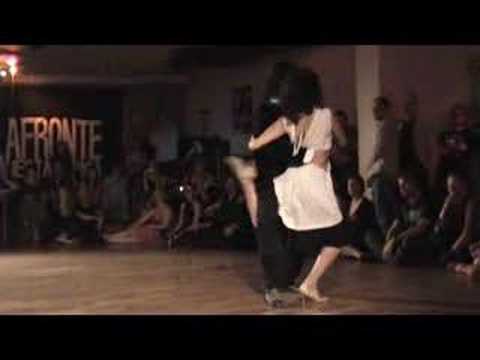
One of only four 1958 Troilo vocals with Goyeneche, a nostalgic song about the old neighbourhood, recorded in much better fidelity now that Troilo has left the low-quality TK label for Odeón.
♪ Music · 4:46 ·
A modern instrumental loved by classical musicians but, Lavocah insists, nearly impossible to dance to because its sudden tempo changes are never telegraphed to the dancer.
Oh, this part towards the end with the dialogue between Troilo's bandoneón and the violin. It's just so beautiful. It's really, really beautiful. Beautiful music. So much color. Different sounds through the piece.
Yes. And when Troilo's bandoneón is really exposed, he does a tremolo, which you actually have to shake your instrument so he gets these deep notes, then he goes with them very emotional. He starts to do that more partly because he can't play the really fast stuff any longer, so he has to put more expression in things that require less facility with the fingers.
Now the many comments in the chat window about how wonderful a piece that was and people saying it'd be great to dance to. Well, would it? I mean, I understand the feeling, I want to move my body to that music, but I just want to say nobody is dancing to that music and you can hear it. Why do I say that? Because there are certain moments where the speed changes very suddenly and you've just got no way of knowing about that as a dancer. So after the very energetic passage, the passage dun dun dun dun dun, and when you get to the next passage, suddenly the tempo is gone. And as a dancer, you've got no chance there at all. Even if you know it's coming, you have to be a show dancer and memorize it.
Yeah. So now if you could just, you know, go back in time and adjust that, maybe someone's going to go and do this after the show with Audacity and just make that a little bit more regular, then yeah, you could dance to that and it would be lovely. As it is, I wouldn't play as a DJ because a lot of people would get lost in that moment.
So the public aren't dancing. Troilo is a band that has a deep grounding in playing for dancers, but they're slowly drifting apart. Simply because there aren't dancers to play for so much anymore. There still are dances, of course. Special occasions, carnival, but mostly people are listening, so that it slowly starts to drift apart.
And going to your first track, the Goyeneche track, I really enjoyed listening to that. I spoke about the qualities of Goyeneche's voice and they're not fully developed there. So then that's my problem, if you like. I'm kind of expecting Goyeneche to sing now the way he does in 10 years time. And that's silly of me. If I just appreciate it for what it is, very enjoyable. Thank you for playing that.
I was thinking what you say about this slowing down of the pace, because Pugliese does that from much earlier and we don't mind. I mean, we dance to that. So what's the difference? It's much more. The change of pace is much more. And it's not telegraphed in advance either. Okay, so you can memorize the track and you know it's going to come. Like Pugliese, for example, he always tells you when he's going to change the pace and give the stop. He communicates that to you as a dancer.
Yeah. Some of the attraction for me of this program is to play some songs that I'll never play at milonga, and next two songs will be by two of Troilo's former singers, Floreal Ruiz and Edmundo Rivero, and Ruiz was recording with José Basso in 1958 a few tracks, and we'll hear this western Carnaval, which, I mean, know this from a 1941 recording with Fresedo and a different Ruiz, Ricardo Ruiz. And someone asked yesterday on the Facebook event if there would be some Fresedo tonight. Sorry, guys, there will be no tonight either because he didn't record this year. But the closest we'll get to Fresedo is this best cardamal with Ruiz singing.
Yeah. And the orchestra is José Basso.
Compared to a 1941 Fresedo recording of the same song with a different singer (Ricardo Ruiz); Lavocah calls Floreal Ruiz, alongside Berón and Goyeneche, one of tango's very best singers.
♪ Music · 2:31 ·
Oh, Floreal Ruiz, I love his voice. And we listened to him with De Angelis in 44 and with Troilo in 47 program. And it's just amazing, I think. It's like Charlo. The moment he opens his mouth, the quality goes up.
I was reading about Raul Beron on Todo Tango for one of our previous programs. And he was one of the best singers in tango together with Floreal Ruiz and Goyeneche. So I was happy to read that. I think everyone's going to have their own ideas about who the best singers are, but I think no one would disagree about Floreal Ruiz. And that version is so different to the Fresedo one, isn't it?
It's very different. So different. There is a second Fresedo recording. So to the Fresedo fans who write in every week and say, aren't you going to play some Fresedo? Check out the 1959 recording of Después del Carnaval, which is also by Fresedo, that is. She's a very nice recording.
When I told this story about the three great singers, Baron and Ruiz and Goyeneche, to a DJ friend of mine, he said, what about Rivero? Why isn't he mentioned? And that's true. I mean, because for me, it's also one of the incredible nice singers, and we're going to listen to one song by him from 58. And he's had a solo career mostly since he left Troilo in 1950, I think it was, and backed by guitars, sometimes by orchestras. And he only has three recordings from this year. And there's two tangos backed by Carlos Figari, and there's a milonga backed by guitars. And I wanted to play the milonga because I like the guitar backing.
I love Rivero. It's very expressive voice, very sincere, but not in a shallow way, you know, not just a heart on the sleeve, there's a lot of expression in the voice and a very broad singer. He's almost what you would call a cantor nacional rather than cantor de la orquesta, in the sense that his repertoire covers lots of ground that you don't get in tango orchestras, and his repertoire becomes more and more juicy with time. I think I mentioned in another program he gets more and more interested in lonfardo and becomes one of the leading experts in Buenos Aires on lonfardo and performs lots of interesting songs, often new songs that aren't conventional tangos at all. I didn't check this one, La Señora del Chalet. I don't know if it's recorded by any other orchestras and I didn't check the lyrics. I don't think it is.
I don't think it is, but yeah, it's one of his big hits. Nice one. Yeah, let's listen to it.
One of only three 1958 Rivero recordings, backed by guitars rather than orchestra, mocking a poor barrio girl's posh pretensions.
♪ Music · 1:37 ·
Isn't that wonderful? Rivero. His voice. It's so special and people keep saying, well, can we dance to this and so on, but this is not really for, I don't think about this as for dancing, I think about this as for listening and just enjoying this wonderful voice. Yeah, he does it like a milonga campera, doesn't he, because you get the milonga thing going and then suddenly it stops.
I posted a little fragment of the lyric, I just looked it up quickly. It's hard to translate because the language is extremely colloquial, but it's sort of about somebody who's got airs, you know, wants to be posh, but they're not posh. They're from a really poor part of town. So it says, oh, you've got dreams of having a fancy car and a chauffeur. And then people go, oh, look, there goes the lady from the chalet. So he likes to paint barrio life and make fun of people. Yeah.
I think we'll come back to Rivero at later editions. I hope so. We have to listen to him every time. The more I listen to him, the more I like him. Yeah, me too. He became very disillusioned with the recording industry. So towards the end of his life, he recorded stuff privately and just kept the tapes. His widow's got them. Never released. Hundreds of songs, apparently. Who can get to know this widow and get them released? Yeah.
Before we continue with some more stuff, let's get into a more obscure corner, as I like to do at every program. Play at least one song. Oh, what have we got now? And this time I talked to, I mentioned last time we have a great DJ community in Bergen in tango also, and I talked to Virgil and he mentioned an orchestra I'd never heard before, Paquito Roca, and I checked it out and I found one song. It's an instrumental tango called Abejas de Amor and I don't know nothing about it.
I don't know anything about it either, so never heard about it, but the song is very, yeah, the song is very, I mean, the title is, it means something like love bees or Abejas de Amor. So let's listen to this and it's a very different feel from the usual 58 stuff. That's what I want to play. It's more, much more playful and a different kind of atmosphere to it. Abejas de Amor with Paquito Roca. It's an instrumental.

An obscure find from a Bergen DJ friend; its simple style, well behind what Argentine bands were doing even in 1940, points to a Chilean or other non-Argentine origin.
♪ Music · 2:29 ·
I'm pretty sure that that's from Chile. Yeah, why? It's because if you'd have recorded that in Argentina, no one would have recorded that in Argentina because the level of complexity is so far behind what the Argentine bands are doing, even what the Argentine bands were doing in 1940. So it has to be from outside Argentina. So it's Uruguay or Chile. And it reminds me more of the style of tangos that we hear recorded from Chile. So I don't know. I've never heard of this guy before, but I'm guessing it's from Chile.
Yeah. Yeah, and it was fun. I enjoyed it. Yeah, it's very fun. It's very different from the Argentine 1958 stuff. Someone said, Christos says it's very fitting for an open Moolonga in the forest. And Big is wondering if it might be European. I guess it might be. So let's all try and find out.
Yeah. Yeah. All right. Let's get serious again and go back to the, to, and listen to some Pugliese. And Pugliese had, like Di Sarli, he recorded 16 tracks in 1958. And he had two vocalists, Miguel Montero and Jorge Maciel. And we're going to listen to a tango from each of them. Agua Fuerte with Montero and Adiós Corazón with Maciel. What's Pugliese doing in 1958? What would you say about him?
I'd say he's moving forward. That's the real thing. Pugliese said, we can't just keep on doing the same stuff that we did 10 years ago. So Pugliese is always modern and he's challenging the dancers. He still wants to play for dancers, but he's not going to just play what he'd played five years ago and let them switch off. He wants you to pay attention. And we have to pay attention, but it doesn't really work so well for dancers, does it? That's the earlier stuff.
Well, people danced to this at the time. Yeah. Yeah. Jose Maria Otero, who has the Spanish language tango blog, Tangos al Barro, he was living in Buenos Aires as a young man at this time. And he said in 59, 60, 61, we would go to Club Arakan and dance to Pugliese all night for the five nights of Carnival. And it was fantastic. So that was the normal for them. For us now, we do find it challenging.
An old (1931-ish) tango with a sharp social-protest lyric, written in Milan after Argentine touring musicians witnessed real inequality in a cabaret there.
While you're playing these, I'm going to go and look up the lyric for Agua Fuerte, because it's an important tango. It's a tango from 31, I think, with a bit of a social message. But I'll go and check that whilst it's playing. Jorge Maciel is a lot of people's favourite Pugliese singer. He sort of takes the Morán role, the dramatic high-octane voice, and he sings beautifully. Montero, it's a much deeper, darker voice. Wasn't quite as successful as Maciel.
I'm thinking what you said about live music because that struck me, that you can listen to and dance to much more when you're at the live context than when you listen to the records and playing at the milonga. Yeah, you're totally connected to them then. Yeah, it's a different thing, so maybe that's the reason. Okay, let's listen to Pugliese's Agua Fuerte with singer Miguel Montero and Adiós Corazón with Jorge Maciel.
Chapter · 1:32:07
The lyric too scandalous for Milan
A tango about rich men and hungry workers was almost banned in Italy.

Called the song of the year: every 1958 version, Pugliese's included, is considered excellent.

Hasta mañana, corazón, Michael. It's the song of the year, isn't it? Because every interpretation of Adiós Corazón is great. This is a great interpretation, of course it is. Salamanca's very satisfying. Di Sarli, yeah, very satisfying. Even D'Arienzo with Valdéz, I think it's a great performance. So, song of the year. And then the previous one, Agua Fuerte, what a lyric. Yeah. Good grief, a social lyric.
It was written in Milan. Some Argentines on tour in Europe, they went to a cabaret in Milan and they looked at, you know, because rule one of the milonga, people, I can't remember who said this, if someone can remember please type it in the chat window, rule one of the milonga, in the milonga everyone sees everything. You know, you can see what's going on with all the social interactions, you just open your eyes and look around. How more true in the cabaret. So these guys, they were touring, they had a night off, they went to the cabaret, they sat down, they looked around and what was one of the lyrics? Look at that dirty old man trying to get Lulu drunk on champagne today. He refused to rise to a worker who wanted one more bit of bread. That's tough, you know.
“Rule one of the milonga: in the milonga everyone sees everything.”
So Argentine bands were frightened of lyrics like that. They had trouble getting it published. They took it to a publisher in Milan, he refused to publish it, and then one of them knew a priest. So with the intervention of the priest they got it published, but only because it said tango argentino on the cover, which implied that the events described were taking place abroad and not in Italy. So it would pollute the moral of the Italian society. Exactly, exactly. That's fantastic tango.
And there's one or two others. Pugliese resurrects old songs and, yeah, I really like Maciel as a singer. But from Pugliese singers I would say that my favorite is Alberto Morán, and the next track in the playlist is a song by Alberto Morán, because he also recorded in 58. Yes, of course, though not with Pugliese anymore, he's been solo for a few years. What have you chosen for us, Dag? Well, actually, before we go to that, let's play the instrumental we talked about earlier, this La Bordona, because you talked about that.
And as you said, it was Balcarce who worked for Pugliese who wrote it. And then Pugliese wasn't interested. And then Troilo recorded it. And then when Pugliese saw the success, he thought he had to record it as well. He did. That's exactly what happened. He sort of went up to Balcarce and said, I made a mistake. Please do a version for us now. I like both. I mean, but let's listen to this one.
You can hear Pugliese's piano playing really well. Yes. And there's the very famous introduction where we have more piano, as you say. In the Troilo version, you get a cello counterpoint. I think in the Pugliese version, you don't. You just get this piano introduction. But please, everyone, when you get to the end of the introduction, pay very close attention to Pugliese's piano, because Pugliese always keeps himself at the back. Apart from doing the zumba, he doesn't really show what a great pianist he is. And every now and then, something slips out. And that's what happens here. There's this beautiful liquid run up the keyboard. It's just like a second that goes... But absolutely perfect, fluid, classical playing.

Pugliese's own version of a tune he originally turned down when violinist Emilio/Elvino Balcarce offered it to him; he asked for a version once he saw how big Troilo's recording had become.

♪ Music · 3:00 ·
The quality level just went up 10 points. Yeah, yeah. Is that the violin we hear? Is that still Camerano playing the violin for Culeze? I think, yeah, it's one of his last recordings. Amazing, yeah. And someone commented, it's not so different from Danzarín. And I kind of agree. Troilo and Pugliese are kind of a little bit merging for me in the sound, the sound picture I hear from this period. Part of it. I disagree. It's okay.
Yeah, I think what we're hearing there is just the zeitgeist. We're hearing that it's the late 50s and not the 40s. I think that's really what we're hearing. Modern. We're hearing modernism. Yes, but I wouldn't go any further than that personally. Actually, it struck me preparing for this program that a lot of the orchestras sound more similar. I mean, you can listen to a lot of different ones that you know from very different sound from the 40s, but at this point they sound pretty much the same. I think in the middle, that's really true. The orchestras they call medium complex orchestras, some of the ones that we heard in the early 50s. Yeah. But there's a style, there's a style, of course.
Now let's go on to Alberto Morán and the song El Abrojito, where he's accompanied by guitars. Yeah, I think it's one of the only songs where he's accompanied by guitars instead of with an orchestra. And I really enjoy it a lot because with guitars, he's less tempted to blast it out. Before Morán sang with Pugliese, he always sang everything at maximum volume. And then when he joined Pugliese, Pugliese taught him, he said, no, no, don't do that. Sing mezze half the time. Sing at half power a lot of the time and then it's going to be much more effective when you get to the top. So he did that and of course it's a smash hit and we identify that as the Morán style, but Pugliese taught him to do it and then once he left he slowly slipped away from that again, went back to singing 100% all the time, not always but more. And of course he damaged his voice doing that and by the end his voice was really gone. But here with guitars the accompaniment's not so powerful, so he doesn't push his voice so much and it really works. And it left me thinking, gosh, yeah, okay, it's a high octane voice, but I'd love to hear more of what he did with guitars.
And I was curious because according to the database I use, I can't find any recordings with Morán from after 58. Do you know what happens to him after? Does he record more or no? There are more, there's more. He changes his backing orchestra, so up till now it's been Armando Cupo and he changes to Alberto Di Paolo. So there's at least one CD re-released of that music. There is more. All right. But listen to this El Abrojito, where he's accompanied by guitars from 58, Alberto Morán.
A rare Morán recording backed by guitars instead of an orchestra, letting him sing without pushing his voice to its usual maximum volume.
♪ Music · 2:31 · The lyrics, on the song's page
It's nice. What a nice voice. Nice. It's unusual. So unusual to hear him with the guitars. Very unusual. I'm not aware of another recording he made with guitars. His fans loved him. You can understand that. He had absolutely devoted following of fans who would follow him around and scream and shout whenever he sang.
Well, I would have if I was living at time. Yeah, but it was the girls, wasn't it? It was the girls. Well, that was mine. I would follow the girls. Yes, I think that. I met a milonguero who said to me, when Morán sang, the dancing stopped because all the men found themselves without partners. Because they all ran to the front of the stage. Oh, Alberto. It's a bit like when you're DJing, Michael, isn't it?
Yes, that's right. They're throwing all their clothes on the stage. Yeah, it's a problem now. Someone in the chat with me and they were asked, where is the Sarli? And yeah, we're going to approaching the end.
And of course, we're going to finish with the Sarli because the reason I chose 1958, as I think will probably be the last year we'll do for Tango by year, but we'll never know. But I think it is. And of course, it's the last recording year of the Sarli. And I think it's amazing that he keeps recording such nice stuff.
“Come on, lads, these guys don't like tango.”
Well, he changes record company in 1958. I don't know why, but he, yes, I do know why. He got fed up with RCA Victor. RCA Victor introduced a new level of management. So up to all this time, it was always the artists who made the decision about which take was released, for example. And Di Sarli would very often release the take that wasn't the technically perfect one, but he felt had the best emotion.
But in 57 or 58, RCA Victor introduced a new position, which was sort of, you know, head of artistic recording or something. I don't know the name of the job, but it was somebody who would do those decisions for the bands. And Di Sarli was really annoyed that they were taking away this artistic freedom. And when he heard that he was at the studio, he turned to the band and said, come on, lads, these guys don't like tango. And he just walked out, went down the stairs, went out the building with the band and never came back.
And that's why he switched to Polygram, part of the Philips company, but you can really hear the difference in the recording technique. The polygram recordings, they're using a different arrangement of microphones, and the piano sounds harder on the polygram recordings than it does on the RCA Victor ones. Easy way to prove that to yourself is just to listen to the two recordings of Bahía Blanca, and they're quite different although the arrangement is absolutely identical.
You're right in your Di Sarli book that at this point he has eight violins in his orchestra. For the final, yeah, I'm not sure on the record, but quite possibly, but for the Carnival Dancers in 59 he played with eight violins, but I think there's six already permanent in the band. There may be eight on the recordings, yeah. Is it right that Elvino Vardaro was one of them? Yes. That's amazing. The guy we listened to in 1929 just playing this wonderful violin solo.
Chapter · 1:52:45
He taught the heartthrob how to whisper
A singer who always sang at full volume was taught restraint, and it made him a star.
But he's just playing on the records. And there are no solos, of course. Di Sarli, first of all, he didn't like the solos in general. And secondly, if you've got like six world-class violinists in your band and you give one the solo, the other five maybe aren't very happy. So that was another reason not to have any solos. Yeah. I can just imagine Di Sarli in 50s song with a short break with Vardaro playing a solo. It didn't happen. It didn't happen.
But the qualities, what's so interesting about Di Sarli is it's clear he has an internal feeling of how he wants Tangier music to be. He finds it and he just sticks to it his whole life. So it's a pure expression that comes from his soul and he's not disturbed by commercial pressures or anything from outside. Maybe that's why he keeps recording stuff that's dancable from the beginning in 28 until his last recordings, whereas the other big four orchestras they start really well, um, and then they kind of, or some of them lose it a bit, I think. It's not just because this artist died young, but it's also he keeps recording it through 30 years, and it's, I find the through his whole recording career there's so much stansable music.
Yeah, the consistency is absolutely astonishing, but you'd have to say there's less development than there is with Pugliese or even with Troilo. Yeah, the kind of weight goes from, because in the early recordings, I focus on the piano, but in these late ones, it's more the violins. They take over more and more. Yes, there's more violins and that changes the balance because the weight comes, doesn't come from the bandagnons in the Di Sarli orchestra because they have a very restricted role. So the weight's coming from his left hand and the piano and the double bass. And there's only one of each of those.
So as the number of violins goes up and up and up and up and up, you're not increasing the volume of the bass elements in the orchestra. So this balance is shifting and it becomes more, not so much more air, it becomes more watery. The smooth violin sound flooding everything and making it smooth over the top.
Chapter · 1:55:02
The take they wouldn't let him choose
A new manager took away one bandleader's say over his own records, so he walked out and never came back.
Okay, let's listen first to Nubes de Humo, Clouds of Smoke, with Jorge Durán singing. And it's the title track of this LP that came out in November 1958, which is his last edition, music edition. And it was also what we chose for the event photo. And if I can understand the lyrics right, it's about this guy smoking and remembering a woman he left, and then he realized that he loved her after and he regretted leaving her. And in the end, he concludes that youth fades like smoke. Nice lyrics.
And then I play the instrumental. Una Fija. Oh, fija is fixed and it means, for example, I don't know if this is the only meaning, but if you bet on a horse and the horse is sure to win, then you say, oh, una fija, sure to win, a safe bet, una fija.

Title track of Di Sarli's final LP, released November 1958; a man smoking and regretting a lost love, closing on the idea that youth fades like smoke.
♪ Music · 2:46 ·

An instrumental whose title, a sure bet, matches the reaction: dancers in the chat immediately ask when they can dance to it again.
Everyone asks, when can we dance again? It really brings out the dancing feeling. It's just wow. What can we say? Let's play some more this hour. I want to play also two more instrumentals from these last November 58 recordings.
So one of them has to be Indio Manso, of course. This is my favourite tango from the late 50s. It's amazing. Totally awesome. Just magnificent, yes. And then as a tribute to his genius we'll finish off with his own composition Bahía Blanca, the second recording, which he recorded in November 58.
And yeah, he came from Bahía Blanca and he used to, he started composing this I think a long time before, didn't he, Michael? It took him 20 years to finish Bahía Blanca, but when you listen to Bahía Blanca you immediately hear the waves of the Atlantic Ocean washing in on its long white beach, and that's the key to Di Sarli's music in this time. It's just waves, great waves of melody. And if you can, listen to the double bass and notice how it makes these little pairs of notes to end the phrase and begin the phrase. It goes boom, boom. Like, yes, in Indio Manso, the first thing that we'll hear is it will go boom, boom. Then the melody comes.
But if you just listen only to the bass elements in the orchestra they go boom, boom, boom, boom, and that's it, sort of goes and stop and go. And then you get the phrase and then you get again boom, boom, and then it's a little pause, boom, boom, like, and stop and go and stop and go. And it's very easy to miss because the violins are just sucking you out of your seat, but if you listen to double bass it really gives you information about how to make your phrases. This is something that I teach everywhere I go, and although it took me only 10 seconds to explain it, it's very difficult because the violins are so seductive. Sorry, try to listen for the bass, try and listen for the bass while still enjoying the violins and the piano. Yeah, Indio Manso and Bahía Blanca, folks, Carlos.

Lavocah's own favourite late Di Sarli tango, prized for the paired double-bass notes that frame each phrase beneath the seductive violins.

♪ Music · 2:52 ·

Di Sarli's own composition, twenty years in the making, dedicated on the sheet music to the city that saw him born; his last tribute before his death the following year.
The dedication on the sheet music of Bahía Blanca reads, A la ciudad que me vio nacer, to the city which saw me born. Oh, so he returns to his roots. Really touching. He, yeah, he returned to his roots and he put all his feeling into this one piece of music and we feel it. Yeah, yeah, it's a beautiful, beautiful ending and, uh, it finishes off his incredible 30-year career of, uh, of this man and he dies, as you write in your book, just over a year later from cancer. Yeah, in, in great pain.
It's, ah, so with this recordings, I guess, uh, tango's the best days are over and there will be no Tango by year from after 1958, I think. There's still plenty of great years to go back to. Yeah, there is. And I'm thinking about next year maybe we should go back to the golden age again. I mean the core of the golden age. I suggest 1945.
1945 is a super rich year. Troilo is on fire as well and yes, Pugliese is really coming into his own. Lots of great stuff. Oh, D'Arienzo, we have the first tracks with Laborde, the changeover from Mari to Laborde. That will be an exciting year. Yeah, I think that will be a great year. And more mainstream. Because now we've been jumping in between 29 and 58, which are also great in a different way, but they're not so known among dancers.
All right, so but I think we'll say that still 1958, it's, uh, it was a, for me at least, it was a good tango year and, uh, thanks to everyone for listening and to you, Michael, for accepting this, I know, later year than you expected. I enjoyed it a great deal and there's still plenty of good stuff for there, you can hear it's a different time. Yeah, it is and thanks to everyone who has the means to support Michael's amazing work through this GoFundMe link. As I always say, if you don't have the means you can also enjoy this program for free, it's perfectly acceptable.
So, um, yeah, and the sponsors, uh, yes, always thank you to our sponsors, to Tango Abraso in Bergen, to Tango Norfolk here in my home city, and also to the Chanteclerc Cabaret in Buenos Aires who say that you're all very welcome to come to visit them when you're able. Yeah, look forward to that actually to go into that club. Yeah, and it's this, of course, you know, the whole thing's completely remodeled, but the stage is still where it was and it's the same physical size where it was and you can look at that stage, visualize Troilo and the others on that little balcony.
So somehow it doesn't really feel quite right to play something after these last Di Sarli tracks, but we do have a tradition though to play La Cumparsita from the year in question. It's a good tradition. Yeah, let's keep it and from 1958 I found two recordings, probably you haven't heard them before. One is by a band called Los Muchachos Alantes. It's a very strange and funny tango milonga version with guitar and some kind of blowing instrument.
Tuba. Is it a tuba? It's really a tuba, yeah. It can't be a tuba. No, no, I don't think so. A clarinet maybe. It's not dark tuba. Okay. Clarinet or oboe or something. I'm thinking of the later recording. Maybe, maybe it is. Yeah. Yeah.
Well, anyway, the second song is by Orchester Jorge Caldera, which I've never heard of before. Well, Caldera was a member of Pugliese's band. Was he? Oh. Yes. A band of non-player. And eventually he split and formed his own orchestra. All right.
Okay, so let's listen to this one because it's kind of in the more dramatic, intense spirit of the year. And it's with the singers Carlos Montalvo and Miguel Martino. I never heard of these either. But I don't think we're going to do an after-party tonight, Michael, are we? No, there's not quite enough real great quality. Of course, there's great tracks that we haven't played. But still.
But we can all make ourselves super fresh for 1945, because that's going to be a long night. That's going to be a hell of a night. It's going to be a long night. Bring your sleeping bag. Yeah. But since there'll be no after party, I think I'll just play the other one at the end as well. So let's finish with these two versions of La Cumparsita from 1958. And thank you again.
Thank you, Dag. Yeah. Thank you, Michael. It's been another nice night. Really nice. Really lovely. So La Cumparsita with Jorge Caldera, with singers Carlos Montalvo and Miguel Martino, and Los Muchachos Alantes with his instrumento, with guitar and some blowing instrument, I'll say. We'll see what it is. You can put it in a chat window if you can identify the instruments. Good night, everyone.
The customary composite close: Caldera, a former bandoneón player in Pugliese's orchestra who split off to form his own band, in a dramatic, intense 1958 version.
♪ Music · 3:06 · The lyrics, on the song's page
The second 1958 version, a strange and funny tango milonga arrangement with guitar and an unidentified wind instrument.
Praised afterward as Dag's favourite 1950s D'Arienzo instrumental and, in his view, inexplicably never used by show dancers.
You know, 1958, it's not tango's greatest year, let's be honest, so we weren't planning an after— This isn't really an after party. We're all still here. So while we send each other messages on the chat window and have a glass of wine, we might as well listen to a couple of songs. I didn't really want to play, because 1958, that's not my favourite year.
But that's amazing. I would say that's my favourite 1950s D'Arienzo instrumental. Really my favourite. And I've never heard it at a milonga, ever, in my life. I don't understand why it's not used by show dancers.
There's one point where I can hear triple back cicada. I can hear back, you know, where the woman's doing the four dot shows and the guy keeps rotating like Gustavo Navida style and keeps doing the... I can hear it. I can't dance that. My spine's not flexible enough to do triple back cicadas. Not well. I can do it badly, but that's not good enough for me.
Now, I mentioned that there are also some tender numbers from D'Arienzo, so how about this one?
Played to show a gentler, tender side of Valdéz, far from his usual high-octane delivery.
♪ Music · 3:44 ·

A sincere tribute to mothers, offered as further proof that Bustos (and here Valdéz) had more emotional range than their tough-guy reputations suggest.
I dare say Jorge Valdéz as you never heard him before. A different idea about Jorge Valdéz, to what we're used to, this high power shouty guy. Now I said earlier that Bustos has more range emotionally. Listen to this. This is called Un Vals para Mamá, a waltz for mother.
Not too cheesy, just a little bit, just a little bit. From his heart, from his heart. Here's some very genuine and sincere songs. Now, you know, there's not so many great songs from 58, so it's going to be a short little after party. But I want to play an instrumental of Salamanca. Now, we're not used to those, are we? We listen to the vocal numbers, but there are some really good ones.
Not from 58, there is Matraca. Pugliese did a better version, but he never recorded it. You can find it on YouTube from an Argentine TV show, the Pugliese Orchestra performing. When Pugliese does anything, it tends to get better. But from 1958, we've got from Salamanca a version of Raza Criolla, El Taita. There's two titles, also one done by Pugliese in 1945. And the fun fact about this particular performance is that there's a quote from classical music in the arrangements, from Toseli's serenade, from the section called Rimpianto, which means regret.
An instrumental showing Salamanca's lesser-known side, quoting a phrase from Toselli's classical Serenata (the section called Rimpianto, 'regret').
Yeah, I see for a few people that's changed your idea about Salamanca a little bit. We think it's unusual, but it's only unusual because we're used to hearing the vocal numbers. If you search out his instrumentals, and they're not that difficult to find, you'll hear another side.
Now, what shall we have next? I don't want to play loads and loads of Pugliese. I'm not in the mood. But I will play one. And I will play Dicha Pasada. This is one with Montero, so that's the darker voice that Pugliese has at this time, not with Maciel. This is an old Gardel number from 1926.

An old 1926 Gardel number reworked by Montero, who changes the lyric so the singer ends up looking for 'a good soul' rather than just another lover.
So the guy is looking back at something from his past in a nice way. He's looking back on a love affair in a nice way, but Montero changes the lyric in a really positive way. So in the original lyric, you can listen to Gardel singing it in 1926, and the guy says now I'm going to look for otro cariño. That's in the lyric as Gardel sings it, but now in 58 Montero sings that what he's looking for is una alma buena. He's looking for a good soul to be the person with him. That's a nice change.
I was preparing for this evening, I realised there's a lot of De Angelis in 1958, and De Angelis in 1958, it's not my favourite, let's be honest. And then I was looking at some of the numbers that were hits for De Angelis in 1958, and I realised that Ángel Vargas is still going. Ángel Vargas, who was with D'Agostino through the middle part, early to middle part of the 40s, huge, huge importance, and he continued with different backing orchestras and he's still continuing in 1958. So let's listen to something of Vargas. Now Vargas is a bit like Di Sarli, he doesn't change what he does, he just keeps on in the same line, so maybe it's beginning to sound a little bit old-fashioned, but still really good quality. This one is called ¿Quién Tiene Tu Amor?, which means who has your love?
Proof Vargas, D'Agostino's star singer of the mid-40s, is still recording in 1958 with new backing orchestras, in an unchanging style some might call old-fashioned.
♪ Music · 6:02 ·
1958, it's not a dancing year. That's one of the themes, that's one of the difficulties that as dancers we have with the music. But as Dag keeps saying, we have the opportunity on nights like this to listen to music that we don't want to dance to, or that we don't hear at the milonga. So let's take that opportunity and listen to something from a group called Los Astros del Tango. Now what does the Stars of Tango, what's that all about? This is a project of Argentino Galván.
Now you don't know, Gerardo is smiling, you don't know most of you who Argentino Galván is unless you read the Troilo book really carefully, but I'll remind you, Argentino Galván was one of Troilo's arrangers. Some people like to say the most important or first arranger of Troilo. No, that's not true. Toron had many good arrangers. But Galván certainly was very important and a great musician. So in 58, he formed a group. And it was easy to get hold of good musicians in 58 because there wasn't much tango work.
So he got hold of a group. And as a great arranger, he just wrote what he liked because it didn't matter if anyone danced to it or not, because no one's dancing anyway. So he wrote brilliant arrangements and he got great musicians. And we'll just listen to one because it's very unusual. I'm really curious to know how you're going to find this. So, you know, don't say immediately after five seconds. Wait till two minutes are up and then you can start to tell us your impressions.
And how about we listen to Flores Negras? Now, Flores Negras, it's already an interesting tango because it's not really a dancing tango. Flores Negras, it's one of the most beautiful melodies ever written in tango. That was Francisco de Caro in 1927. And it took me a while to realize why didn't Pugliese record this, because Pugliese took De Caro's music and said I'm gonna make dance versions, and he never recorded Flores Negras, one of the most beautiful melodies ever written in tango. Why not? Because it's not meant for dancing.
Flores Negras is, it's like a tango romancer. It comes from a slightly different tradition, and Francisco de Caro is the pianist in the Julio de Caro band, and although he contributes a lot of ideas and he's really the most important musician in that orchestra, musically speaking, Julio de Caro is more interested in the dancing parts, and Pugliese identifies himself with Tango Milonguero, Tango for Dancing. And that's why Pugliese never recorded Flores Negras. I still feel it's a pity, to be honest. I'd love to hear what he might have done with it. But here, so, this is, we're into experimental music. Now, Los Astros del Tango, Flores Negras, 1958.

An explicitly non-dance 1927 Francisco De Caro melody, arranged by Argentino Galván's experimental project, possible in 1958 only because good musicians had little regular tango work.
♪ Music · 2:19 ·
So I'm looking at the comments window. I don't really agree with the comments, but you know, everyone's entitled, well, not entitled, everyone has their feeling, and that's it. But as tango dancers, we don't really have reference points. If we're just dancers, we don't really have reference points for this music. So give it time. I don't want to dance to that. I'm not saying it's, you know, a wonderful dance number that's undiscovered. Not at all. But the musicianship is exquisite.
Like in jazz music. In jazz, when you listen to the interpretation of a jazz standard, you know, often the actual original melody is buried like 10 layers deep, because the musicians know the music so well that what they're doing is hinting at it. Think of it that way. Maybe that's a better way to think of it, because they're trying to make advanced music, not caring for dancers now. There aren't dancers so much anyway, but within the tango framework.
Now I'm going to play my last number, because there's not so much great music. My last tango. The last tango is going to be a version of La Bordona. So we already heard Pugliese's version, and you know that the other version is Troilo's version, but I'm not going to play Troilo's version. There's a third version that escaped into the wild by, of all people, Pedro Maffia.
Now, Pedro Maffia quit in 1946 or something, someone with a tender, intimate, quiet, soft, introverted sound. And tango music became all loud and he said, well, you know, my time is over. And he just withdrew from the scene. But in 57, Alberto Gómez, the singer, asked him to come back and to back him as a backing orchestra. So that's what happened. And they made a few recordings. Now, this was released by mistake. Sometimes it happens like this.
Those of you who are nerdy tango geeks, like some of us, will be aware of a tango label in the 90s in Mexico called Orfeo, and they released all this stuff, and there was a Troilo CD. There were a number of Troilo CDs on this label, which was releasing the stuff on TK from the early 50s. And there was a version of La Bordona on it, and we listened to it and went, that's not Troilo, who is it then? We didn't know for ages, and then finally someone identified it. It's a version from Pedro Maffia from 1958.
Chapter · 2:57:05
The Troilo recording that wasn't
For decades, collectors swore this record was Troilo. It wasn't.
“Think of it as Troilo, but without the gloss.”
So how to understand Pedro Maffia in 1958? Think of it as Troilo, but without the gloss. So that's going to be the last tango, and then I'm going to play a couple of tracks of Howlin' Wolf as my play-up Cortina, and then party's over. So enjoy this unexpected little bit of music from Pedro Maffia. La Bordona.
A third, little-known version: Maffia, retired from tango since the mid-1940s, came back in 1957 to back singer Alberto Gómez; this recording was mistakenly released decades later on a 1990s Mexican reissue label and long assumed to be Troilo.
♪ Music · 2:30 ·
I'm just loving the comments, and people can't believe it's not Troilo. I spent a minute saying it's not Troilo and then it comes on, people go, oh, it's Troilo. No, it's not Troilo. It's not Troilo. It's Maffia. And Maffia's not copying Troilo. Who's copying who here? Who's the influence on who? Ah. Right then.
A closing cortina of American blues, unrelated to tango, used to wind the night down.
So goodnight everyone, and we'll see each other in 1945.
Tango By Year is Dag Stenvoll and Michael Lavocah's, published here with their permission. The audio plays from SoundCloud.