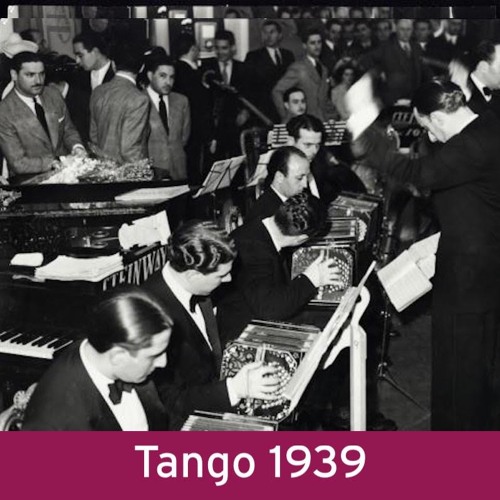
Tango 1939
Dag Stenvoll and Michael Lavocah · 30 Sept 2020 · 3:55:18
Dag Stenvoll and Michael Lavocah treat 1939, the month the war began in Europe, as a surprisingly narrow year in Buenos Aires: D'Arienzo's triumph is almost complete, while Troilo, Tanturi, Demare, Caló and Laurenz make no records, Pugliese and Gobbi are not yet in the picture, and the age of the soloists has faded since Gardel's death in 1935. What remains is D'Arienzo at the height of intensity with Echagüe and Polito (the show's pick for his best year, ending with the last session of that band, whose titles read like a premonition of its mass walkout), the first records of Di Sarli's new band with a 17-year-old Rufino, Biagi's new band, Canaro's hardening with Famá and the arrival of Mariano Mores, Fresedo, Firpo, Lomuto, Donato, Rodríguez and De Caro. Dag adds Soviet tangos and a Berlin La cumparsita, and Lavocah's afterparty explores the musical connection between Europe and Buenos Aires and Poland's mostly Jewish tango world that was about to be extinguished.
0% heard
3:55:18 left
Up next, as released
Tango 1946Episode 20 · 14 Oct 2020 · 3:24:26What this episode gave Tangopedia
Facts said in the episode, each now cited to the minute it is said.
1939 is a narrow year: D'Arienzo's triumph is almost complete, with lots of good tangos but few different styles and not many bands to choose from.
The age of the soloist has come to an end, beginning with Gardel's death in 1935, so there are few records by solo singers in 1939.
Tanturi, Demare and Troilo (signed to Odeon), Caló and Laurenz make no records in 1939; Gobbi has no band, Pugliese is just starting and Troilo is unrecorded, so the De Caro followers are absent.
1939 is the only year when De Caro and D'Arienzo record the same song (Ay, Aurora).
Canaro's music hardens in 1939 with Famá: he has his finger on the pulse of the hardening times, and the fit makes the music make more sense to Lavocah though it isn't his favourite.
Chapter · 5:00
A 17-year-old and a one-take tango
Di Sarli's comeback was recorded in one take, with a boy singing.

The first recording of Di Sarli's new band, with 17-year-old Rufino, done in one take, with a walking beat and a rare woody violin solo by Roberto Guisado.
♪ Music · 3:10 · The lyrics, on the song's page
Watch it danced · 130
The B side: a playful, jazzy instrumental by Afro-Argentine composer Carlos Posadas (c.1913), with a strong arrastre and Di Sarli's piano.
Only in the episode

A short, fast waltz from one of the standout bands of 1939, led in the studio by bandoneonist Federico Scorticati.

An instrumental from a Canaro stage show labelled tango sinfónica, theatrical and hard to dance.
Watch it danced · 15
A fast, happy milonga with Famá, who is back with Canaro after Maida left.
Only in the episode

An ironic waltz with a band mocking the singer; Rodríguez was the second-biggest seller after D'Arienzo outside Buenos Aires.
Watch it danced · 17
Chapter · 36:14
First singer to go solo
Castillo wasn't the first orchestra singer to go solo.

A Firpo quintet instrumental with a decorated piano and octave solos; it and Fantasma were recorded on the same day.
♪ Music · 3:05 ·

A super-energetic tango that reminds Dag of Donato's El huracán, mixing Firpo's style with what was going on around him.
Watch it danced · 8

An instrumental of 'pure class', famous for a video that synchronises Laurel and Hardy's dance with it.
♪ Music · 3:25 ·
Watch it danced · 72

A killer, super-fast waltz in which Falgás is a seven-out-of-ten match for Biagi, with a variation so fast the band almost can't keep up.
The lyrics, on the song's page
Watch it danced · 539
Chapter · 52:50
Laurel and Hardy dance to Biagi
A 1936 Laurel and Hardy dance lines up perfectly with a 1939 tango.

A Biagi composition; Lavocah says the singer is not integrated with the orchestra, unlike the Troilo-Fiorentino model.
♪ Music · 2:50 · The lyrics, on the song's page
Watch it danced · 13

One of the few Biagi milongas (six or seven in all), with Homero Manzi's sad lyrics, and a final-ten-seconds acceleration.
The lyrics, on the song's page
Watch it danced · 233

A solo recording by a 19-year-old woman, backed by Lomuto, who sings the whole lyric.
Only in the episode

A one-off woman singer, perhaps from a Lomuto stage show; Lavocah doesn't know who she is.
A hit of 1939 where Omar sings only the chorus; the order of the three goods (health, money, love) matters in Argentina.
Only in the episode

A patriotic milonga listing why Argentina and its women beat anywhere else; Dag prefers this version to Canaro's famous one.
Watch it danced · 86
Chapter · 1:19:55
The bluest room in Buenos Aires
A famous tango is named after cheap blue paint.
Played as 'the best track of 1939': a deeply melancholic version with guitar backing of a Mariano Mores tango.
Only in the episode
♪ Music · 3:07 ·
A new singer with Fresedo; Lavocah links the lyric to Contursi's cycle on a real woman, music by Troilo.
Only in the episode
♪ Music · 3:20 ·
A sweet, playful, slightly odd instrumental showing the piano as decoration, like a harp.
Only in the episode
Ray's last recording with Fresedo, with a great riff; a track even non-Fresedo fans love.
Only in the episode
♪ Music · 2:21 ·

With Lita Morales; Donato's violin counter-melody, played for his best dance year.
♪ Music · 2:55 ·
Watch it danced · 3

With Horacio Lagos and Romo Gavioli joining the chorus.
The lyrics, on the song's page
Watch it danced · 76

A medium-speed Donato milonga, probably the only recording of it, with a bubbly piano.
♪ Music · 1:47 · The lyrics, on the song's page
Watch it danced · 29

A waltz composed by the bassist Duclos, first recorded by Canaro in 1931; D'Arienzo's version is on fire.
♪ Music · 1:23 ·
Watch it danced · 222

Instrumental with a magnificent interaction between piano runs and the double bass.
The lyrics, on the song's page
Watch it danced · 26

Lavocah notes the 'cadencia' that violinist Matzeo gives the milonga phrasing.
The lyrics, on the song's page
Watch it danced · 569
Chapter · 2:03:44
A record that predicted a walkout
The titles of D'Arienzo's last Polito session were a premonition.

From the last session of the Polito-era band, whose titles read like a premonition ('bitter pill').
♪ Music · 2:00 ·
Watch it danced · 117

More than three minutes of instrumental, unusually long for D'Arienzo, with a modulation of power; not on the Argentine CDs.
The lyrics, on the song's page
Watch it danced · 84
Chapter · 2:17:21
The tango world of Poland
In 1939 the centre of tango in Europe was Poland, and then it vanished.
A Soviet tango inspired by Vivaldi's four seasons, with a slow habanera-milonga rhythm; recommended by two Russian tango friends.
Only in the episode
♪ Music · 3:03 ·
A Soviet tango, 'I return your portrait', about a man handing back the lover's picture; Lavocah praises the quiet, unangry lyric.
Only in the episode
♪ Music · 1:48 ·
The B side of a record also covered by D'Arienzo the same year; De Caro is inventive but confused by D'Arienzo's success.
Only in the episode
♪ Music · 1:25 ·

A De Caro composition, with whistling, that Dag describes as a young person with too many ideas.
Chapter · 2:35:17
A De Caro without the lawyer's recommendation
Without this man there's no Pugliese, no Troilo, no Laurenz.
Dag's Cumparsita of the year, recorded in Berlin, with many solos including a piano octave solo like those being developed in Buenos Aires.
Only in the episode
♪ Music · 4:23 · The lyrics, on the song's page
Afterparty cortina.
Only in the episode
♪ Music · 3:01 ·
A wild Argentine-sounding side the Paris band recorded under the name 'orchestra of English tangos' for a specialist audience; Lavocah does not know the title's meaning.
Only in the episode
♪ Music · 2:25 ·
Zerrillo returned to recording in 1939; the tango is better known from Típica Victor.
Only in the episode
♪ Music · 2:17 ·
An OTV track for which Lavocah knows of no high-quality transfer.
Only in the episode
♪ Music · 2:47 ·

A Canaro tango no other orchestra recorded.
♪ Music · 1:58 ·
Watch it danced · 5

First of a Canaro waltz set.
♪ Music · 1:02 · The lyrics, on the song's page
Watch it danced · 29


Lavocah starts the D'Arienzo run with one of the most exciting tracks.
Only in the episode
♪ Music · 3:10 ·
A D'Arienzo milonga with a guitar-serenade lyric, played before Mandria.
Only in the episode

A tough-guy lyric ('lend me your poncho') at D'Arienzo's most intense.
♪ Music · 2:29 · The lyrics, on the song's page
Watch it danced · 550


Played as a contrast to Donato's happy side of the same era.
♪ Music · 1:52 · The lyrics, on the song's page
Watch it danced · 77

An instrumental to lower the energy slightly before the finale.
♪ Music · 2:42 · The lyrics, on the song's page
Watch it danced · 107
Played to bring the energy down before the final tango.
Only in the episode
♪ Music · 2:16 ·
The closing tango from the band's last session, Lavocah points to its six-note riff, violin counter-melody and a variation not at the end.
The lyrics, on the song's page
Watch it danced · 84
Danish folk songs by the tenor, Lavocah's play-out; his mother is Danish.
Only in the episode
♪ Music · 10:31 ·
Follow through every episode
Tango By Year is Dag Stenvoll and Michael Lavocah's, published here with their permission. The audio plays from SoundCloud.