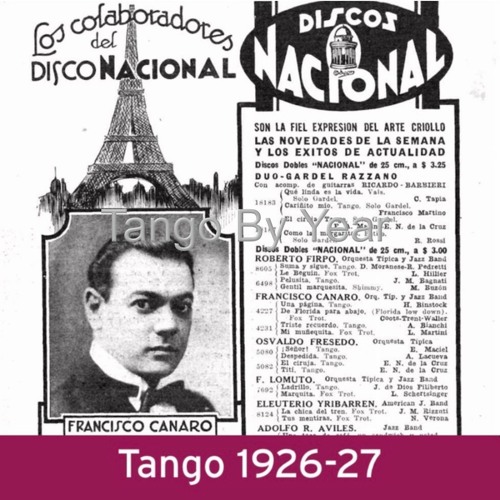
Tango 1926-1927
Dag Stenvoll y Michael Lavocah · 3 de mar de 2021 · 2:56:45
Dag Stenvoll was sick, so Michael Lavocah ran the whole show alone, playing from Dag's playlist plus his own picks. The episode sits at the start of electrical recording (Victor from March 1926, Odeon from November 1926, both labels staying quiet about it so old acoustic stock would still sell), just as tango's six-piece sextets were recording prolifically because there were no written arrangements yet. Lavocah tracks the 'old guard' (Firpo, Canaro's stand-in band, Fresedo, Lomuto, Maglio, Guido) against Julio De Caro's sextet, already building the harmonic vocabulary that Troilo, Laurenz and Pugliese would use. Working-class 'arrabalera' singers Rosita Quiroga and Azucena Maizani are set against the more polished new arrival Libertad Lamarque. Lavocah names Osvaldo Fresedo his favourite orchestra of 1927, just before Canaro and Lomuto are lifted to a new level by singer Charlo.
0% escuchado
faltan 2:56:45
Lo que sigue, como se publicó
TBY Lost Afterparty V - 1926-1927Episodio 34 · 10 de mar de 2021 · 2:43:30Lo que este episodio dio a Tangopedia
Datos dichos en el episodio, cada uno citado al minuto en que se dice.
The term 'orquesta típica' began in 1909 as a marketing label coined by Greco and Canaro, so by 1926-27 tango's orchestral sound was already about 15 years into its development.
Victor introduced electrical recording in Argentina on 1 March 1926; Odeon didn't follow until November 1926. Neither label announced it publicly, by a gentleman's agreement, so buyers wouldn't stop purchasing the older acoustic-era stock still on shelves.
Victor introduced electrical recording in Argentina on 1 March 1926; Odeon didn't follow until November 1926. Neither label announced it publicly, by a gentleman's agreement, so buyers wouldn't stop purchasing the older acoustic-era stock still on shelves.
The only way to spot an electrical recording at the time was tiny markings: Odeon restarted its matrix numbering at 1 with a small 'e'; Victor later added 'VE' (Victor Electrical) to its labels, but gave no visible sign when the format first switched.
The only way to spot an electrical recording at the time was tiny markings: Odeon restarted its matrix numbering at 1 with a small 'e'; Victor later added 'VE' (Victor Electrical) to its labels, but gave no visible sign when the format first switched.
Capítulo · 2:58
The Revolution Nobody Announced
In 1926, tango's sound quietly changed forever -- and the record labels told no one.
Lavocah opens with a Gardel milonga, noting it has the groove Piazzolla later gave Fiorentino in 1945, even though the danceable milonga rhythm as a dance form supposedly wasn't 'invented' until 1932.
Solo en el episodio
♪ Música · 1:46 ·
A tender Gardel love song, which Lavocah compares to the 1959 Pugliese/Jorge Maciel recording of the same title.
Solo en el episodio
♪ Música · 2:29 · La letra, en la página del tango

Lavocah starts his Firpo run with a strong, melancholy-tinted number, calling Firpo a romantic with real melody underneath.
♪ Música · 2:00 ·
A second Firpo instrumental, intense and heavy-beated with complex violin harmonies; the title is never stated in the transcript.
Solo en el episodio
♪ Música · 2:30 ·
A third Firpo instrumental played straight after the second; again the title is not said on air.
Solo en el episodio
♪ Música · 1:30 ·
One of Odeon's first electrical-recording matrices, made by Canaro's stand-in band (run by Minotto Di Cicco and Luis Riccardi) while Canaro himself was in Paris; notable for the bandoneón carrying more of the backing than the piano.
Solo en el episodio
♪ Música · 2:31 · La letra, en la página del tango

An adventurous, playful version from March 1927, picked to show the band picking up the pace after a run of sub-60bpm tracks.
♪ Música · 2:00 · La letra, en la página del tango
Verlo bailado · 5
Chosen to illustrate 'canyengue' slapped-bass syncopation, which Canaro's band and especially Fresedo's used heavily in this period.
Solo en el episodio
♪ Música · 2:30 · La letra, en la página del tango
Capítulo · 43:14
The Rigged Contest That Still Gave Us a Classic
Buenos Aires's biggest tango competition had a dirty secret.

One of the winning entries in Max Glucksmann's annual Odeon tango competition; the lyric, despite the festive title, is a jealousy-murder story.
♪ Música · 2:56 · La letra, en la página del tango

An Agustín Bardi composition, played for its playful pizzicato violin; Lavocah notes D'Arienzo's later recording (from the late 1930s) is the most famous version today.
♪ Música · 2:00 ·
Another playful, pizzicato-heavy Fresedo number, picked to show violinist Adolfo Muzzi's three-finger pizzicato technique.
Solo en el episodio
♪ Música · 3:15 ·

A darker-coloured Fresedo track, shown as a contrast to the playful ones played just before it.
♪ Música · 2:30 ·

A late, sweet and tender entry to the same Max Glucksmann 'best version' competition; Lavocah calls Fresedo his clear favourite orchestra of the year on the strength of this run.
♪ Música · 2:30 · La letra, en la página del tango

Lavocah calls Lomuto 'Canaro's apprentice with a heavier bass' and picks this one for its strong violin playing from the very start.
♪ Música · 2:18 ·
A smoking-and-kissing love song that Lavocah pairs with Corsini's warm, 'countryside' voice, as a change of mood after the Lomuto track.
Solo en el episodio
Called the very first electrical recording made in Buenos Aires; Lavocah reads the lyric as the voice of the poor barrio criticising the sophistication of the city centre.
Solo en el episodio
♪ Música · 2:55 ·
Capítulo · 1:20:29
The Bridge the City Paved Over
A song written for a neighbourhood that was being destroyed.
Quiroga's version of a lyric mourning a barrio being redeveloped and paved over; Lavocah prefers Pugliese/Vidal's 1950 version for drama but likes this one just as much.
Solo en el episodio
♪ Música · 3:01 ·
Introduces Lamarque's more sophisticated vocal style, contrasted with the rougher 'arrabalera' sound of Quiroga and Maizani.
Solo en el episodio
♪ Música · 2:18 ·
Capítulo · 1:28:45
The Tapes That Shouldn't Exist
The original masters were melted down in 1962. So why does this still sound so good?
A Paris-recorded Argentine band with an intensely melancholy sound Lavocah has a personal fondness for, built around bandoneonist Juan de Ambrogio ('Bachicha').
Solo en el episodio
♪ Música · 2:58 ·
A comic, spoken-dialogue version of the strike-themed tango Lavocah says the show had played a few weeks earlier under its other title, 'El Aocado'.
Solo en el episodio
♪ Música · 2:58 ·
A French Odeon pressing by a Hungarian-Jewish bandleader who later fled the Nazis and settled, surprisingly, in Buenos Aires as a jazz bandleader.
Solo en el episodio
♪ Música · 3:00 ·

A waltz by a full-time jazz band only later drawn into tango; Lavocah and listeners debate whether a flute or piccolos are audible in the background.
♪ Música · 2:05 ·
Verlo bailado · 1
An old-guard waltz on the Victor label, featuring violinist Elvino Vardaro, who recorded on nearly everything Victor put out in this period.
Solo en el episodio
♪ Música · 2:00 ·
A trio recording chosen to compare another 'singing violin' stylist to Vardaro; Ferrazzano had played on Firpo's first-ever performance of La Cumparsita in 1916.
Solo en el episodio
♪ Música · 3:00 ·
Capítulo · 2:02:56
The Prison Song That Outsold Everyone
A song about an innocent man in prison became the best-seller of 1927.
A prison-themed tango that, per Victor's own sales ledger, sold about 16,000 copies, roughly ten times a Julio De Caro record from the same year.
Solo en el episodio
♪ Música · 2:39 ·

A one-off two-sided Victor record by the pianist (not yet a bandleader) that Lavocah calls the spookiest thing ever recorded in tango.
♪ Música · 3:00 ·

A house-band track chosen to show how unpredictably simple or advanced OTV's playing could be from one side to the next.
♪ Música · 2:30 ·
Verlo bailado · 2
Lavocah argues this strong-melody, strong-beat band is the direct ancestor of D'Arienzo's later sound.
Solo en el episodio
♪ Música · 2:30 ·
Capítulo · 2:21:16
Where D'Arienzo's Beat Really Came From
You know this sound. You've just never heard where it started.
A second, wilder Maglio track played on request after listeners responded to the first.
Solo en el episodio
♪ Música · 2:30 ·
The most harmonically advanced track of the night, with the band laughing in chorus at the start and a striking two-bandoneón variation at the end.
Solo en el episodio
♪ Música · 2:49 ·

Played to showcase the Pedro Maffio/Pedro Laurenz bandoneón pairing that De Caro aficionados prize over the later Laurenz/Blasco combination.
♪ Música · 2:12 ·
One of the biggest hits of the era, sung by Maizani as another voice of the poor barrio.
Solo en el episodio
♪ Música · 1:37 ·
Capítulo · 2:42:55
Tango's Love Letter to Itself
A song that apologises to tango -- and loves it anyway.
A spoken poem, not a sung lyric, which Lavocah calls Maizani's greatest track and opens with lines he says every Argentine knows by heart.
Solo en el episodio
♪ Música · 1:58 ·
Capítulo · 2:47:20
Two Bandoneóns, No Orchestra
Just two musicians, no band -- and it's astonishing.

A bandoneón-duo recording De Caro had his two players make once their playing started attracting attention on its own.
Solo en el episodio
♪ Música · 3:00 · La letra, en la página del tango

The least-heard of Canaro's three old-period recordings of the song (1927, 1929, 1933); closes the show since almost everyone knows the much more common 1933 version instead.
La letra, en la página del tango
Verlo bailado · 4
Seguir por todos los episodios
Tango By Year es de Dag Stenvoll y Michael Lavocah, publicado aquí con su permiso. El audio se reproduce desde SoundCloud.