Song
El Flete
El Flete is a tango composed in 1916 by Vicente Greco, one of the early pioneers who helped establish the orquesta típica. It remains a staple of the Golden Age repertoire, particularly in instrumental versions by Juan D’Arienzo and others, despite disputed lyricist attributions.
El Flete stands as a classic example of the early twentieth-century tango that bridged the Guardia Vieja and the more structured orchestral era. Composed by the bandoneonist and leader Vicente Greco, the piece entered the repertoire around 1916 and quickly found favor both in sheet-music sales and in the dance halls of Buenos Aires.[1][2] Greco, born in Buenos Aires on 3 February 1888 (some sources list 1886), was among the first musicians to move tango from the outskirts into the center of the city and is credited with coining the term “orquesta típica.”[3][4] His death from uremia on 5 October 1924 cut short a career that produced several enduring titles, including Rodríguez Peña, La viruta, and El flete itself.[3]
The title draws on lunfardo. “Flete” can mean a horse or any fast means of transport, and by extension “to give someone the flete” means to dismiss or send them packing. Two distinct sets of lyrics exist, and sources disagree on authorship. One version, preserved on Todo Tango under the 1916 entry, is attributed to Pascual Contursi and describes the end of the old toughs: the “pesaos,” “patoteros,” and knife-wielding figures who once dominated the streets are now caught and given the flete to “la otra población.”[5] A second set, listed by tango.info and on a separate Todo Tango page dated 1941, is credited to Gerónimo Gradito and treats the flete as a racehorse—a zaino escarceador whose heart is hard to match and who carries the narrator’s hopes on the track.[6][7] The Contursi lyrics appear never to have been widely recorded, while the Gradito text is the one heard on the 1930 Orquesta Típica Porteña recording with Ernesto Famá.[8] Contemporary accounts and SADAIC registrations have not resolved the discrepancy; both attributions continue to circulate.[5][6]
Early instrumental versions appeared almost immediately. Roberto Firpo is listed with a 1914 performance on tango.info, followed by further Firpo sides around 1916.[2] Francisco Canaro recorded the piece on 7 March 1928, and his later Quinteto Don Pancho returned to it on 30 March 1939.[2] The 16 September 1930 Orquesta Típica Porteña side with Famá remains one of the few vocal versions from the period.[2][8] Juan D’Arienzo’s 3 April 1936 recording, made with Rodolfo Biagi at the piano, became a reference point for dancers; its driving pulse and crisp accents exemplify the “rey del compás” style that would define the late 1930s.[2][9] Later readings include Héctor Varela’s 1950 and 1952 sides and Osvaldo Fresedo’s 1966 version, each preserving the original’s rhythmic clarity while adding the polish of their respective eras.[2]
Sheet-music sales figures from Greco’s lifetime give a sense of its early popularity: an interview preserved in Todo Tango states that El flete sold 6,000 copies in three months, a substantial number for the period.[4] The piece continued to appear in the repertoires of orquestas típicas throughout the Golden Age and remains a regular choice at milongas, valued for its clear 2/4 pulse and opportunities for crisp walking and turns. Its dual lyric traditions and the range of orchestral treatments—from Firpo’s early acoustic sides to D’Arienzo’s 1936 classic—illustrate how a single early tango could be reinterpreted across decades without losing its identity.
Authorship and Lyrics
The music is universally attributed to Vicente Greco and dated 1916 on both tango.info and Todo Tango.[1][2] The lyricist question is unresolved. Todo Tango’s primary entry lists Pascual Contursi and reproduces verses beginning “Se acabaron los pesaos, patoteros y mentaos.”[5] A second Todo Tango page and tango.info credit Gerónimo Gradito with the racehorse text that begins “Parejero; zaino escarceador.”[6][7] An independent site notes that Contursi’s lines were recalled by Víctor Soliño as having been written for Greco’s already-composed melody, yet SADAIC records list Gradito.[10] No definitive contemporary contract or registration has settled the matter.
Key Recordings
The earliest documented sides are those of Roberto Firpo (listed as 1914 and 1916).[2] Canaro’s 7 March 1928 recording and the 1939 Quinteto Don Pancho version kept the piece in the commercial catalog.[2] The 16 September 1930 Orquesta Típica Porteña recording with Ernesto Famá is the principal early vocal interpretation of the Gradito text.[2][8] D’Arienzo’s 3 April 1936 instrumental remains the most frequently cited for dance, its Biagi piano and tight rhythm section providing the model later copied by many orchestras.[2][9] Varela’s 1952 side and Fresedo’s 1966 recording demonstrate the piece’s longevity into the post-Golden Age period.[2]
Style and Legacy
El Flete is typically played in a bright, rhythmic style suited to walking and clear changes of direction. D’Arienzo’s 1936 version is frequently cited as an exemplar of the driving 1930s sound.[9] The piece’s continued presence in contemporary milonga playlists, from Varela reissues to modern ensembles, shows how Greco’s early composition adapted to successive orchestral aesthetics while retaining its original character.
References
- 1.EL FLETE - tango.info · tango.info“El flete | tango | Vicente Greco | Gerónimo Gradito | 1916”
- 2.EL FLETE - tango.info · tango.info“Roberto Firpo | 1914 | Francisco Canaro | 1928-03-07 | Juan D'Arienzo | 1936-04-03”
- 3.Biography of Vicente Greco · todotango.com“(3 February 1888 - 5 October 1924)”
- 4.Biography of Vicente Greco by Juan Silbido · todotango.com“"El flete" sold 6.000 copies in three months.”
- 5.El flete. Tango (1916) · todotango.com“Music: Vicente Greco Lyrics: Pascual Contursi”
- 6.El flete [Gradito]. Tango (1941) · todotango.com“Música: Vicente Greco Letra: Gerónimo Gradito”
- 7.Subtitled Video #49: EL FLETE · tangodecoder.wordpress.com“Music by Vicente Greco; lyrics by Gerónimo Gradito.”
- 8.EL FLETE II · hermanotango.com.ar“Grabado por la Orquesta Típica Porteña ... cantando el estribillo Ernesto Famá. 16-09-1930”
- 9.Tango music · en.wikipedia-on-ipfs.org“"El flete" is an excellent example of D'Arienzo's approach.”
- 10.EL FLETE · hermanotango.com.ar“Letra : Pascual Contursi Música : Vicente Greco ... aunque en Sadaic figura como de letra de Gerónimo Gradito.”
Credit
- Music
- Vicente Greco
- Lyrics
- Pascual Contursi
Source: TangoCloud catalogue
Every recording
6 recordings · our catalogue, dances filmed on TangoTube · 10 more we know of
- Roberto FirpoNot in our catalogueInstrumental1914
- Roberto FirpoNot in our catalogueInstrumental1916
- Francisco CanaroEarliest we holdInstrumental · Odeon · Feb 77 dances1928
- Orquesta Típica PorteñaInstrumental · Sep 19Not danced on film yet1930
- Juan D'ArienzoMost dancedInstrumental · RCA Victor · Apr 3303 dances1936
- Quinteto Don Pancho (Francisco Canaro)Instrumental · Odeon · Mar 30Not danced on film yet1939
- Quinteto Don Pancho, dir. Francisco CanaroNot in our catalogueInstrumental · Mar 301939
- Héctor VarelaNot in our catalogueInstrumental · Dec 41950
- Héctor VarelaInstrumental · Jun 92 dances1952
- Osvaldo FresedoInstrumental · Columbia · Apr 15Not danced on film yet1966
- Anibal Arias, Osvaldo José MontesNot in our catalogueInstrumental
- Jorge ArduhNot in our catalogueInstrumental
- Pablo AslanNot in our catalogueInstrumental
- Roberto FirpoNot in our catalogueInstrumental
- Ensemble HyperionNot in our catalogueInstrumental
- La TubatangoNot in our catalogueInstrumental
Lyrics
Español · Underlined words are lunfardo: tap one for its meaning.
Se acabaron los pesaos, patoteros y mentaos de coraje y decisión. Se acabaron los malos de taleros y de palos, fariñeras y . Se acabaron los de faca y todos la van de araca cuando llega la ocasión. Porque al de más copete lo catan y le dan flete pa' la otra población. Esos taitas que tenían la mujer de prepotencia, la van de pura decencia y no ganan pa'l bullón. Nadie se hace el pata ancha ni su pecho ensancha de puro , porque al de más copete lo catan y le dan flete pa' la otra población.
English · machine translation
No more pesaos, and the patooties and the of courage and decision. No more bad guys of taleros and sticks, fariñeras and facon. No more faca and everyone goes araca when the occasion arises. Because the one with the most they catan him and give him freight to the other town. Those taitas who had the woman of arrogance, they go with pure decency and they don't win for the bullón. No one plays the wide-legged nor does his chest widen of pure compadron, because the one with the most wealth they catan him and give him freight to the other town.
Danced to it
Music from 1928–1966 · danced on film 1997–2026
1997: 1, 2004: 1, 2005: 1, 2006: 2, 2007: 7, 2008: 19, 2009: 22, 2010: 27, 2011: 20, 2012: 20, 2013: 22, 2014: 11, 2015: 13, 2016: 20, 2017: 28, 2018: 16, 2019: 19, 2020: 8, 2021: 11, 2022: 15, 2023: 11, 2024: 12, 2025: 10, 2026: 7


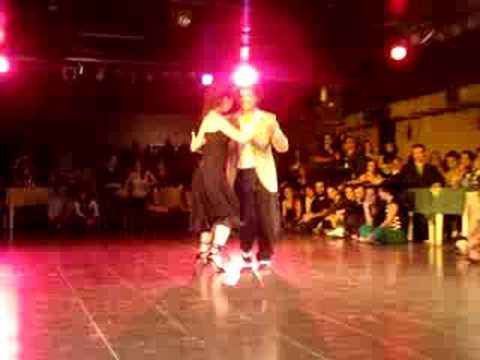

Where it is danced
The places our videos show it danced, by performances filmed there.
- Club Social y Deportivo Villa MalcolmVilla Crespo3 performances
- El BesoBalvanera2 performances
- El Yeite Tango ClubVilla Crespo2 performances
- Plaza DorregoSan Telmo2 performances
- Club GricelSan Cristóbal1 performance
- Club Sin RumboVilla Urquiza1 performance
- Espacio Riobamba (Club Castel)Balvanera1 performance
- Luna ParkSan Nicolás1 performance
- Salón El Pial (La Baldosa)Flores1 performance
- Sunderland ClubVilla Urquiza1 performance
Data: recordings, facts and sources
Recordings by year
Source: TangoCloud catalogue
1928: 1, 1930: 1, 1936: 1, 1939: 1, 1952: 1, 1966: 1
Composer1
Composed by Vicente Greco
Supported · 2In other catalogues4
TodoTango · tema/3257
Single sourcetango.info · T0370013005
Single sourceMusicBrainz · 2e19562e-a300-4b5f-95fa-4aa7625a0046source
Single sourceTodoTango · tema/7880
Single sourceIs a1
Is a Tango
Single sourcePublished1
Published 1916
Single sourceLyricist1
Lyrics by Pascual Contursi
Single sourceListen
Ask Tangopedia
Answers only from cited facts, each with its source.