Tango 1942
Dag Stenvoll and Michael Lavocah · 2020-08-19 · 3:51:00
1942 is the year lyricism takes over tango, led by Troilo's arrangement of Malena — the first proper vocal arrangement written for his orchestra, after a run of vocal numbers delivered almost spontaneously — and matched by D'Agostino, Caló, Di Sarli and even D'Arienzo reaching for more romance and space. Miguel Caló has his commercial breakthrough with Al compás del corazón, a song its own singer Raúl Berón almost refused to record, while Carlos Di Sarli poaches 18-year-old Alberto Podestá straight out of Caló's band. It is an unusually prolific year for dance tango — D'Arienzo alone makes around 33 recordings, Troilo 27 — and, Lavocah and Stenvoll agree, almost all of it will already be familiar to dancers. Formal censorship is still a year away (it begins in mid-1943 under Perón), but self-censorship is already visible, as in two competing takes of Malena's third line; the war in Europe surfaces obliquely too, in older songs like Biagi's Bélgica and in the closing, deliberately non-tango choice of We'll Meet Again.
What this episode gave Tangopedia
Facts said in the episode, each now cited to the minute it is said.
Troilo's 1941 arrangement of Malena, written by bandoneonist Héctor María Artola, was the first proper vocal arrangement made for his orchestra — before that his singers delivered vocal numbers almost spontaneously.
D'Agostino's and Di Sarli's milongas pay more attention to the phrase than to a repeated beat, giving them an unusually lyrical swing (cadencia) compared with most milongas.
Al compás del corazón was written by bandoneonist Domingo Federico, who was still playing in Caló's own orchestra when he brought the tune to the band.
Singer Raúl Berón initially refused to sing Al compás del corazón; when Caló was late to a gig, violinist Enrique Francini sang it instead, the crowd loved it, and only then did Berón take the song on.
Berón started as a folk singer, not a tango singer, which gave him his soft crooning style; Lavocah compares him to the young Frank Sinatra of the early 1940s, before Sinatra's big-band fame.
Records played · 50
Transcript
Transcribed by machine from the audio, then punctuated; names may be misheard. Tap any line to hear it. The episode is in English, and so is its transcript.
Hello everybody and welcome to another edition of Tango by Year. Tonight's year is 1942. My name is Dag Stenvoll. For the new listeners, I'm a tango DJ from, or living in Bergen in Norway. And with me here across the digital cafe table, I have someone you all know and cherish. Monsieur Michael Lavocah, Tango Oracle living in Norwich, England.
Is that an introduction? Where can we go from there? That's it. It's all downhill now. Lovely to be back with everyone. I miss you all every time and really looking forward to exploring this great Tango year with everyone.
Yeah, me too. And I think we're going to enjoy 1942. I mean we visited 1940 and 1941 already, so what are we up for tonight, Michael?
“We're up for lyricism.”
We're up for lyricism. That's it. 1941 to 42, the change is so clear in the music. It's the year when lyricism breaks out as the most important thing that tango wants to say, so that the music gets slower in order to deliver that lyricism. And if you've been looking on Facebook, you'll all have seen that a few days before the event, I changed the picture to the sheet music of the tango Malena. Why? Because that's the tango that really embodies this change. First of all, because of the exquisite beauty of Lucio Demare's composition, his melody. But secondly, because of the arrangement. And it's Troilo's arrangement, actually.
Demare's one's more accessible, easy to enjoy, but eventually the Troilo one gets you and that's an arrangement of supreme importance. We could even say it's the most important arrangement in tango music ever. How about that? Because it's the first vocal arrangement for the Troilo Orchestra in 1941. Now we know this, I'm not just making this up, we know this in 1941, all the vocal numbers, which is most of them, are just being done what they call a la parisia, spontaneously. And only the, um, instrumental numbers like Cacciarolo and Guapiando, which are more complex, are being arranged, and the arranger is Héctor María Artola, a bandoneon player from Uruguay. And then I don't know how it happens, I guess Troilo says to him, please arrange a vocal for me and make it really good, and he arranges Malena, and we can hear that it's more complex, more interesting to listen to. And then the whole scene follows this lyrical development, even D'Arienzo eventually catches the bug.
Chapter · 2:32
Tango's Most Important Arrangement?
One arrangement, Michael Lavocah says, might be the most important ever written in tango.
Yeah, and we will of course listen to Malena, and you didn't know that I was going to play it when you changed the picture, but that's a song that's impossible to get around. You're listening did 1942. No, can't get around it. We'll get back to it later, but, um, yeah, and, uh, I think this will be a very different evening from two weeks ago when we did tango 1930, because I remember about the third into the program one of the listeners typed into the chat window, this track I've heard before. And I understood what he meant, but tonight's going to be very different, I suspect.
Your listeners will have heard most of the music, there won't be any big surprises, and you will have danced a lot of it too, because 1942 is really a year for dance tango. Yeah, a familiar year. It will certainly be familiar with all of the Troilo tracks, I would imagine, like 90% of the D'Arienzo, probably not 100%, um, the D'Agostino may be a bit less, 80, but yeah, well known. The Di Sarli and the Caló again, I think the Di Sarli, that's going to be 100% familiar too.
Yeah, and I really enjoyed preparing for this, uh, because it's a great year, but also I'm going to say that the joy was a bit mixed with, with sadness, because this is so, so, um, for me it's just so really emotional dance music. So it's hard not to dance to it, so I hope that people will be okay tonight listening to all this great dance music, and most of you will not be able to dance it, but we have to live with that. We do. Yeah, let's start with an orchestra that, uh, you said before, Michael, went slow and lyrical a little bit before the others, already in 1941.
Well, this is D'Agostino then, yes. I want to play, I mean he recorded about more than 20 tracks and all of them except two with Ángel Vargas singing, and I want to play a not so normal tango. It's called A la carta. It's about boys playing cards as far as I can understand. I didn't find a translation of the text, but, uh, and then, uh, I also want to play a playful milonga, Así me gusta a mí. Yeah, yeah, both nice tracks.
Opens the show with a lesser-known D'Agostino/Vargas number about boys playing cards.

A playful milonga paired with A la carta; Lavocah notes D'Agostino's rare piano solo in it.


Um, you know, by this time, by 42, D'Agostino's found his sound and it doesn't really change from here on in. The milongas are really special actually, uh, perhaps a bit less in this one. One, El Portagnito, which is from 44 or something like that, has the most exquisite phrasing. Di Sarli and D'Agostino do their milongas a little bit differently. They pay more attention to the phrase and less to the repetitive beat. And we can still hear that in Así me gusta a mí. There's a beautiful phrasing to this milonga, a nice lilt, a nice cadencia, an Argentine would say, the swing of the phrase.
And there's a very nice short section just after the second verse, I think, where D'Agostino plays the piano, just him. Like, a little Christmas feeling to it, I think. Oh, I look forward to that. Yeah, let's listen to this too. This is A la carta and Así me gusta a mí with D'Agostino and Vargas.
Playful and light like a sunbeam on the lake, Janos writes. That's nice. Beautiful, soft and phrased. Yeah, and the piano there with the playing. You don't hear D'Agostino so often play that solo. No, you don't. It's a bit like a Paniagua, which you played a few shows ago. It's like suddenly it goes off-piste. It gives you a little tricksy surprise. Yeah.
So let's move on to a band that will listen to recordings from many years before this, but gets its breakthrough in 1942. I think it's fair to say, Miguel Caló. Very well described, yes. Yeah. And the breakthrough comes with Berón singing Al compás del corazón, to the Beat of the Heart.
Chapter · 12:40
The Singer Who Said No to His Own Hit
The song that defined him almost didn't have him on it.

Caló's big commercial breakthrough of the year, written by his own bandoneonist Domingo Federico.
Danced to it · 5 of 53



Yes, well, it nearly didn't, you know. He didn't like it. So now we think, oh yes, Caló, Berón, Al compás del corazón. This tango was written by Domingo Federico, who is a bandoneon player. He's still in the orchestra in 1942, and he'd written it quite a while back. He brought it with him. And we identified this song absolutely with Berón now, but surprisingly, Berón didn't want to sing it.
Which is even more surprising when you learn that Berón was inspired in his early singing career. Now, remember, he's not a tango singer before. He was a folk singer, not a tango singer. That's how he has this soft crooning voice whispering into the girl's ears, which was a new style for tango. And he was influenced by Frank Sinatra. Now, when I say Frank Sinatra, you're thinking mid-50s, big band Frank. But before mid-50s, big band Frank was early 40s, crooner Frank, singing to all the American girls whose men had gone off to fight the war. So Frank was a crooner. So it should have been a perfect fit for Berón, Al compás del corazón. It wasn't. He didn't want to sing it.
The piece got its debut in an afternoon. Caló wasn't there. Typical thing, you know, the band leader turns up late because he can. And Berón refused to sing it, so Francini sang it the first time. Can you believe that? Francini sang the tango. Public really liked it. And when Caló turned up later, they asked for it again, and the rest is history.
Machine the violinist. Did he sing a lot or just this once? There's another recording when Francini is in Japan on a tour with the Quinteto Real in the 50s, but he really is, you know, second string singer, so I think it's like emergencies. Yeah, um, like when Piazzolla would play the piano for Troilo because Gongi hadn't shown up. He was the emergency singer for the band.
And the triple piece of luck is that the radio station had said to Caló, this new singer you've got, Berón, he's no good, get rid of him. And he had told Berón, I'm afraid I'm going to have to let you go, when the record came out and was a huge hit. So the success was by no means assured. There were many little steps that had to happen before this song came along and really defined a style. Coincidences.
And now, according to Todo Tango, Berón is among the most highly regarded singers ever, besides Goyeneche and Ruiz. Yeah, I wonder how much of that now is because of the work he did with Troilo later on. We listened to the 50s. With each passing year, we appreciate it more. That's a slow process because the recording quality on Troilo's early 50s recordings is really quite poor, but, yeah, it's easy, easy melodies to follow and immediately gives a romantic mood. Yeah.
So listen to the iconic tango Al compás del corazón, and after that I was also to play another milonga, a Caló milonga. Yes, turns your hair grey.

A second Caló track Dag calls simply 'another milonga'; title never spoken, inferred from the lyrics about an old jockey.
Danced to it · 5 of 40



The medical orchestra. Why do you call it the medical orchestra? Well, because they were all medical students. That's how the band starts. Now, let me... Castillo is a gynecologist. That's right. Alberto Castillo is a gynecologist.
And the reason that Centuri met him is because he was playing for the medical students. And I think he trained medically as well. I'm not 100% sure on that. So, don't quote me. It must have been popular with his patients. Well, at the beginning, he tried to continue both professions. So Castillo is his stage name. I can't remember his real name. I've forgotten.
So he would perform under Alberto Castillo at night. And in the afternoon, he had his gynecology practice under his real name. But he was forced to give that up because very soon his waiting room was full of young women eager for an internal examination from the doctor. The perils of fame. Yeah.
Chapter · 22:36
The Doctor Who Had to Quit Medicine
A gynecologist by day, a tango star by night — until his patients found out.

First of this year's Tanturi/Castillo pair, from the band nicknamed 'the medical orchestra'.
Danced to it · 3 of 6


♪ Music · 0:08 ·
So let's hear the gynecologist singing the tango La copa del olvido, The Glass of Oblivion. And also the waltz, Marisabel. I guess that's the woman's name.

Paired waltz; Dag guesses Marisabel is just the woman's name in the lyric.



Good swing in that one. What a fantastic orchestra. Yeah. Killer band and yarn section. Violins always keep it simple, full of emotion.
And it was really nice to see the lyric for Marisabel there because it's a little bit more complex than the lyrics that waltzes often give us, and it tells a story in keeping with the fact that it's a waltz. It's a nice story, a story with a happy ending, but nevertheless a little bit of complexity. I hadn't paid attention to that lyric before, so I'm really happy to see it. Thank you for that.
Let's go to Lucio Demare. Lucio Demare, I guess it's pronounced, Italian background. And he hasn't really been recording a lot. This is also his kind of breakthrough year, isn't it, 1942, too. Well, he's been trapped in a recording contract with Odeon, hasn't he? Like Troilo. Exactly, just like Troilo, and also like Tanturi, actually, who's liberated himself now. But Odeon happily see the error of their ways just in time, and in 1941 they start releasing more records with him, otherwise he'd surely have left and gone to Victor as well.
And his main singer is Juan Carlos Miranda and I want to play two tracks with Miranda, who is my favourite Demare singer, I must say: No te apures carablanca and the waltz Nunca supe por qué. I would guess that it's everyone's favourite singer with Lucho Demare, although Horacio Quintana, who comes a bit later on, is clearly following in his line later on.

Demare finally getting more releases after years stuck in his Odeon contract.
Danced to it · 5 of 59


Paired waltz played straight after.
Danced to it

No te apures carablanca is one of these desperately sad tangos that it's one of those ones where you think, why did I learn Spanish? Because before you learn it, you think, oh, this is nice. And then you listen to the lyric and the guy's saying to the horse, don't hurry because no one's waiting for us when we get home. Oh, God. I couldn't find any good English translation on the internet. Maybe that's because no one bothered to translate it because it's so sad.
Well, they tried to, but they were too depressed and they couldn't finish the project. Yeah, well, I'll post the Spanish lyrics anyway. So Lucio Demare, No te apures carablanca, and then the waltz Nunca supe por qué with Miranda singing.
So there was a question there about the sound fidelity of these tracks. Yeah, well, let's talk about Demare first a little bit. But I want to deal with that question. It's an important point to pick up. What I love about Demare is it's romantic, but it's also really muscular. It's not a weak music at all.
Very strong, particularly in the violin part, which I think is still Raul Kaplon in 1942. And that's something that we're going to hear more with Tanturi, but in 1943. And 1943, I need to mention that again for all the Demare Baron fans. Demare Baron is 1943, you're not going to hear any Demare Baron tonight because there isn't any. Baron goes and takes a year off. It's the money, it's always the money, isn't it, so yeah.
Lucho Demare, muscular and romantic, and really it's a difficult vocal in Nunca supe por qué. He's rapping the way that Charlo sometimes does and the way that Castillo sometimes does when he goes solo. But listening to that, I'm going to listen to that one again after the show because he's rapping and then he phrases at the same time, so he's not only rapping, he's moving between rapping and phrasing, which is very difficult.
The question about sound fidelity, it's to do with the record company, so RCA Victor are okay but Odeon are better, and Troilo is on Victor, Pugliese is on Victor, Di Sarli is on Victor. What's the difference? There are two differences. The first is the make of microphone, which creates a different sound balance. The Odeon make is a little bit better for the singer and you can hear on the records the noise is lower. So if this here is the volume of the music, then the volume of the noise is, say, it's here on RCA Victor and on Odeon it's there. That's probably not to do with the recording itself, that's to do with the pressing, when the records are actually made, because in a record, what's the noise? It's called surface noise. You have a groove like this and the needle goes along the bottom of the groove and it literally bumps along, like falling down the stairs on your bottom you go. So if it's very smooth on the bottom there's very little surface noise and we perceive the record as quieter, but if the bottom of the groove is a bit bumpier then the needle is bouncing along the bottom of the groove and we hear noise, and that's to do with the quality of the materials. So you can hear the difference. And the other problem is, of course, that people like the records so they played them a lot and they get distorted and worn, you know. Nobody bought themselves a complete set of records and put them in a cupboard for their grandchildren or for us, they didn't think that way. Yeah, of course, if we still had the masters it wouldn't be a problem, but we don't.
Yeah, about Miranda as a DJ, you don't have much choice if you want to play a Miranda tanda because there are a few recordings. What happens with him after 42, I don't know. No, I don't know, but you could combine with Horacio Quintana and it would probably go okay.
All right. You said that we changed the event photo just a couple of days ago, and the first event photo was of this band, the gray suits or blue gray suits, Jose Garcia and Los Zorros Grises. Yeah, it's an interesting band because it's not a downtown band and they'd been around for some years, I couldn't quite tell, but certainly from 1936, possibly earlier. So Jose Garcia ran a music conservatoire all the way out in Lanus, which is quite a poor barrio, and he formed the orchestra in order to give work for his students. That's how it started. And when they had their first gig they didn't have much money, but there was a special offer in the local tailors for grey suits, grey flannel suits. 30 pesos only, which was very cheap. So that's what they bought because it's all they could afford.
So then they were called Los Grises, the grey ones, and then they changed it to Zorro Gris because that's a famous tango, isn't it? Zorro Gris, a famous old tango of Rafael Tuegos. So that then became their signature tune. Really nice band. It's sort of, rhythmically, there's some relationship to Di Sarli, although, of course, it doesn't have the same kind of complexity in the left hand of the piano, because they don't have Di Sarli for the pianist. Nice band, nice band.
To make a contrast, to play something that's still nice to dance to, but not as well known. And they recorded about 40 tracks from January 1942 to March or April 1945, and I want to play the first tango they recorded ever: Fea, the ugly woman. It's the sad lyrics about the woman who's suffering from her ugliness so much that in the end she kills herself. Oh God, that's a really tough, if I recall correctly, that's a Gardel number way back from 25, but gosh, that's a really, really tough lyric. Awful.
A brutally sad 1925 Gardel number about a woman who kills herself over her looks, revived by García's conservatoire band.
And the singer is Alfredo Rojas. As far as I know, he only recorded with Garcia, so José Garcia. Yeah, fair, Alfredo Rojas.
Nice incopatience, I think. It's a really good orchestra. Somebody asked about the timbre of the orchestra in terms of instrumentation. It's really standard. The only real difference is that you've got the trumpet there, not sure if it's a trumpet or a cornet, maybe it's a cornet. But then Canaro had one and Lomuto had one. The texture of the orchestra is quite sparse, isn't it? There's a lot of space. It's not a busy sound. Quite simple arrangements.
So it might remind us of D'Agostino a little bit in that respect, and also very much of Malerba, keeping it simple, because probably they couldn't play more complex music than that. And Garcia himself, he's a violinist, so he does maybe the solo. He plays with the orchestra at the beginning. At a certain time, he switches and just directs, and I'm not sure when that is.
Yeah, so let's go to the second event photo of Malena, and I want to play the Troilo version. As you said, it's the best version. Yeah, and Troilo, he records a lot in 42, 27 numbers, with Fiorentino most of them. Yeah, and I want to start with Malena, which is from his first recording session on January 8 already. Well, is it? So let's talk about the arrangement of Malena.

Played as the arrangement that defines the year's turn to lyricism.
Danced to it · 5 of 21


The first thing that strikes you is the beginning, when you hear the piano at the beginning you know you're in new territory because it doesn't start off dun dun dun. It's like the piano's in another room. The piano appears as if from a distance, very, very softly, and then slowly the volume increases and the tango opens to full volume. So that's the first thing that we'll hear. And unusually, there were two different takes recorded of Malena. And we're absolutely sure about this because Fiorentino sings a different lyric in the two versions. So the third line of the verse, how does it go? Con este tono triste de la canción.
That's different in the second version, where it talks about, I think, about alcohol. It's two different versions. And the second version, we don't know when the recording date was because it's got the same matrix number. It's possible that they were both recorded on the same day, but the second version didn't get released until six months later, so it's possible, actually, that it was recorded six months later. It's one of those little things we don't know. Little touch of mystery for you. So it could be the first song of the year. I'm not 100% sure, but I think this is the first version, but we can listen to that line and see what in front of this.
I also want to play another very sad tango, Los mareados. The tipsy ones or the drunk, drunkards? Or how would you translate it? Well, it does mean the drunkards, but it means drunk the way that you would be if you were seasick on a boat. Okay, so dizzy, more like drunk dizzy. Yeah. So this is, that's another tango with a really interesting story.

Another very sad Troilo/Fiorentino number, built from an old Cobián melody with a new Cadícamo lyric.

If I've got this right, the lyric is by Enrique Cadicamo, and the music is by Juan Carlos Cobian, one of tango's mystery men, great composer, friend of Di Sarli. And this tango was originally written, the melody that is, Cobian wrote his melody in the early 20s, something like that. And there was another lyric, but I think it was performed as an instrumental by Fresedo. And Troilo turns up at Cadicamo's house one day with a record under his arm and says, he says, listen to this. Isn't that a great melody? A melody like this deserves to have a really excellent lyric. Please write one for me. So Cadicamo writes a lyric, which is Los mareados, completely unaware that there's already a lyric, which causes a few difficulties. Anyway, so yeah, that's how that tango came to be.
So when I was in the chat window, whether the exchange of alcohol with canción could be related to censorship introduced. Well, this would be self-censorship. So censorship's not enforced until the middle of 1943 when Perón comes to power. And perhaps surprisingly, given that he supports the workers, the shirtless ones, immediately decides to make friends with the Catholic Church by approving a policy that they've been trying to enforce for ages, which is to purify the language. But well before then, for many years, there have been various decrees and laws, and there's been self-censorship going on. So possibly, it's possibly an example of self-censorship.
“Censorship's not enforced until the middle of 1943 when Perón comes to power.”
Troilo didn't use any lunfardo, really, in his lyrics. That's something to notice. So generally, he's not really affected by censorship, but that's a topic we should return to when we come to 1943. All right, we will one day. So let's hear Aníbal Troilo with Malena and Los mareados, and it's fantastico, Francisco Fiorentino singing.
Such a sad song, isn't it? It's a very beautiful, sad and very sad song. Yeah. Perfect music.
Goñi's on fire. Wonderful solos from Goñi. Fiorentino's perfect.
And just to repeat something that came up in the chat window. So, yes, Fiorentino sounds way better here than he did before. And it's because Troilo has taught him how to sing. Not the technique of singing, but how to make a phrase. Troilo teaches all his singers exactly how he wants them to make their phrases. So that's why Fiorentino sings better with Troilo than he does either before or afterwards. Obviously one of the best singers, orchestra singers. Sounds better every time.
So, yeah, most of the recordings in 1942 was with Fiorentino, but he had some nice instrumentals too. So I want to play one of those, La maleva.

Instrumental showcase for pianist Orlando Goñi's bass-note crescendo.


Oh, this is excellent. Yeah, you like this.
In La maleva, okay, it's easy to enjoy because it's a very powerful track, but what you have to listen out for, especially at the end, as the piece builds to the crescendo, is the left hand of Orlando Goñi. I don't know what the verb I'm looking for is. Just destroying the bass notes of the piano.
Really growling, growling. Yeah, very forceful. Easy to miss, easy to miss because they're very deep notes, but you feel the power that he creates. Incredible crescendo. Listen to the bass notes. Listen to the bass. People turn up the bass, space up to 11 now.
“Listen to the bass notes, listen to the bass — people, turn up the bass, space up to 11 now.”
Genius! He pulls the crescendo out of nothing. And it's just like La Tablada, isn't it? It's almost like the rest of the band isn't there. It's Troilo and Goñi. Those two are the core of the band. Kicho Diaz is also supporting what's going on on the double bass, but it's very hard to separate his contribution from Goñi's contribution. But a track like that, it shows what's at the heart of that band. It's the relationship between Troilo and Goñi.
Beautiful. I've got the goosebumps. Good.
“I've got the goosebumps.”
And we already, in the Troilo special, we already listened to, I think, two or three tracks from 1942. I didn't want to play those again. So these are new ones. There's no shortage of perfect ones. Exactly. Every one is 10 out of 10. Yeah.
All right. Let's go to another orchestra that you don't associate maybe 1942, but it's Roberto Firpo. And he has some recordings. And I want to play one that he has with his orchestra because he also makes some with his quartet, which I don't like that much. But he has a beautiful waltz. One of my favorite Firpo waltz is Vals del recuerdo, with Alberto Diallo singing. It's a beautiful waltz.

One of Dag's favourite Firpo waltzes; notable for an unexpected Hammond organ.
Danced to it

It is a beautiful waltz. It's a long waltz. And just this week, our good friend Teresa Faust couldn't contain herself and posted it on Facebook, if I recall, and pointed out that structurally it's the most simple structure that can be. It just keeps on using the same piece of music, more or less, right the way through. But it doesn't get boring. And it's not the only good waltz of Firpo from 1942, I should add. There are other nice ones.
Good. Maybe you can play some of the others at the after party. Okay, let's listen to this one. Vals del recuerdo, Roberto Firpo.
Well, the Hammond organ's divided opinion, isn't it?
Yeah, I usually don't like the organ, but this one I think also it works. There's a French saying about something completely different, which is: C'est bizarre, mais ça marche.
“C'est bizarre, mais ça marche.”
Exactly, yeah. It's very strange, but it kind of works. Yeah, yeah, yeah. It works because Canaro uses the organ, but are there other bands who use the actual organ at this time? Apart from Canaro, I can't think of any. There may be, but I can't think of them.
So let's go to an orchestra that, as far as I know, do not use the lexical organ, and it's more rhythmical. It's a lot for Biagi. And I think 1942 Biagi is interesting because it has some instrumentals that don't really reflect the new, more lyrical sound. I want to play this Bélgica, an instrumental that still got this really choppy...

An older, WWI-era tango about Belgium that resonated again with Belgium's WWII invasion.


Yes, it's still really up-sempler. Yeah. I think, again, this is something we're going to hear more in 1943. But what happens is Biagi, it is slowing down a bit. There's a little bit more space in the arrangement. It's not as dense and busy as before. So as it slows down, there's more space. The texture's a little bit different, but it's still got this very sharp and jumpy beat.
And Bélgica, well, it's 1942. I don't know how long it's been in the repertoire, but of course it's a song about Belgium, so it's very topical because Belgium was one of the first, not the first, of course, that was Poland, but one of the countries invaded during the war. And that's what everyone would have been thinking when they hear the tango Bélgica. They're thinking about the war in Europe.
But it's older. It's probably then from the First World War. It's from the First War, that's correct, yeah.

Introduced as a waltz for 'all those waltz lovers'; discussed afterward by its piano variación.


So when I also want to play a waltz, a Biagi waltz, for all those waltz lovers out there, it's Amore waltz with Horacio Lagos singing. Yeah, this is the one with the really long ending.
So just in case, I mean, I know a lot of people here have been to Buenos Aires or even are from there or live there. But something that happens there that I still find a bit of a challenge is when there's a waltz and it's got one of these really, really long endings, people just stop dancing. They don't feel the need to interpret every little detail of the ending. They just stop dancing and have a little chat and wait for the next waltz to come along. So liberate yourselves, folks, and I will try as well, because I find it really hard to stop before the end of the music. But you're allowed. You're allowed to stop while it's doing this long cheesy ending. So keep that in mind.
“So liberate yourselves, folks.”
All right. The role for Biagi with Bélgica and then Amori Ross.
Did you manage it? Did you manage to stop dancing before it went boom, dung? Very long ending, yeah. And a very feel-good waltz, as someone pointed out. It's just romantic and beautiful. Love and waltz.
Yeah, so the piano pattern, he's playing triplets. Let's slow it down. One, two, three, one, two, three, one, two, three. But you don't normally play that with one hand. You normally play with two hands. So one thing, two notes from one hand and one from the other, because you can play faster that way. So if you listen especially to the...
“Every time Biagi does something that you miss, imagine him laughing at you from the stage, and just enjoy the joke with him.”
It's a piano variación, I suppose we should call it, shouldn't we? If we listen to the piano variación in Lágrimas y sonrisas, then definitely he's doing the two-hand thing to get the emphasis and the three notes. Yeah.
And as someone pointed out in the chat window, Biagi can be challenging for dancers, and Bélgica's combination of off-beats and stops, full stops can be very challenging. It makes it one of the difficult ones. Let's scroll back to what Andreas Geerstorfer scrolled to us. Apparently there's a post, I've never seen this, there's a post somewhere on the internet, what your favourite orchestra says about you, and Andreas has posted what Biagi says about you, if it's your favourite orchestra. You like to memorize strange beat patterns that make your partner feel bad when they can't follow or lead them.
That's a bit nasty. I think that's genius. But what I want to say is, every time Biagi does something that you miss, imagine him laughing at you from the stage and just enjoy the joke with him, rather than beating yourself up that you missed it, or your partner missed it, or you couldn't lead or follow it. It's a game. It's a game.
I think so too. It's fun.
So in the beginning, we listened to two angels, D'Agostino and Vargas. And now I want to play a third angel, Ángel Sica. It's a very little-known orchestra.
From Uruguay. Yes, I wanted to hear this tonight. Yeah. He records two milongas, which seems to be the only recordings he ever made, I think. Yeah. I don't know the full discography because they're recording on Sondor, aren't they? This small Uruguayan label. But yeah, I'm not aware of any others, but I found two, and they're not in very good sound fidelity, but I want to play one of them. Rebelión with Romeo Gavioli singing, and another guy called Freddy.
A milonga from the Uruguayan Sica orchestra, sung by Romeo Gavioli (also mentioned alongside a second singer, Freddy).
And Gavioli, he sang with Donato until Lizzie, didn't he? He did, until, yes, he couldn't stand it anymore, and he went back to Uruguay, and then eventually he forms his own band, and they play a lot of candombes. But this is a fun one. It's a milonga.
Rebelión. Rebelión. You'll hear him sing. Rebelión in my heart.
And it's the Uruguayans, I think because of the strong connection that they kept with the Candombay and with the black culture, the milongas are always special. They have a special feeling for milonga there. Let's hear it.
So people are asking about the story behind that Gavioli quits Donato. And it's a menage à trois, isn't it? And it blows up the orchestra in 1942. Donato's orchestra, I mean. So, oh, goodness. This is tragedy writ large.
Chapter · 1:18:38
The Love Triangle That Blew Up a Happy Orchestra
A singer introduced his girlfriend to the bandleader. It ended in tragedy.
So Horacio Lagos is the singer in the Donato orchestra, and Lita Morales is his girlfriend, later wife. And I think he introduces her to Donato. And then we've got the two voices in the orchestra. And there were very few orchestras that had a woman singer in a Typica. There were a few, but this is one of the only ones that actually made recordings.
And then to give him a broader range, Romeo Gavioli comes in. When he's in Argentina he records as Romeo Gavio, so the li on the end is chopped off, it's made a bit shorter, but it's the same guy. And he has his repertoire of milongas, and he becomes Lita's lover, and yes, that explodes the orchestra.
But we should say two more things. Okay, you've asked. So here we go, first of all. Lita has a child. Who's the father? Why does she retire completely? Maybe she, it's all speculation, isn't it? But in the 1950s, after he's had his own orchestra in Uruguay and has been relatively successful, Gavioli goes down to the docks in his car, drives off the edge and kills himself.
So draw your own conclusions, folks. Yeah. Tragedy writ large. Yeah.
“So draw your own conclusions, folks.”
And it seems to be sad for Donato as well because he's known as the happy orchestra. But in 1942, he records one of the saddest tangos ever called Mishiadura. Mishiadura. Yes. It's very sad.

One of Donato's saddest tangos, recorded right as his orchestra was collapsing.
Well, I like the sad Donato. Yeah, me too. But after the orchestra collapses at this time, then it's the end. When he comes back in 45, 46, it's a completely different orchestra. And the same with the 50s recordings. When Donato records in the 50s, he sounds just like an average 50s orchestra. And the quality, the flavor of Donato is gone. But yeah, the sad Donato ones are particularly special, the bittersweet quality that they have. Let's listen to this one. It's an instrumental.
Yeah, definitely not the happy Donato we usually hear. No, and there are some other really interesting songs with a similar feeling from this year. Yeah, so you could be Lottanda from 42 Donato maybe. Yeah, I think you could. Yeah.
Yeah, let's go to an orchestra that we've never played before during this tango by ear programs. Manuel Buzón. He just records like 20 numbers, something in total I think, and most of them this year. And I kind of like them. I mean, this is not something I played at milongas, but I like the sound, and the first tango I want to play is Al cerrar los ojos, which is I think his own composition.

First of a Buzón/Moreno pair.
So it's interesting he composes quite a few, and what's the milonga that he, um, he records but he wrote the milonga, but Troilo recorded it as well, so of course everyone listens to the Troilo version. Which one is that? I can't remember. Yeah, yeah, I looked at that, um, before. I can't remember the name, but instead of the longer I want to play a voice, Pichón enamorado. That's nice. Yeah.

Second Buzón/Moreno track played straight after.


Both of these are with Osvaldo Moreno singing. I don't know about this singer. Do you know him from other orchestras or just sings with Buzón? I don't know him from other orchestras. The other singer that he had is Amadeo Mandarino, who was the second singer alongside Fiorentino in the Troilo Orchestra, but left Troilo because whenever they went to the recording studio, the studio said, oh, record one with Fiorentino, please. And then the next time they went, record one with Fiorentino, please. So he didn't get any recordings. So, yeah, he quits to join an orchestra where he can be recorded. Good. Let's listen to it. Al cerrar los ojos and Pichón enamorado. Manuel Buzón.
Someone pointed out the piano is a little bit like Carlos' Madernal, it's playful. Yeah, it's similar. It doesn't have that diaphanous, almost transparent touch, but light and playful. I'd agree. Yeah.
And a few people in the chat window commenting on the Buzón version of Miedo, confessing that they liked it more than the D'Arienzo one. Yeah, well, I listened to it, but I cannot agree with that one. I prefer the D'Arienzo. But of course, you're free to disagree. Yeah. So enough Buzón. Let's go to, let's hear another waltz by another good waltz orchestra, Francisco Lomuto. So Lomuto, 1942. I think, I mean, we've spoken about this before, but it's later on in Lomuto's career, but I think he's really strong in 1942. Excellent orchestra. Yeah.
Dag calls Lomuto an underrated 1942 waltz orchestra but never names the track on air.
It's got a good swing, I think. It's very nice. Always the heavy beat of Lomuto that keeps you pinned to the earth. It's not a waltz that goes up, up, up like that. Yeah, it's grounded, very grounded.
So, um, I want to hear listen to or play another one of the old timers, Osvaldo Fresedo, and, uh, he records, uh, 17 numbers this year and almost all of them with Oscar Serpa singing. Well, let's just, oh, sorry, no, go on, go on. Yeah, I just want to say it's, uh, Serpa's first recording year, isn't it? Except from, I mean, we listened to one of his solo recordings in, I think it was in 37, but that's That was very unique. That was a special track that you got from a magic place.
So this is Serpa's start with Fresedo. What can you say about Serpa as a singer? Well, I want to say something more generally about the Fresedo Orchestra. So you thought quite naturally that what's different about the Fresedo Orchestra in 1942 is that it's got a new singer. But it's a little bit more different than that. In fact, every single person in the orchestra is different. Wow.
It's exactly parallel to what happened to another romantic and related orchestra, the Orchestra of Di Sarli, in 1956. The whole orchestra left him over money. They had the chance to appear in a film, which they did. So they said, ciao, ciao, Fresedo. And Fresedo had to assemble a completely new orchestra. And that's why there's a new singer, Serpa, who doesn't sound quite as good as he will later on with Di Sarli, we have to say. But also, you know, when he sings with Di Sarli later on, the sound fidelity of the recordings has improved and it's easier to appreciate him in those later recordings.
So we can all listen together here and see what we think about the tone of his voice, how well it's recorded and how well we think it suits Fresedo. But let's listen also to the violin. And I don't know which tracks you're going to play, to what extent they feature the violin, because Fresedo manages to recruit a rather good violin player for the 1942 orchestra who doesn't stay very long. It's Elvino Vardaro. Maybe the top tango violinist ever, if we can say such a thing.

Played from Fresedo's entirely new 1942 lineup, briefly including violinist Elvino Vardaro.
Danced to it

I didn't know that. Wow. Yeah. I probably regret that. I was just planning to play one Fresedo song. I mean, for Fresedo fans, there's been a lot of frustration in the chat window over the weeks and months we've been together from Fresedo fans going, no Fresedo tonight. And sometimes it's been a year where there isn't any Fresedo. But I promise to make it up to them in the after party.
Well, this is a very nice one and it's a long one and special. Most people know it from another orchestra, it's Gitana rusa. So Russian Gypsy Woman translates as... Now, if I recall correctly, there's an introduction to this. There's quite a sort of slow and unusual introduction. It is. I didn't listen to this song this week, preparing for the program, but I think there's these wild slides, very slow descending slides on the violin and that's Vardaro. All right. This is why I found this song quite magical. You see? You knew what you were doing. You've chosen a piece that has Serpa and Vardaro on display. I never heard it at the milonga. The sound fidelity is not good but it's beautiful. Let's listen to this. Gitana rusa with Fresedo and Serpa singing.
Thanks for telling me it was Vardaro. No, it explains the fantastic intro. But it really changed our appreciation of the piece, didn't it? And just at the end, there was this articulated uran, which I hadn't noticed previously. So what do we think of Serpa? What did you think about that? I think he sounds different, really different to how he sounds with Di Sarli, you know, to the point where if I didn't know it was the same guy I almost wouldn't recognize him. There's something of the same tone of voice, I think. He's a lot further from the microphone, um, yeah, it sounds different. What are those miracles this Di Sarli gets the most out of Serpa. Yeah, maybe it does. Not a Porteño voice.
Fresedo didn't want Porteño voices because Fresedo wanted his orchestra to sound more European in a way, and he wanted his singer not to have a Porteño accent. If you think about Roberto Rai, it's not a Porteño accent at all. And Serpa's not Porteño. He's from Cuyo, from the province which has Mendoza all the way up there.
So that fits not having a porteño accent, but he doesn't really sound properly Spanish. Maybe that's why I don't like his voice quite so much with Fresedo, because he's trying to sound Spanish, where when he sounds with Di Sarli, he's singing more naturally.
So Teresa's commenting a Hollywood voice. No, possibly a slightly Hollywood sound. And I do think we overuse that word as a shorthand for a whole style of the time, but I don't think it's his voice that sounds like that, because I don't think Serpa's voice sounds like Hollywood when he's with Di Sarli. I think he sounds more magnificent when he's with Di Sarli, but sometimes it's just, what's the word? It's a little bit magical, indefinable. How do we define why someone sounds better with one orchestra than with another? That's a very tricky thing.
Roberto Rae and then after him Ruiz will remain the emblematic singers of Fresedo. And if only he'd had better industrial relations, he could have kept with Fresedo.
Someone wrote in the chat window that they prefer the La maleva version. And this is the one most people have heard and danced to, of course. But I wanted to play this one because it's much more special for this. They're different, aren't they? If we think in terms of musical complexity, this one is much more complex. La maleva, we appreciate for different reasons.
1942 is not really a year with a lot of women singers, but I want to play one track by Libertad Lamarque who recorded a milonga, Milonga del aguatero, and her backing band is Mario Maurano. Her husband. Is it? Oh right, I didn't know. So I think the only other version I know of this milonga is Questa Typica Victor from the year before or after. Say the title again. Milonga del aguatero. Milonga del Alicuatero, Milonga of the Water Cellar, yes.
A milonga about Buenos Aires's old water-sellers, tied to Afro-Argentine history.
Yeah, African sounds, Michael. That's your cue. Tell us about your projects.
Okay, so for the past month, I've been looking at the black roots of tango full time in connection with a documentary series that's coming up on TV. So Milonga del aguatero, the milonga of the water cellar, what's that about in particular? Why was there a drum? So something unique about the slave population in Buenos Aires in the 19th century is that they were taught trades because what did black slaves do? They work mostly on plantations. Yeah, but there weren't any plantations in Buenos Aires, so the slaves were in domestic service. The women worked as cooks and looked after children and the men were taught trades because they could earn money or they could be hired out. And one of the very common trades that the African slave population were involved with was the trade of water cellar. Why that trade in particular? So the water cellars would go down to the river, to a fresh water part of the river, and fill up a huge barrel with water, which would then they take it around town on a cart. But to attract trade, they would have their own little African drum and they would tap on the drum. And when people heard that, like when you hear an ice cream van and it has a special sound, the sound of the drum being played, you knew the water seller was there and you would go and buy your water, and that's what this milonga is about.
Chapter · 1:48:01
The Water Sellers' Drum
Before the ice-cream van's jingle, there was the water seller's drum.
And the slavery in Argentina, when was it abolished, you know? Slavery in Buenos Aires was abolished in 1861, fairly late, but that wasn't the end of it, because what a lot of people did was they sold their slaves to Brazil in order to realize their capital investment, because slavery was not abolished in Brazil until 1888. Wow. Yeah, tough stories.
And you're also looking at African roots of the music, you said, so tango. Yes, I mean, there's the milonga rhythm and there's also the movements, the so-called cortes and quebradas, but, you know, that's a big topic for another time. Yeah, so let's move on to some more known territory, Carlos Di Sarli. And as you said in the introduction, yes, there are great songs from this year and he records 23 tracks. I think there's one, because it's not an equal number, it's one in late 41 that was probably put on the disc. So 12 of them are with Alberto Podestá singing and seven with Rufino. So we'll hear a tango with Podestá first, No está, and then with Rufino, Decime qué pasó. Do you want to say something about Di Sarli 42?

First Di Sarli track played, with newly-poached singer Podestá.
Danced to it · 5 of 58


Second Di Sarli track, with his other 1942 singer Rufino.
Danced to it · 5 of 46


Well, what defines Di Sarli 42 really is the arrival of Alberto Podestá, who's poached from Miguel Caló. And Miguel Caló, you know, it's an advanced orchestra musically which hasn't really broken through to the big time at the end of 41. So it's really easy for somebody like Di Sarli, who's got more fame and more money, to come along and just steal the people he wants. It's just like football players now.
So Podestá tells the story in an interview. He says, I was at the Singapore Club, which was the Caló Brothers Club. And before I went on stage, one of the waiters brought me a business card. And I looked at the name of the business card and it was the name of Carlos Di Sarli's representative. So that meant only one thing. Di Sarli was interested in me to sing. And Podestá said, I was holding the card so tightly in my hands that I was bending it. When I realised, because Podestá's really young at this point. He's 16 when he joins Caló. So now he's 18. So he puts the card in his pocket and he goes out on stage and he said, I had the chills the whole night. But I can tell you, I sang as never before. And as we know, he's hired.
Chapter · 1:50:50
The Card That Made Him Sing Like Never Before
A waiter handed an 18-year-old singer a business card mid-show. It changed his life.
“I had the chills the whole night. But I can tell you, I sang as never before.”
And the Podestá voice is a very good contrast, a very good compliment to the Rufino voice. Rufino is a dramatic, pyrotechnic, exciting voice. It can be romantic, but it's romantic in this very dramatic way. Podestá's voice is very contrasting. It's smooth and better suited in a way to the slower romantic repertoire that's coming in. So for me, 42, it's really the story of Podestá with Di Sarli. So let's hear him sing No está, and then after that Decime qué pasó with Rufino also.
Can we listen to both those songs again? Yes, let's go. I mean, I'm sort of, I'm half serious. Oh, gosh.
So first thing to say, so when I'm, if I give a lecture on Di Sarli, by the end of the lecture, one of the things I say to people is with Di Sarli, you must listen to the violins, even when the singer is singing. And that's difficult because he's got wonderful singers. So you're attracted by the singers. But if you're able to keep listening to the violin at the same time as the singer, then it's like going into the fourth dimension. The music opens and the violin counter melodies, nobody does violin counter melodies better than Di Sarli does, nobody. And when you start listening to them, it's a new world really, because it's a rediscovery. It completely changes your dancing, because say with Fiorentino, you follow Fiorentino, but then with Di Sarli, once you start tuning into the violins, you're listening to them and feeling the singer, but you follow the violins in your dancing. And that's what slows your dancing down to these early Di Sarlis.
“Nobody does violin counter-melodies better than Di Sarli does. Nobody.”
Oh, goodness. I can really feel the music in my body. Podestá, so mature as an 18-year-old. Extraordinary maturity. And the Rufino track is also excellent. But people, could you hear it? For me, I can hear that this guy is three years older than the guy who sang Corazón. You can really hear the maturity, the growing maturity in that voice. He's come a long way in those three years. Exquisite music. Yeah, it's exquisite.
And for everyone who hasn't read your book, Michael, on Di Sarli, get it. Because I really rediscovered Di Sarli when I read your book. And one thing is the counter melody. Another is the growling left hand and Di Sarli's piano playing. So start listening to those two things, it opens up Di Sarli in a new way for listening and for dancing, I should say. Yeah. Let's listen to one more of the Di Sarli track, which also has a beautiful counter melody. It's the waltz Rosas de otoño, with Podestá also singing.
A Di Sarli waltz praised for its violin counter-melodies, again with Podestá.
♪ Music · 2:08 ·
All the instruments there come through, like piano, violins. You should write double bass also. Just the band of gions. Yeah, wonderful. Cant a melody this early, folks. Listen to it and dance to it. It's hard to dance to because it can be hard unless you really know the song together. But it's really nice. Yeah, I mean, Waltz is a special case, isn't it? Because the rhythm is more regular. But he showed a bit more what he can do with the right hand in the piano in that number.
Okay, we have two more orchestras before the after party, I should say. First one is Juan D'Arienzo. And he was very productive this year, of course 33 numbers, and I think you write in one of your books that like Troilo he slows down, but it takes more time than with Troilo, so he has a mix of faster numbers and so on, I think this year. And also in terms of mood there's a mix, and something we should keep in mind because there is quite a big change from 41 to 42. But what did that mean when the bands were playing live? I imagine that they were still playing quite a bit of their 1941 repertoire and mixing it up with the 1942 repertoire, which would have made for a lot of contrast in the sets. Sure, it would be great for live dancing to that mix. I think that would have been a special year from that point of view because of that contrast.
Yeah. So obviously you didn't continue to record 1941 repertoire because you'd recorded the biggest hits and the ones you didn't manage to record, that's just too bad. Now there's the new 1942 repertoire to record. So maybe 42 is the year we'll pick when we get that time travel machine. That would be a good year to pick. So D'Arienzo has three vocalists this year. He has some recordings with Alberto Reinald and Juan Carlos Lamas. And since we haven't heard Lamas singing before on these programs, let's listen to Seguime corazón. And Michael, you write in your D'Arienzo book that Lamas came to do the achaigue part, the tough street voice.

One of three D'Arienzo singers this year; Dag plays this before the instrumental Loca.
Yes. I mean, someone's got to do it. The D'Arienzo Orchestra always needs a tough street voice and he's the best guy on offer, but he's not a Lberdo Achaigue. Still, he does a great job. And after that, I want us to hear the stunning interpretation of the classic instrumental tango, Loca.
Crazy woman. Yes, now, okay. So, people, if we say Loca, what do you think? This mad video from Uruguayjin TV from the 1960s, D'Arienzo conducting the orchestra and going absolutely bananas. And then if we say, no, no, not the video recording, you think 1955, glossy recording on TateMaster. But D'Arienzo recorded this three times, 55, 46 and 42, and this 42 recording, I'm so happy that you're playing this, Dag, because it's virtually unknown and I absolutely don't understand why, because it's got everything that the 55 one has got except Tate Masters. So 13 years earlier he's already had all these ideas.
It's extraordinary, this sense of contained power. Not exploding power, although there are exploding moments, but contained power that you get in 42 and especially 43. I'm plugging 43 now. I can feel I need a 43 night.
Just you and me in a private party. But I want to say one more thing about the D'Arienzo Loca.
So now that you know it's from 1942, how do you think? So people, the D'Arienzo style changes completely in 1940, doesn't it? You all know that. He loses the whole orchestra that he's had, the orchestra that created the D'Arienzo sound. They're all gone, and he gets a new orchestra with a new arranger, Ectovarella, a new pianist, Salamanca, and they make this very different sophisticated music.
Now to my way of thinking, Loca does not fit. Loca does not sound like D'Arienzo 1942. It sounds like D'Arienzo 3940. So this is total speculation on my part, but what do we know that happened in 1940, the band quit while they were in Uruguay for the summer carnival season, and they would go for six weeks. And during that time, they can't record. So generally speaking, they make their last recording, sort of like, you know, New Year's Eve, very end of December, then they get on the boat, the ferry, they go over to Montevideo, and they don't come back till March, something like that.
“Loca does not sound like D'Arienzo 1942. It sounds like D'Arienzo [19]39-40.”
So my intuition, I've got no evidence for this except my feelings, folks, my intuition is that Loca was the work of the previous band, and it was in the repertoire for Carnival 1940 and never recorded until 1942, because Polito would have been, sorry, Varela and Salamanca, they would have been perfectly capable of creating this, but why would they?
It's not the new sophisticated D'Arienzo sound, it's the old one. I feel this is a survivor because the band had a huge repertoire. The 1940 band had 100 songs ready to go without music, and this was one that the public forced them to record. That's my feeling. I have no evidence except my feelings.
“I have no evidence except my feelings, folks.”
Your feelings matter to us, Michael. Yeah, let's hear Loca. But first, before that, Seguime corazón with Juan Carlos Lamas singing. Great.
“Your feelings matter to us, Michael.”

An old instrumental that Lavocah suspects actually dates from D'Arienzo's pre-1940 band.
Danced to it · 5 of 161


I just had a sudden thought, which is a really obvious thought that follows on from my earlier observations, but I never thought it before, which is, if that was from the 1940 orchestra, then that violin solo would originally have been played by another man. It would have been played by Matt Zell, who played those low fourth string violin solos even better than the Cayetano Pulisi did. So you'll just have to imagine that, folks. 1939 recording of Loca.
Yeah, 39 or early 40, you know. Yeah. Who knows? It's an old song. Loca was originally sung by a female singer whose name escapes me back in the mid-twenties, and D'Arienzo was at that time in the orchestra of Alfredo Attadia who was accompanying her. So D'Arienzo would have known this song since 1925, and that's how he exhumed this old tango that everybody else has forgotten.
And as we talked about earlier, the D'Arienzo instrumentals from the 40s are a bit underplayed during milongas because there's so much great songs also from the 30s and 50s by D'Arienzo. So let's play those when we get back to dancing again in milongas.
All right, let's go to Héctor Mauré, the third singer this year, and I think we can say the best singer, or in my opinion anyway, and the tango Barranca abajo and the waltz Tu pañuelo, both from July, I think. The waltz is really fast. Yeah, D'Arienzo's good at these fast waltzes in his time, isn't he? He's not a slow waltz kind of guy. And whatever the merits of the different voices, we can say that Mauré is the voice that's most in tune with the zeitgeist, with the mood of the year, which is a lyrical mood and increasingly a romantic mood. So, Barranca abajo and Tu pañuelo.

D'Arienzo's main 1942 singer, called by Lavocah the best of his three that year.
Danced to it · 2 of 4


Paired waltz, same session as Barranca abajo.
Hard to sit still to D'Arienzo valses. And not played so much, that one. I don't think I've heard that very often at the milonga, but very enjoyable. Yeah, maybe not one of the most shiny D'Arienzo tracks, so others get picked in favor, but it makes a nice mood. Yeah, it does.
We're approaching the end and we have one orchestra left. So you know me, Michael, so you can guess. Will it be Canaro, Malerba, Rodriguez or Lawrence? Hmm. You know, when I was looking through the songs for 1942, I was, well, let's just forget the adjective. I noticed that it's quite possible not to play any Canaro and give a very good description of 1942. So it's not Canaro. So it's got to be Laurence. Yeah, of course. I had all those other three also on my list. But I mean, this just shows that it's so much great music from 1942. Yeah, very strong. Yeah, very strong. So we have to leave out something. So listen to Laurence.
And he makes 10 recordings this year with four different singers, I think. So what's the thing with the Lawrence and all the different vocalists this year? Well, as we all know, after Troilo, after Troilo 41, if you wanted to reach the highest levels of success, you needed a really good singer, like a top five singer. Now, suddenly these singers are a hot property. As we've already heard this evening, they're being poached by more successful orchestras from less successful orchestras. And that's what's standing in the way of Laurens reaching the highest level. And that's what's behind the change of singer. And of course, he doesn't manage it until Podestá comes and joins him for a time the following year. So yeah, that's the reason for the change.
First of a Laurenz pair; Dag's title is badly garbled on the recording.
♪ Music · 0:13 ·
Yeah. Well, we'll hear two tangos. The first one is Firulete, the bandoneon, and this is Juan Carlos Casas singing. Yeah, the guy who stayed with him the longest time. Yeah. And then the tango Al verla pasar, on seeing her pass by. And this is with Mercedes Podestá singing. I mean, it's not Alberto. Yes, no connection. It's just a random thing.

Second Laurenz track; Dag notes this singer surnamed Podestá is unrelated to Alberto Podestá.
Danced to it · 5 of 73


Yesterday when I saw her pass by, I understood. It's over and there's no use going back. That's beautiful. It's a sad song and the melody also is beautiful. A beautiful arrangement and very typical of Laurenz, the very sudden crescendos that are so sudden you almost don't notice them. And of course the variación. Laurenz is one of the best originators of variación. Something very characteristic of the Laurenz style of variación is that you can always recognize the original melody inside it. And that's not always true. Very often the variaciones become so elaborate that the original melody gets lost. So that's a real sign of his genius. Let's try to listen to that sign of his genius in these two songs.
Wow! Yeah, exactly. That's it. You've got to end the program now. There's nowhere else to go. Well, but we have to finish, of course, with La cumparsita. Before that, I want to say thank you, everyone, for coming back to us. And it's been really nice to see you all again and to listen to music again together. It's a joy for me, and I know for you as well, Dag, to spend these evenings with you. It's great. And 42 was such a pleasure to prepare and also to listen to because it brings back... A really strong year. Yeah, and it brings back the dancing mood.
I've been thinking about the next year because I like this big jumps in time. I mean, two weeks ago, we did 1930 and now 42. So I want to... Next week, we're not having a program, but in two weeks again. I think we go further into the future to 1952. So 10 years.
52 is a good choice. A very strong year for Di Sarli. And many, many of the new orchestras that we've been discovering in the 50 and 51 programs. Exactly. And it's a great year for Pugliese also. So a lot of good music.
Yes. Yes. Yeah. Okay. So in two weeks, 1952, we'll announce it. So, Dag, I know that you are becoming one of the world's La cumparsita experts. So you've no doubt... I had a quick look. I think there's two La cumparsitas for you to choose from tonight.
There are six, actually. You see? You see? It's incredible. Yeah, there are three... Okay, go on, go on.
But you're right. There are three interesting ones. And Biagi, for some reason, recorded two versions. Now I can explain why. It's because of the ongoing lawsuit about the lyric of La cumparsita, because a new lyric was written without the authorisation of Gerardo Matos Rodríguez. And this lawsuit was only settled a few years later through the personal intervention of Canaro. So he was forced to withdraw from sale the fantastic version that he had with a glosser and replace it with an instrumental one.
So what you're saying is that you prefer the Glossa one with Ortiz. It's spectacular. Spectacular, nothing like it. So let's hear that one, but before that we'll hear Di Sarli's, because he has also an instrumental version. Oh, it's double La cumparsita night. Yeah, let's believe it.
And I was even considering three ones, because this one with a band called Felix Perez Cardoso is a conjunto de arpas, like a harp version. But I couldn't find a good recording on that one, so we're not going to hear that tonight. Is that Argentine? No, no. It must be from somewhere else in South America. Probably, yes. Yeah, I didn't look into it. Paraguay, I would guess. Yeah. Let's see if we can find it maybe after. Well, anyway.

First of this year's two La Cumparsita readings, Di Sarli's instrumental.
Danced to it · 5 of 25


So first, Di Sarli, La cumparsita, and then Biagi with Ortiz, doing a glosa halfway into the song. And, well, we say good night, but... Yes, thank you so much, everybody. Yes. Fantastic evening. Wonderful to be with you all again. And thank you, Dag.

Biagi/Ortiz version with a spoken glosa partway through, tied to the song's lyric lawsuit.
OK, so thank you for your beautiful music, Dag. Thanks. Always enjoy listening to your music. So let's just start by something sort of like a Cortina. People, would you like to guess who was the first Argentine artist? And it's a popular music artist. It's not some opera singer. Who was the first Argentine artist to get a gold disc? Guesses, please, in the chat window, because you're going to hear them now. Pacho, no. Back in 1913 records were luxury items people couldn't afford them in like 2000 was good. Canaro, no. Ferrella, no. Okay I'm not going to tell you I'm going to play a song by this artist and you can tell me who it is. The first Argentine artist to get a gold disc. They were taken to New York to receive it.

Played for a guessing game: Brunelli, an accordionist, was the first Argentine artist to get a gold disc.
♪ Music · 2:03 ·
No, that didn't sell a million records, but that's for Luciano Brunelli. The way you could find your way to the right answer is first of all by noticing that it was an accordion and not a bandoneón, and the accordion's got quite a prominent role, even more prominent than it does in the Donato Orchestra, so that's a huge, huge clue. And Brunelli was an accordion player himself. That record didn't sell a million, but he was the first guy to receive a gold disc from RCA Victor for his record sales, before D'Arienzo, before Di Sarli. And they took him to New York. He made a lot of money for RCA Victor. How about that?
Chapter · 2:44:16
The Gold Disc Before D'Arienzo
Before D'Arienzo. Before Di Sarli. Tango's first gold-disc star played the accordion.

Demare's own version of the song he wrote, played in the afterparty to compare with Troilo's.
Danced to it · 5 of 35


Now how are we gonna do that? Are we gonna... I know what we'll do. Let's have a bit more Lucio Demare, shall we? Because we've only heard one of the two versions of Malena tonight and I really think we need to hear them both, so let's have some delicious romance with Juan Carlos Miranda and the orchestra of Lucio Demare. And the author, Lucio Demare, wrote the music for Malena famously in 15 minutes. Homero Manzi gave him the lyric and said, I'd like you to write some music for this, and Demare put it in his pocket and forgot about it. And Manzi asked him about it, so he was sitting at a cafe, took it out of his pocket, looked at it and wrote the music in 15 minutes. For you and I a lifetime would not have been enough.
Not bad, huh? Now before we leave Demare, he did have another singer in 1942 who was Roberto Arrieta. So I think we need to listen to at least one song from him, and the one that touches me the most is Canción de rango.

A track with Demare's other 1942 singer, Roberto Arrieta.
♪ Music · 2:42 · The lyrics, on the song's page
What an unusual voice, huh? Really special voice. Different. I like it. It's a darker voice. It's unusual for this time, isn't it? Such a dark voice. Very dark. And it sounds like he's projecting from a different part in the throat and mouth, which gives it a unique quality. I like it. I think it sits the orchestra muscular.
So we have to have a little bit of Troilo. How about we start with one more Fiorentino number, which I really hope we haven't played in a previous program? I can't remember what we've played, but I don't think we've played this. Buenos Aires, a very old tango, just listening to the syncopation at the beginning. Very unusual syncopation.

One more Fiorentino number, an older tango about the city.
So whether or not it's Wuna's Address that you're missing, the feeling we can all bring to that is just how much we're missing tango. Yes. Okay, we've had a little bit of Troilo. Who's next? I think we need some more Tanturi. Yeah. Dag, you played magnificent songs but there's some really insignificant Tanturi songs that we didn't play.
Now let's start with the happy one and then go to the sad one. So first of all, Así se baila el tango. This is how you dance the tango. She's got some wonderful lyrics about how you dance the tango. But at the time, the part that made the most impression was the first part, the verse, where Castillo sings, What do those slicked-back pretty city boys know? What do they know about what the beat is, about what tango is? This is how you dance tango. And of course there were some of those guys in the audience and there were fights whenever Castillo sang this lyric. But, you know, all publicity is good publicity.

More Tanturi/Castillo in the afterparty; Castillo's taunting verse reportedly started real fights.
Danced to it · 5 of 59




A Discépolo-lyric Tanturi/Castillo number.
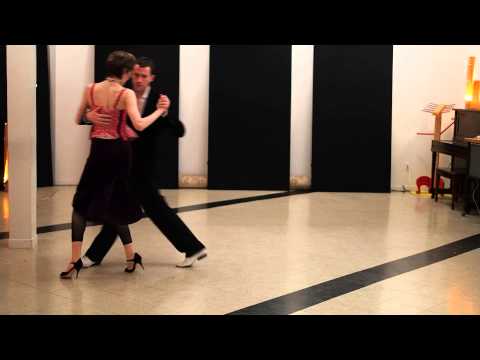

So I'll play that and then I'll play Esta noche me emborracho, which is a Di Cepelo composition and no surprise therefore to hear one of the most heartbreaking tangos ever. About a guy coming out of a milonga. You all come out of a milonga really late at night at four in the morning. We've done that. He comes out of my longer and he sees this woman in a terrible state and then he remembers, oh my god, that's my ex from way back, she's not in a good shape these days. So first and then which means tonight I'm going to get drunk. He sings tonight I'm going to get really drunk. I'm going to get absolutely wasted so I won't think about it anymore.
I want to play one more. Oh, no.
First of all, people were commenting about the L'enfardo, and Gerardo was lamenting that it's so rich in L'enfardo that really it's impossible to explain the lyric. You know, we could spend two hours talking about the lyric. It really is an exceptional lyric. But somebody was commenting, who was it was commenting? Silvia.
Me mamo bien. Now, amar, this is l'unfarro, but it's not. Mamar refers to the breast. So when a child suckles on the breast, then you would use the verb mamar. So, me mamo bien means it's an incredibly strong image. It's using the word in a different way. It means I'm going to suck on the bottle. I'm going to suck myself right down. One of the last lines of this tango, almost a violent image. Let's leave that, you know, there's hours of instruction for those of you who want to go away and investigate that tango.

A third 1942 Tanturi/Castillo track whose opening lines reference Afro-Argentine history.


I want to play one more from 42 of Tanturi, which is Moneda de cobre, Copper Coin. And the reason I want to play it, it's one of my favourite tangos because of the relationship between the music and the instrumental arrangement, which there isn't time to talk about now. But I just want to explain the opening two lines to you because I've had to, well, I haven't had to. But when you start to investigate the black origins of tango, things start popping up for you that you don't realise that in the music there's a lot of clues in the lyrics. For example, the opening two lines of Moneda de cobre, Copper Coin, run as follows. In fact, I'll just put them in the chat window, actually, so you can see them, and then I'll read them out.
Tu padre era rubio, borracho y malevo. Tu madre era negra con labios malvón. Which means, your father was a blonde, a drunkard and a bad man. Your mother was black, a negress, with geranium-colored lips. So, what's significant about that? A white person and an Afro-Argentine marrying. There's a deep significance to that because in the wars of, not the wars of independence, although also there, but later in the war of the Triple Alliance, the war against Paraguay from 1864 to 1870, black soldiers were sent to the front line as cannon fodder and died in their thousands, which meant that the remaining community in Buenos Aires was imbalanced.
Chapter · 3:10:23
Hidden History in a Copper Coin
A 1942 tango's opening lines hide a brutal piece of Argentine history.
There were lots of black women but very few black men, and that led to black women, black African Afro-Argentines, marrying into the white population. And that's what's hinted at here: your father was a blonde and your mother was a negress. Lots more to say about this lyric, but there isn't time.
Okay, here's our program. We'll have a bit of Lomuto, because Lomuto is really strong in 1942 and I think a bit neglected, and then we'll have a little bit of a D'Arienzo fest because it's a great D'Arienzo year, and then one louder instructor finish. Okay, that's our program. Now for the Lomuto I want to play two songs to you, both instrumentals. First Criolla linda. Criolla linda, it's a slow burner, you know, it doesn't grab you in the first five seconds, but slowly it gets you, and by 30 seconds it's got you, so give it 30 seconds, I promise you'll love it. And then Sentimiento gaucho, which is a very famous tango with many great interpretations, won the competition for best tango in 1925, but this version of the Lomuto stands with the best. So first, Criolla linda.

A second, instrumental Lomuto track played in the afterparty.


Paired straight after Criolla linda.


Another Firpo waltz from the year, played in the afterparty.
Very positive feedback from the public and looking at you, grooving out to Lomuto. So DJs, accept this feedback. The public really like that. Lomuto 42. It's good. It's a bit overlooked, I feel, because there aren't so many recordings. So as a little sorbet to clean the palate before we plunge into the D'Arienzo festival, we'll just have one track of Firpo. Dag played this lovely waltz earlier, Vals del recuerdo. But there's another beautiful Firpo waltz from 1942 and that's Elvira te quiero, I love you.
So now it's time for the D'Arienzo fest. There's too many good tracks, but I'm just going to play some tracks with Mauré. First of all, Mírame en la cara. Then Clarinete. And then I think Judas, or Judas I suppose we'd say in Spanish, much less well-known. But first of all, Mírame en la cara, very typical this of the sound that D'Arienzo is developing in 1942, spacious but still dynamic and powerful.

First of a short closing D'Arienzo/Mauré run.
Danced to it · 5 of 27

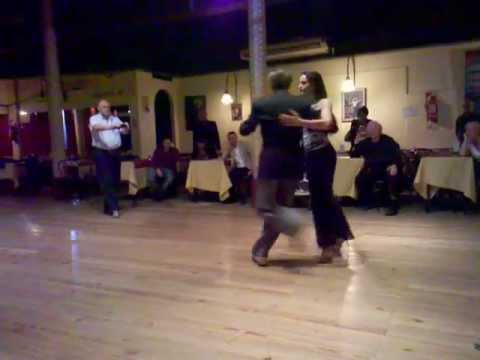


Announced straight after Mírame en la cara; the lyrics that follow don't clearly match this title.

Third of the closing D'Arienzo run, also unconfirmed by the audible lyrics.
Danced to it · 5 of 75


Well, after party people, we're coming near the end. Now, I'm going to play some Laurenz. And then I'm going to play something unexpected and then I'll play our theme tune. So, let's see what we have from Laurenz. I'm gonna play Es mejor perdonar to begin with, it's better to forgive, that's a good message, huh. And then I will play Taconeando. Now Taconeando is a, tacón means heel in Spanish, the heel of your shoe, so taconeando is about the clicking of your heels. Isn't that a Pedro Mafia composition? Yes, Pedro Mafia wrote this back in the 30s, so do search out Pedro Mafia's original recording.

First of a closing three-track Laurenz run in the afterparty.
Danced to it


A Pedro Maffia composition from the 1930s, played second.
Of course Mafia and Laurenz were friends and colleagues in Julio de Caro's orchestra from 1926 until whenever it was, I forget the years, 24 to 26, something like that. And then I mean there's more we could play, gosh, what time, look at the time now. I'm just gonna play three, I'll skip over some other fantastic songs, and then I will play the Laurenz Flores del alma, which in my opinion is one of the greatest waltz arrangements ever recorded, very hard to find in good fidelity. So that's going to be our Laurenz program, three songs: first Es mejor perdonar, Taconeando and then Al verla pasar.

Billed by Dag as one of the greatest waltz arrangements ever recorded; closes the Laurenz run despite his having said a different third title.
Danced to it · 5 of 10


So are you ready for this? The Laurence Flores del alma. I guess that half of you have never heard this. It's absolutely extraordinary. Full of the Laurence dynamic. Let's go.
A deliberately non-tango swing closer, chosen for its wartime resonance.
So guys, now a little song before our theme tune and I'm going to play the song We'll meet again, which was a hit of 1942. Of course, it was a hit because of the war and many people were separated for a long time. But we're also separated for less serious reasons, but serious reasons nevertheless. There are two, at least, good recordings from 1942. It continued to be recorded through the whole war period.
But in 1942, there's two great recordings, one from Penny Goodman with Peggy Lee on vocals. Again, like Frank Sinatra before she was a soloist, she sang with the dance bands. But I'm not going to play that one.
I'm going to play a swing version by Woody Herman, who was one of the big swing bands from 1942. So a serious message with a light interpretation.
Tango By Year is Dag Stenvoll and Michael Lavocah's, published here with their permission. The audio plays from SoundCloud.