Tango 1941
Dag Stenvoll y Michael Lavocah · 2020-04-09 · 1:59:57
Dag Stenvoll and Michael Lavocah spend their first Tango By Year on 1941, one of Lavocah's favourite tango years and the last year of the music's initial fast, rhythmical explosion. Troilo finally escapes a three-year dead-end record contract and signs with Victor, launching his breakout year; D'Arienzo, a year into a rebuilt orchestra arranged by Héctor Varela, is playing as fast as he ever will and gains singer Héctor Mauré. Biagi, D'Agostino, Laurenz, Caló, Fresedo, Di Sarli, Firpo and Tanturi are each finding or defending a personal sound, while Julio De Caro, tango's great modernizer, has lost direction chasing D'Arienzo's success and now makes music too undanceable for the milonga. All of it plays out against the war in Europe, which Buenos Aires' Italian and Spanish immigrant communities follow in the daily papers even as the tango world dances on.
Lo que este episodio dio a Tangopedia
Datos dichos en el episodio, cada uno citado al minuto en que se dice.
1941 is the year Troilo finally signs his record deal with Victor, after being stuck for three years in a dead-end contract with a label that would not record him.
1941 is the last year of tango's accelerated, fast-tempo explosion that began at the end of the 1930s, playing out while first- and second-generation Spanish and Italian Argentines followed the European war daily in the papers.
By 1941 D'Arienzo had lost his whole orchestra over money; the new band, a year old, was arranged and run by Héctor Varela.
The orchestra D'Arienzo lost had recorded La Bruja, Pénsalo bien and (probably) Mandria; none of its members carried over into the 1941 band.
Mauré joined D'Arienzo in 1941 as a young singer with a rich, creamy voice that would have a big impact on the band over the following years.
Discos que suenan · 24
Transcripción
Transcripción automática del audio, luego puntuada; puede haber nombres mal oídos. Toque una línea para escucharla. El episodio es en inglés, y su transcripción también.
Well hello everyone and welcome to 1941. I'm Dag Stenvoll and I'm talking to you from Bergen, Norway, and with me I have Michael Lavocah from Norwich, England. How are you there, Michael?
Hi there, Dag. I'm very excited to be here and to be part of this initiative. I'm so happy you said yes to this. It's a funny thing, but I have a lot of free time. Yeah, I don't know why, I was just thinking.
Yeah, anyway, uh, many of you listeners already know Michael, of course. You've read his books or listening to his lectures, and in his five must-have for tango lover books, Michael follows the orchestras from start to end chronologically, spanning many decades from 1920s or even earlier to the 1960s and 70s. And in your lectures, Michael, you also started to talk about instruments across orchestras, like when you were here in Bergen in January you had talks about the piano in tango, you talked about the bandon on in tango, and I also heard you at the Remolina festival just before that talking about the violin in tango, and now you also have lectures on other instruments, a double bass. Yes, even did a double bass seminar for the first time. Great, yeah.
Now, so the idea of this event is a little bit different because we're going to listen to and talk about tango music just from a single year, 1941. And what were the different orchestras, what they were recording at the time and what was typical of this year. And I chose 41 because it's one of my favorite tango years, but there are many favorite tango years. But there's a lot of good stuff from 41. And I think it's a good place to start if you are tango geeks like us, Michael.
And I'll soon give you the chance to tell you what you think about 1941 and what's special about it. But just past part of this introduction, a couple of more practical things. First, the format of this Zoom event: I'm doing this introduction and I'm selecting as well as playing the tracks, but Michael will be doing most of the talking after this intro, and the plot twist here is that Michael doesn't have a clue what I'm going to play, not the songs, not even orchestras, nothing. So the idea here is to have like a free, informal and rather spontaneous conversation about music from 41. Keep music live, that's what. Yeah, exactly. So just really informal atmosphere, and this is not an online milonga, of course. You play lots of nice music and feel free to dance by yourself or if you have someone there with you. Neither is it a lecture. So what is it? I think of it as a night of listening to some wonderful music together from this exquisite tango year 1941 and to have the world's most knowledgeable man on tango music sharing some thoughts with us. We are really lucky.
So Michael, 1941, why do you think that I as a tango DJ and music nerd would pick 1941 for an event like this? What's the characteristics?
If we say 1941, the first thing that comes into my brain, I think to most people who know a bit, is Troilo, Fiorentino. It's the year when Troilo signs his record deal with Victor after having been stuck in a dead-end contract for three years with someone who wouldn't record him. And we're still at the time when tango music is being played fast. It's the last year of this accelerated initial explosion of tango that takes place at the end of the 30s and the beginning of the 40s. And that of course is related to what's happening in the world at the time, which is the political situation in Europe. The world has been moving towards war and the Argentines and first and second generation Spanish and Italian people following the news at home on the front page of the paper every day. And now the war's been going a year and a half and they're dancing the night away while Europe is blowing itself to bits. So it's a very intense experience.
Capítulo · 4:15
The year Troilo finally got his deal
Three years stuck in a contract that wouldn't record him. Then 1941 happened.
“The war's been going a year and a half and they're dancing the night away while Europe is blowing itself to bits.”
So Troilo leads us to 1941, but D'Arienzo is also at a peak. A lot of orchestras are in their best times. Yeah. Yeah. I think we'll start with D'Arienzo because he kind of defined the five-year period leading up to 1941 with his revolution and the rhythmical tango that was part of this first period of the so-called golden decade of tango. So what's, uh, what was Juan D'Arienzo doing in 1941?
Well, the first thing to keep really clearly in mind is this is not the orchestra that's made him famous. So the orchestra that played La Bruja, Pénsalo Bien and Mangria, it's gone. He's lost his entire orchestra over money and this is a new orchestra. Well, in 41 it's a year old. I like to call it the D'Arienzo Varello orchestra because Hector Varela is arranging the music and running the band basically, and it sounds really a lot different to the band that we heard before in the late 30s. So D'Arienzo is getting more sophisticated but he's still playing really fast. So the end of 1940, beginning of 41, he's playing fast, this is as fast as he gets. Who's singing for him this year?
Well, at the beginning when he starts with this new band it takes him a while to find the right singers. The big event in 41 is the arrival of a young singer called Héctor Mauré, who's got a really rich and creamy voice that's going to have a big impact on the band in the next couple of years and change the way it sounds. Good. I picked a recording with Mauré as the first tango. So that's good. I picked actually the first recording from April, it's called Ya lo ves, I see her. And the second tango we're going to listen to is an instrumental called El resero. It was recorded later in November. And I really like this one because of the violin playing during the last 30 seconds or so. So let's listen to these two songs.

The first recording with D'Arienzo's new singer Héctor Mauré, whose rich, creamy voice would shape the band for the next couple of years.
Lo bailan · 5 de 11


♪ Música · 2:46 · La letra, en la página del tango

Picked for violinist Cayetano Puglisi's solo in the final 30 seconds, which Lavocah compares in his book to the sound of a bee.
Oh, that's a sweet violin, isn't it? I think you wrote in your book, Michael, that it sounds a bit like a bee, don't you? I think he sounds like a bee. Cayetano Puglisi. Sorry? Cayetano Puglisi is the name of the... Oh, right. The violinist. Well respected musician, had his own band back in the sextet times, but it didn't become big. So D'Arienzo and Monofo, he couldn't refuse. Yeah.
Capítulo · 13:13
The bee in the violin
Listen for the bee in the last 30 seconds.
You said also the whole band was new in 1940 and of course the pianist was new. And the next band we're going to listen to is D'Arienzo's pianist from 1935 to 1938, Rodolfo Biagi, who was very defining for the D'Arienzo sound. And luckily for us he started his own band when he was fired by D'Arienzo in 30 years. Very quickly he got fired at the end of June and he was recording in the studio already in middle August. Maybe he already had a feeling that D'Arienzo would kick him out. Some people think so, yes. Anyway, what was Biagi doing in 41? What was his sound? Or what can you say about D'Arienzo?
Capítulo · 14:15
The pianist who got fired and landed on his feet
D'Arienzo's star pianist got fired in June. By August he had his own band.
Well, you know, the Biagi sound doesn't really change very much. So, yeah, it's a little bit slower than it was when he starts in 1938, but it's the Biagi sound, which is this super sharp marcato, even sharper than the D'Arienzo marcato. And for the orchestra as a whole, trying not to feature the piano too much. He doesn't want to be the star. Yeah, he wants to play, but not to be the only star. I often think that what Biagi did with his orchestra is take this quality of surprise that he gave D'Arienzo and then thought, well, I'll make the whole orchestra do something surprising. So that's the whole thing with the offbeats in Biagi, isn't it? We never know when they're coming. And that's a lot of the fun. Yeah.
So Biagi, he sang with Jorge Ortiz in 41. And he also did some really nice instrumentals. And we're going to listen to first an instrumental called El entrerriano and then a composition by Biagi himself, Humillación. Enjoy.

An instrumental chosen to show Biagi's super-sharp, surprising marcato, with the piano filling in everywhere without dominating.
Lo bailan · 5 de 29


♪ Música · 2:51 ·

A Biagi composition sung by Jorge Ortiz, played to show the bandoneón's low tremolo under the vocal and Biagi's trick false ending.


That's a special ending there, isn't it, Michael? It's crazy. And what's the, they say in opera it's not over till the fat lady sings. It's just, it's not over till it's over. He's playing with us, isn't he? So it's really hard to hit all the offbeats in Biagi, but if you don't get it right it doesn't matter, just laugh. Yeah. There's a lot of Chris Piano playing in those songs, also the instrumental one. Yeah, the piano is everywhere but without dominating, which I like. The marcato is just crazy. And the way the violins, and it's violins, bandagnons are not dominant in this music. Not in 41 anyway. This super, super sharp marcato. I love it.
“It's not over till it's over. He's playing with us, isn't he?”
Did you notice when Ortiz begins to get into the first point where he sings, I hate this love? And underneath the bandagnon, the solo bandagnon is playing with this low tremolo. Wailing. Good connection with the music. We'll talk more about that when we hear Troilo maybe. I look forward to your choices.
OK, let's move on to the next one. This is also, I think we're going to stick to the piano conductors. This is one that hasn't been recording for a while. You mentioned him just before we played this, D'Agostino, because he's also a piano player and he wasn't really a person in this D'Arienzo phase, was he?
He started recording in the end of 1940 so he entered this new phase quite directly. Yes, and it's he always gives nice, nice melodies, although in a soft way. And he records in 1941, he recorded two numbers in November, I think, 1940, and then it was 12 tracks this year, 41, and they're all vocals with Vargas and they're all classics that most people know. Tres esquinas and Jacare, you name it. Listen to Tres esquinas and also to El Choclo actually, which is a...
You said there was a difference between the first and the last recordings. Well, this is from July. He didn't record the first half of the year. I don't know why. But he started in July and then he recorded through December. So El Choclo is, of course... Sorry. El Choclo will be particularly interesting to listen to. Okay, so Tres esquinas first and then El Choclo. D'Agostino.

One of the D'Agostino-Vargas classics most dancers already know, from the first batch D'Agostino recorded that year starting in July.
Lo bailan · 5 de 144


Stenvoll changed his mind and played this dialogue song instead of the planned El Choclo, to show D'Agostino's softer, more relaxed sound after the high-energy tracks before it.
“If you had played those two songs the other way around, it would have been different.”
You changed your mind, Dag, you played Adiós, Arrabal. Yeah I did, I did. It's a great song I said, this dialogue song. As soon as the D'Agostino came on, before you played this very high energy music, it's a high energy year, mostly. And I was at the front of my seat and then D'Agostino came on and I started to move. And after 10 seconds, I noticed I went, oh. Relaxing. Relaxing.
And Gabriela asks a really good question. Where does D'Agostino fit? Is he a traditionalist or an evolutionist? Well, let's think about it. How many, how complex was what we listened to?
There wasn't really anything in the way of counter melody, there was only one thing to listen to at a time, so he's traditionalist in that sense. Very close, well, I don't know how close, but a personal friend of D'Arienzo from young. But it's the way he manages that, only one thing to listen to at a time, that's really great. He moves it around the orchestra really fast and that's something that you could enjoy very easily in Adiós, Arrabal, a masterpiece, the conversation. So this dialoguing, you get that a lot in Canaro, for example like in Poema. But in Canaro he sets up a dialogue and then he keeps it going. Like you get minor and then the violin answers and then it just keeps doing that, whereas D'Agostino changes it every time.
What about the time flavor of D'Agostino? You said he slows down a bit, but it seems to me that his music with Vargas is pretty much the same. Maybe it gets a little bit slower and darker towards the mid-40s, but it's not a big change, is it?
In terms of speed, no, not at all. But the two tracks from 1940 are much faster. Another question, do I agree, is a huge have-to-have sound.
What I'll say about that is that D'Agostino is played way more in Argentina than it is here. I remember going the first time in 96 and you heard at least one tander of D'Agostino in every milonga.
Why is that?
Well, I think it does for them in a way what Canaro does for us. It's, from their point of view, quite accessible, but it's more interesting to listen to than a lot of Canaro. There's a bit more flexibility about the beat, for example. So, yeah, I love it. And I'd love to hear more of it.
I think we're a bit frightened of letting energy drop in milongas and especially in marathons. That's the cardinal sin, don't let the energy drop. So then maybe we're a bit frightened of playing D'Agostino.
Yeah, but I like the contrast to put this kind of music in between the more energetic ones because it creates really nice contrast for dancing. It does and it lets you take a breath.
Speaking of energy, we'll go to a more energetic orchestra. Troilo. This was the big year of Troilo, wasn't it? After the two recorded tracks in 1938 and then finally he gets to record lots of fantastic music in 1941. Who knows what he was playing in 1940?
Well, some of these songs that he records are hits that he's saved up from his back catalogue and others are new. So yeah, but it's still a fresh young band but maturing fast. Yeah. We'll listen to two songs you've heard a lot before, all of you, and you've danced to a lot, I think too. It's difficult to get around that when you play Troilo from 1941, they're all played a lot. So we'll have a regime, you can say that better than me, maybe, Michael.
El bulín de la calle Ayacucho. It's a vocal, but with Fiorentino.
And a bulín, we should explain what a bulín is. A bulín is a small room that you might rent either to meet with your friends because people lived at home with their families until they got married, just for economic reasons, as they still do quite often in Italy. So to meet with your friends or to meet with a girlfriend, you needed somewhere else. So that's what the bulín is and the lyric describes a particular bulín, a real one which was owned by the lyricist Cadicamo and what they did there. There was the guitar hanging up there, there was a little primers stove, a little gas stove where they could make the matter, so it's very nostalgic, great.
The second one is an instrumental, it's a great uh song full of energy, I think, Milan guando and L-40. So we'll listen to this too. I'll talk a little bit more about Troilo afterwards.

One of Troilo's best-known 1941 recordings, with lyrics by Cadícamo describing a real room he and his friends used to rent.
Lo bailan · 5 de 51



♪ Música · 1:55 ·
An energetic Troilo instrumental played to show the band's more complex music: the left-hand piano runs, a David Díaz violin solo, and a true counter-melody from second violin Barrales.
It's much more complete music, isn't it? There, yeah, elements, there's, um, there's a lot of dynamic in the music, change of volume, change of color, that's a word especially jazz musicians, jazz musicians would use, change of musical color. If one is able to follow what Gonyid is doing in the left hand, there's often, we're listening for the right hand of the pianist, but the left hand of the piano is so important for dancing because bass notes are what you walk on. It's doing the job of the drums in pop music and it's elastic. He doesn't go bang bang bang with the left hand, he does these little runs and it makes the music very fluid.
Music's more complex as well when that beautiful violin solo came from David Diaz, the second violin Barrales is playing underneath but they're not playing a simple harmony, he's playing another line, true counter melody, so much more complex, complete music. And this is just for the first year of further, I mean, it's a, it's a fantastic start in terms of, well, it's from, we think of it as his first year but of course not his first year, it's his fifth year because he started in 37.
Someone's asking me, just give a bit more background about the, to orient towards this orchestra. So this is an orchestra that's in a way following in the line of De Caro, not copying De Caro but wanting to make music more complex and interesting, and Troilo's stated mission was to make his orchestra sound like Gardel. So the way Gardel made his phrases as a singer, he wanted his orchestra to phrase that. So yeah, complex music but often at the service of the lyric.
And there's a really interesting question from Birger. So Birger's asking, you know, there's all this new repertoire coming along, did the orchestras still keep playing the old repertoire like two years down the lane? What was Troilo doing with these songs in 43? And we don't really know. It's a really interesting question, isn't it? We don't really know, but we can get some clues. So if you take say a D'Arienzo song like La Chola, you can compare the 42 and the 46 recordings and you can hear that the arrangement is the same and the tempo is almost the same, but the feeling is quite different.
There was new repertoire coming along all the time, so you had to drop songs from your repertoire, so you were keeping like your greatest hits because the public would ask for them anyway, and you'd have all these songs memorized. There was no sheet music on stage, pro orchestra, people quote different numbers but a common number we hear is 120 songs ready to go without music. So new repertoire is coming in, you're learning new songs, songs are dropping out of the repertoire, the big hits are staying. Did you probably would play them a bit differently because the zeitgeist has changed, even if you tried to play it the same you couldn't play it the same because you're two years older, you've got two different years musical experience.
Very exciting music. Make a little bit of leap maybe to, you mentioned, I think, De Caro, and I was thinking about because we played the D'Arienzo and Troilo and we're gonna hear some Di Sarli later obviously. We're not going to hear Pugliese tonight of course, he started recording in 43, but what was Pugliese doing in 41? Was he doing the same as Troilo was doing in 39? Playing concerts every night in Buenos Aires?
The band is going. The band started in 39 but they're not famous so they're playing in small venues. The real question is what did it sound like? And the answer is, we know the answer because there are some radio transcription discs. So during a radio broadcast like you're recording this now, they used to have big vinyl acetate discs. And they would rather go El Mundo, the big radio station, would record these programs live. And some of these survived into the modern age.
So we can hear a couple of songs from Pugliese in 1942, more than a year before he starts recording and you can hear he hasn't really got his sound yet, which shouldn't be too much of a surprise because how he sounds in 43, Farol, first tango he records with Chanel, very beautiful, very lyrical but it's not the Pugliese style really, is it? If we say the Pugliese style is la jumbo malandraca negraja, he hasn't discovered that yet. So actually I'm not too upset that we are missing Pugliese from these years, of course love to hear it, be interesting, but I'm not too upset about that. I'm much more upset about the fact that we don't have Troilo from 38 to 41.
Yeah, but what about De Caro? I mean, he was an inspiration for Pugliese, but we don't really hearing much at milongas. Why is that?
Because, um, gosh, so many reasons, but in terms of the music that you've got now in 41, he's just lost the plot entirely. Sorry, guys, if there's any big De Caro fans listening, but De Caro is completely disoriented by the D'Arienzo phenomenon. So De Caro has dedicated his whole life to making tango music more interesting, to increasing the resources that are available for tango musicians and tango bands to make music. At great personal cost, his dad threw him out of the house when he was quite a young man. And it was more than 20 years before his dad came to one of his gigs and they were reunited.
Capítulo · 44:51
The orchestra nobody could dance to
He invented modern tango. By 1941 he'd lost the plot.
So he really suffered a lot personally to do what he did. Then this guy called D'Arienzo turns up, looks at the work of the past 15 years and all this complex music that's been played and says, nah, not interested. Goes back to the repertoire from before. De Caro completely rejects everything he's done, plays the old stuff more or less in the old way but up tempo, more modern, sharp beats, and everybody loves it.
So De Caro just doesn't know what to do. So he starts playing faster, which doesn't really suit him. He tries different kinds of musical experiments. I mean, of course there's interesting stuff in there, but he just doesn't really know what to do.
Let's listen to one De Caro song just to see what you're talking about, since this is not a milonga, we don't have to dance to it. So this is one called No me pidas la exclusiva. It's a song with the singer Héctor Farrel. So let's see what it's doing in 1941, De Caro.

Played to demonstrate De Caro's missing marcato: the double bass just plays another melodic line instead of marking the beat, so dancers lose the pulse.
♪ Música · 1:57 ·
I think that tango answers your question. Yeah, I don't think it's too bad, actually. I could have danced to this one. I'm not saying it's bad. I'm saying, where's the marcato? Marcato is marking out your four beats. D'Arienzo style, one and two and. Di Sarli style, one and two and. Pugliese style, one and two and. What's the De Caro marcato? Because that's what we walk on. That's like the structure that underpins the music. What's the De Caro marcato?
“There isn't one. There isn't really a marcato. That's why you can't dance it.”
There isn't one, there isn't really a marcato, that's why you can't dance it. Very interesting. So much to listen to, but, and we could dance with it but you're kind of extracting the beats from the treatment of the melody, and the role of the double bass is completely different in this orchestra. It's just another string instrument that happens to make deep notes, whereas say in an orchestra like Di Sarli the role of the double bass is to make the marcato. The double bass isn't doing that in this orchestra. This is why it's not played at milongas, because for songs like this, people wouldn't be dancing. Most people wouldn't be dancing.
No, you lose dancing energy. It's very interesting. And I'm also, you know, I'm touched by it. So it appeals to my head, gets down to my heart, but it didn't get any lower. Yeah, it has to get down there, doesn't it?
But he gets better. I mean, you said he doesn't fit really D'Arienzo style, but what about this later, more lyrical, slower period? Does he make a comeback or like later?
Yeah, this is in 48 or 49. So there's four years where he retires from the scene completely. And he has some problems because he leads a union strike of musicians for better conditions. And he has a lot of trouble for that. And then when he comes back he makes about 20 recordings and they sound completely different. This is maybe a topic for another time or for another year, but then the music sounds different. It has a lot more warmth and what I hear there is that De Caro has been influenced by his own disciple Pugliese. Pugliese has shown De Caro a different way to play his own music. The De Caro for instance or if you want to stick with the really complex ones the Aníbal Troilo, the song that De Caro wrote as a homage for Troilo, very complex and interesting but danceable. But for me that's my favorite period. De Caro as a dancer and for listening my favorite period is that late 20s period when he's got Mafia and Laurenz on Bandignon.
Speaking of Laurenz, let's listen to some Laurenz. Yeah, I knew it's a favorite. So, but he didn't record much studio, I mean he was, he wasn't very super productive in terms of recordings. Why is that?
Because his music is not very commercial. Laurenz wasn't interested in being commercial. He just wanted to make his music and it's avant-garde, it's, um, more daring in some ways than Troilo's music, so it didn't sell that well to the public. We love it now and we think of it as a major orchestra, but at the time it was not a major orchestra, it's in the second tier.
Okay, we listen to two tangos. One is, you've heard a lot of times, Orgullo criollo, which is very, uh, yeah, what you say, it's very inventive and a lot of interesting rhythms. The other one I just rediscovered the other day, I didn't really listen to it much and I don't think I've heard it play much in the milonga, it's called Quédate tranquilo. It's with the singer Martín Podestá. It's very hard to get a good transfer. Yeah, it's not on Tango Tunes, so the version I'm going to play it has lower sound quality than the others, but I think it's interesting and this is not a milonga, we can listen to it and see.
And Martín Podestá, it's not the brother of the other Podestá, is it? No relation at all. Because they were just artist names. Of course there is that, it's just stage names anyway. So okay, let's listen to Laurenz.

A well-known, inventive, rhythmically rich Laurenz instrumental, chosen to show how he made De Caro's complexity more danceable.
Lo bailan · 5 de 10



♪ Música · 3:00 ·

A rarely-played track Stenvoll had just rediscovered, only available in poor sound quality, recorded near the end of December.
It's a pity we don't have that in really good sound quality, isn't it? It's a pity we don't have a hundred more recordings from that year. I mean, imagine what they must have been playing like. But it seems more, the last song seems more like less energetic, less than the earlier Laurenz. Are we seeing the transition here during the year? Because this was recorded in December, this last one. Well, I guess that we are, but there's still a great sense of dynamic.
So Alexander, Alexander Pashkikovsky's comment was about the energies of especially of Orgullo criollo, and it does have tremendous energy. And one of the ways that it achieves that is because of the sense of dynamic, the change of volume that Laurenz does. That's an ingredient that D'Arienzo isn't using in his music. And I don't know if you all noticed, but what I'd just love to listen to Orgullo criollo again now and just listen to the left hand of the band, the bass notes, because there Laurenz is really strong and powerful, and the amount of color. You can hear he's playing quite complex chords, not just, you know, like the three note chords that rock guitarists learn. It really rich chords on the band and young, very interesting. So here with Laurenz you've got another answer to the question: how do you make the De Caro more danceable? Laurenz is one answer, and the most direct answer, because he stayed with De Caro from 26 right through until 34, so he's like the direct descendants of that line but trying to make it more danceable. Yeah, and taking more risks, I think.
Let's move on to another orchestra that also didn't record much between mid-30s and 41, which is Caló actually. And Caló did a few recordings in the early 30s and 36, and then he had one recording, I think, or one recording session in 38, and then he didn't record again until March 41. What happened with Caló?
Capítulo · 1:00:53
Argentina's only two record labels
After 1931, tango had just two record labels left - and one of them barely bothered with you.
What you see in 1938, in there are two record companies in Buenos Aires, RCA Victor and Odeon. All the others were wiped out in the crisis of 1931. So if you want to make music, you have to sign with one or the other. And they have different policies about signing new artists. RCA Victor, before, back in the 20s, they took a lot of risks and they signed a lot of new artists, and then they got their fingers burnt, we say in English, and they had to fire a lot of people. So they changed their policy and said, no, we're not going to take so many risks now. So if you were a new band in the late 30s, your best chance of getting signed was with Odeon. And what Odeon did was they signed you up for three years, it's a three-year contract. But that didn't mean we're going to promote your music, it meant we'll put out a record, and if it's successful we'll print another one, and if it's not we won't.
So they say I happen to call us to as to Troilo actually, as to Troilo, and not the only one. Tanturi is the same, Demare is the same. They're all in this limbo where they can't record because they're signed to Odeon, and Odeon's not promoting them. They should have been taken to court. Well, and of course eventually in 1950 the Argentines come up with their own answer, which is to start their own record companies. But that's still a long way off. So we recorded four songs in 41, and one of them is, um, is a vols and another is a polka and then two tangos. We're not going to listen to the polka. We're going to listen to the walls, which is called And we're going to listen to Which is a very known song that's also recorded by Troilo the same year. But I want to play the Caló version, so let's listen to those.
One of only four sides Caló recorded in 1941 after years stuck in Odeon's contract limbo; Stenvoll played the vals from that session.
♪ Música · 3:20 ·
A well-known tango that Troilo also recorded the same year; Stenvoll chose to play Caló's version of it.
Nice ending, a Caló ending. Typical Caló ending.
It's interesting to listen to that tango because we don't hear it so often, do we? I think there's two reasons for that. One is, as you say, because the version from Troilo is better known. And there was a little bit of competition between Troilo and Caló, and some people would describe Caló as a kind of Troilo light. It's a very smooth sound, it's quite complex but in a subtle way, you don't necessarily notice the complexity. So at a certain point the marcato, the backbeat, was doing the 3-3-2, but it's not right up in your face, and you don't necessarily have to notice it or to dance to it. So quite a lot going on, but very smooth. But I also feel it's not quite fully formed. It's going to sound more Caló next year. Next year, yeah, when it gets baron on. When it gets baron and it finds a sound that's really unique. Yeah. And the piano's everywhere in that. You can hear Moderna on the piano all over the keyboard, really a backbone.
Yeah, orchestra and development that's different. Listen to something also. I don't know if you characterize the Caló as romantic. I think it's kind of romantic orchestra, isn't he? No way, he's romantic. Yeah, it's like a cross between the romantic stream of Fresedo and Di Sarli and the stream coming from De Caro and Troilo, somewhere in the middle. Because Fresedo, he's one of the diner souls in tango, isn't he? He's been recording since the early 20s, at least, and like a lot of music. And he's not that affected by the D'Arienzo revolution, is he? Just keeps doing his thing. Mostly. He keeps doing his thing, yeah. Until, yeah, certainly until 38, 39.
He's made a choice. He made a choice a long time ago not to follow the crowd. So he didn't do the same thing as Canaro that started to try to sound like their answer or whatever, and it wasn't really successful. Well, Canaro also held his nerve if you think about the period with Roberto Maida that lasts until the end of 38, and it's only after that that he loses his nerve and changes his sound. I think dinosaurs not really fair on poor old for us. We play a couple of songs and it's a different, it's much more smooth than D'Arienzo's song at least, that's for sure. Listen to Vamos corazón. Come on Heart. That's a good title, isn't it? And Buscándote. Looking for You.

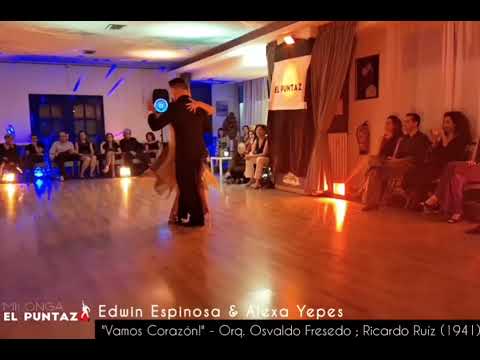
Played to contrast Fresedo's smooth, romantic sound against the high-energy orchestras heard earlier in the evening.
Lo bailan · 5 de 7




♪ Música · 2:21 ·

A deeply characteristic Fresedo mood piece, recorded on the last days of the year and, Lavocah notes, probably the last 1941 recording played that night.
Lo bailan · 5 de 299


If you had played those two songs the other way around, it would have been different. What way? Because, like, imagine I'm a diehard D'Arienzo dancer, and that's my favourite. Then the first song came on, and I could have kind of ignored the romantic feeling, and just concentrated on the tempo and the beats, and danced it in a D'Arienzo kind of way, if I'm not so sensitive in my romantic side. But with Buscándote, okay, which is a special song, but it's also a song that is really deeply in the Fresedo mood. It's not just a special song, it's more different to other orchestras. So suppose again I'm this die-hard D'Arienzo dancer, the tanda begins with Buscándote and I'm not talking about DJing here, I'm talking about our listening experience right now. It creates an atmosphere and I'm not going to make the mistake of just dancing to it like I do when I'm dancing to D'Arienzo. Yeah, good point. I guess the reason I play them that order was that this kind of days recorded on the 30th of December that year, I thought they would be so nice. It's sort of it's probably the last recording from that year that will play tonight as a DJ. What do you play after that anyway? You know, nowhere to go. Yeah, yeah, you have to mix it with other years, I think.
Anyway, anything more about Fresedo or should we move on the other instruments? Yeah, yeah, jazzy instruments. Yeah, well, when we say jazz I think we need to say what we mean, because the word jazz covers a lot of ground. So I think when we say jazz, it's got quite a broad meaning there, it means the same kinds of instruments you would find in North American and especially European bands at that time. So not jazz in the modern sense and not jazz in the sense of swing music, but jazz in the very broadest sense of the word jazz. Let's say actually European instruments or northern hemisphere instruments rather than just jazz, because the harp is not really a jazz instrument, is it? And the role of the piano is different, I don't know if you could notice that. But the piano, he's not comping away setting up the marcata, he's filling in gaps in the melody, it's almost like doing the same job as the harp. Vibraphone, how does the vibraphone sound? Um, it's these little notes. Vibraphone is like a metal xylophone. Did you play xylophone in primary school, all the little wooden blocks and you go lots of little decorative? Okay, let's listen to two other orchestras in a row that are not so much played, or their music from 1940s are not so much played.
That's Francisco Canaro and Francisco Lomuto, and they were friends, weren't they? And I mean, for DJs to play 40s Canaro, it's not something you usually do, it's kind of considered really bad music after 1938 actually. And especially, I mean, we're joking about this, Michael, especially his versions of or his versions of the songs known by Troll or like, and it's a Tardegris and Toda mi vida, and compared to these other versions it's just horrible. But I found one song, and since you're writing a book on Canaro, aren't you? Canaro's two? Yeah, your next book. So I found one song that I think it's okay, and it's not recorded by other orchestras as far as I know, so that makes it a bit different for me. And Lomuto, for me it sounds that he's been able to keep more the, I don't know, the softer, softer sound than Canaro. It's not as hectic as Canaro is. So we listen to Papirusa by Canaro, it's an instrumental, and by Lomuto, which is from August, when the milonga cries. I'm glad you're playing that, it's beautiful, isn't it? Yeah, let's listen to those two, Canaro first and then Lomuto after.

Stenvoll's one exception to his rule against playing Canaro from this era: an instrumental he felt was good and not recorded by other orchestras.
♪ Música · 1:00 ·
A track Lavocah calls a perfect three-minute story, building to a beautiful climax, and an underplayed example of Lomuto's work.
That's also a lot of other instruments than you usually hear in tango, isn't it? Yeah, but they give a nice colour. I mean, but so, like you say, there was a relationship between Canaro and Lomuto. Like, Lomuto apprenticed himself a bit to Canaro when he wanted to learn how to do a band. But those two were really very different. Very different. The Canaro one is light, it's like it entertains but it doesn't, I'm not touched, I'm not touching my heart and I'm not excited either, it entertains, it works. The Lomuto one is a completely different story. I think that track and that period of Lomuto is really underplayed. Well, that there's very few instrumentals actually, so constructing the tanda is a DJ bit of a challenge. But it was a perfect story in three minutes, it really changed throughout the three minutes, there was a lot of musical color, and built up to a beautiful climax. I enjoyed it a lot, it's nice.
Yeah, okay, let's go back to some more core stuff. Let's listen to this early, what was this are doing in 1941 being successful. So he'd arrived back in Buenos Aires in 38, started his orchestra, right back from where we don't know, he kind of just goes off the map for a while. Yeah, it disappears, we don't know. End of 38 comes back, during 39 he finds the Rufino, first recordings are, what is it, 21st November 39, end of 39, Corazón. And in 1940, the orchestra is really successful, more successful than Troilo maybe, in 1940. It's called the Orchestra of the Year. It's beginning to affect D'Arienzo's Monopoly. So D'Arienzo doesn't like that. And the sound is maturing. So again, this is the 1941 evening, so we're not going to hear tracks like Catamarca, one of the first instrumentals that Di Sarli does that's very jazzy and very fast and very complex. The music's already matured quite a lot. I think in a really good place, and the instrumentals particularly from this era, I think we're going to get to know them better because the later Di Sarli, whether it's the very late instrumentals on Victor, they're so shiny. And now Tango Tunes have published the early 50s ones on Musical, and they've got a really powerful bass beat that's great for dancing. Love those. So if you're, as a DJ, picking a Di Sarli instrumental tanda, you've got lots of competition before you turn to the year that we're looking at now. But it's really, really tasteful.
Well, let's play an instrumental. I would play Marianito from May. It's a very choppy one, like this really choppy Di Sarli. And then from later in the year, Lo mismo que antes with Rufino from December, which I find much more lyrical. So we'll hear the contrast. Not so much played.

A choppy, energetic Di Sarli instrumental from May, played to contrast with the more lyrical December track that follows.
Lo bailan · 5 de 21


♪ Música · 3:00 ·

A far more lyrical December recording with new singer Roberto Rufino, showing how quickly Di Sarli's 1941 sound matured away from his choppier early-year, D'Arienzo-like tracks.
Lo bailan · 5 de 17


That's nice, isn't it? It's so beautiful. I love this. Beautiful. Lots of syncopation, so lots of jazzy touches from Di Sarli's piano, especially in the left hand.
Just the opening of the two songs creates quite a different mood. Actually, doesn't it, that when the second song came on, Lo mismo que antes, immediately established a much more romantic mood than Marianito did, long before Rufino came in? Yeah, yeah, and it's very much more lyrical than the 1940 recordings, which sounds almost, some of them sound more like D'Arienzo style, I mean very much more faster and more choppy. Yeah, I've met people who've listened to isani from 1940 and thought it was D'Arienzo. You can tell the difference, of course, because it's more complex, and yeah, there are ways to tell, but yeah, he's kind of escaping the gravitational pull of D'Arienzo, if you like, establishing his own voice. He's sure of himself, he's been in the game for 15 years or something, so that's okay.
Let's, we have a little time left, so we'll listen to two more orchestras, and before we end with Tanturi, I think we'll do that at the last one because it's a great orchestra. We'll do a detour by another old orchestra, Firpo, so that'll be interesting. Expecting to hear him tonight. Nice, yeah, what do you think about Firpo and what's he like in 41, because he's also one of the like all orchestras been orchestrating for many recording for many, many years? What about 41?
Well, Firpo is the orchestra that we know the least, I'd say, and it's the second most recorded orchestra, 2,800 tracks of Firpo, so there's a lot. And I don't know what you're going to play, but if it's a tango, we can certainly say that it's not going to be typical of Firpo's output, because Firpo's greatness is a bit like Canaro's greatness, really, it lies earlier in the 30s. So Firpo is also now beginning to be panicked by the D'Arienzo phenomenon. There's a story of him rushing up to his pianist, who was Carlos Garcia, and saying, what are we going to do, something, do something to try and keep his music relevant. So it's not going to be his very best, almost characteristic period, but it's still interesting musically.
Well, he only recorded four tangos with his full orchestras in 41. I mean, he did all these Quarteto recordings. I really don't like those. They're very special in sound. But is Fantasma one of them? Are we going to hear Fantasma?
No, that's not from 41, actually. I love Fantasma, but it's not 41. I can't remember which year, but it's not 41. But we're going to hear two instrumentals, La Chola from September and El talento from August. Most of you won't have heard this before. I think they're nice. They have this kind of interesting sounds, piano playing is nice. So said, so let's listen to them, El talento and La Chola.
It's very entertaining, isn't it? Poor Biagi, says Sascha. That's a good comment. Yeah, it's entertaining, it's a lot of things happening, piano is going crazy. What was the pianist you said, isn't it this is Firpo by himself? No, he's stopped playing a long time ago and he's conducting. Yeah, I think probably it's Carlos Garcia at this time, but this becomes a style, doesn't it, playing that, the piano in octaves, so you're playing a run using both hands an octave apart or D'Arienzo, you see what Juan Polito with his fingers held an octave apart going bang, bang, bang. That's a style, all the orchestras are doing it.
So like you say, there's only, did you say four tangos recorded with his orchestra out of those 2,800 in this time? So I'm guessing that of the people listening, in a few will know Firpo's earlier work, but a lot of people won't know it very well. And if I think about Firpo, I think of El amanecer, he wrote El amanecer, so it's romantic and often a little bit melancholy, a little bit of darkness in his music. So when I listen to this modern Firpo, it's Firpo trying to keep up with the developments, that's what I hear. I hear him trying to keep up.
Yeah, there's a question from Bigger says that it feels like they lost with Lomuto and the car, they've lost that sense of what's considered relevant dance music, that they sort of lost touch with the dance music. Do you agree with that? In a way, yes. I wouldn't put it quite that way. They are one generation earlier, so there's all the young things, the boy bands coming up, and they're trying to stay relevant to a modern public, and there comes a time when you just run out of creative juice. I mean, how long can you be at the top? The Rolling Stones managed it, didn't they? D'Arienzo manages it, but for Firpo, he's trying to stay relevant. It kind of works, but it's like a cake with too many ingredients. Yeah, I see what you mean.
“It kind of works, but it's like a cake with too many ingredients.”
So, let's move on to the last orchestra, Tanturi. Yay! Oh no, you'll be making for this. What's Tanturi doing in 41, Michael? He's also becoming successful. So he started 38, there's just a few tracks from there, and he's got Castillo on board, and he's found himself. It's still quite up-tempo, so things like Pocas Palabras with Castillo singing, all the instrumentals, Orgullo criollo, up-tempo. But he's finding his sound, which is a kind of a balance between the melodic sound and the rhythmic sound. Yeah. He's doing well.
Can you tell the story when he picked up his singer Castillo, how he recruited him? Well, it's medicine because they're both from the medical field. Tanturi was playing at a medical student's ball, not the infamous spring balls from the 20s, and in the hospital where he was playing they said, oh, there's this young doctor who's a really good singer, and that was Castillo. Okay, let's listen to La vida es corta, life is short, you have to live it. Yeah, it was Castillo singing this, this is from February, so it's early in the year, and then the instrumental I'm gonna play is called Adiós, pueblo, that's from August, and it's slower, much more lyrical. So maybe we see also the change in Tanturi here over the year towards some more lyrical, slower. Let's listen to those two songs.
Capítulo · 1:46:14
The doctor who could sing
Tanturi found his singer at a hospital dance.

An early-year, up-tempo Tanturi-Castillo track showing the pairing that had just found its footing.
Lo bailan · 5 de 243



♪ Música · 1:06 · La letra, en la página del tango

One of only four full-orchestra tangos Firpo recorded in 1941, chosen to show him chasing relevance in the D'Arienzo era.
A slower, more lyrical instrumental from later in the year, played to show Tanturi's sound shifting over 1941.

The second of two rarely-heard 1941 Firpo instrumentals, with busy, octave-handed piano playing (likely Carlos García, conducting by this point).
With this orchestra you don't have to choose whether you like rhythm or whether you like melody. With both songs, especially the second one, but even in the first one, there were moments where I thought I've got a choice here as a dancer. Because he has a very thick texture in the violins and these creamy violins come in. So you could, as a dancer, kind of leave behind the beat, beat, beat and just go with the violins, or not. You could choose, I'll just feel the violins, and I'll keep on the beat. So you've got a strong melody layer and a strong beat layer. It's great for dynamic dancing choices.
And you know, Tanturi is an orchestra that's even more popular now than it was in the 40s. It was popular then, but it's really loved past five years by the public, and maybe that's one of the reasons you get a choice. Well, that's a lot of amazing music from just one year. I mean, we just listened to a fraction of what this orchestra has recorded, and this was just one year in one city, isn't it? Amazing, all this fantastic music was an amazing year. Now, if we were tango geeks, you living in Norway and me living in England back in 1941, we could have bought some of this music, not much, but a few of these records, like there were a few Di Sarli records, Canaro records still being issued in Europe by the record companies, but a very, very small number.
All right. Yeah, it's been great. I've been enjoying it so much. I've also been enjoying it a lot. It's been great having you comment all the music I've chosen. It's really luxury. And we had like almost 60 people listening. So that's great. People have been enjoying, I think. So why don't we think about doing it again someday? Let's do it again. Yeah. Yeah. Let's try next week, maybe. Let's try next week. Yeah, a different year. And what year do you think?
I'm in favor of 1944, jump a little bit into this period. I think that'll be a nice contrast to 1941. I think so too, because Pugliese will be in full vigor then. We'll have the Mara, we'll have more lyrical songs by the other orchestras, so I think that'll be really interesting. Let's see, we'll announce it.
And I wanted to finish off this with La Cumparsita from the year, but as it turns out, La Cumparsita has been recorded over 300 versions, and in between 1925 and 1965 there's just two years it was not recorded, and one of them is 1941. So that's six versions from 1942, like two by Biagi, one instrumental and one with some talking by Ortiz, there's a desire version, but there's nothing from 41. But there's one from 40, from November 40, which is close enough, 18th of November 40. You know who that is? I can't remember. So you don't know anything, everything, no, you kept it going into the last moment and everything collapsed. It's Tanturi, actually, so let's listen to La Cumparsita with Tanturi, and that will be the last song, and it's finished. So thank you, everyone, for listening to us. It's from Bergen and from Norwich. So it's worked well, hasn't it?
Capítulo · 1:54:56
Tango's missing year
Over 300 recordings of La Cumparsita. Only two years have none.
Dag, I want to thank you for the initiative and for bringing us all together. Thanks for jumping on board so enthusiastically. Tanturi, La Cumparsita. And then it's over, guys. Have a good night. Yeah, have a good night, everyone.

Closing track: no version of La Cumparsita exists from 1941 at all, so Stenvoll used the closest recording, from mid-November 1940.
Lo bailan · 1 de 4

♪ Música · 4:00 · La letra, en la página del tango
Tango By Year es de Dag Stenvoll y Michael Lavocah, publicado aquí con su permiso. El audio se reproduce desde SoundCloud.