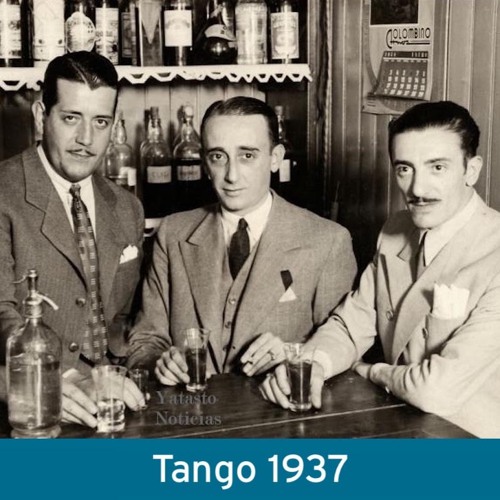
Tango 1937
Dag Stenvoll y Michael Lavocah · 13 de may de 2020 · 2:56:20
1937 is the year Juan D'Arienzo breaks through nationally: his first Radio El Mundo broadcasts start 1 January, and his April recording of La Puñalada (a tango turned milonga on pianist Rodolfo Biagi's suggestion) becomes the hit that makes his name, though singer Alberto Echagüe, who joins the band this year, won't record until 1938. Established giants show the strain of staying current: Canaro records D'Arienzo's own hit as a straight tango, a sign he can't keep up, and Roberto Firpo starts a nostalgic old-style side quartet as his sales slip. Pedro Laurenz debuts as a bandleader with four recordings, including the advanced instrumental Arrabal, which some musicians mark as the true start of the 1940s Golden Decade, while Aníbal Troilo's new orchestra debuts live at the Marabú in July but won't be heard on record until next year. The episode also touches tango's international reach, from a Japanese singer recording for Victor (part of a Japanese fascination with tango predating the 1980s revival) to the music's growing hold on Buenos Aires dance floors, still shared with jazz.
0% escuchado
faltan 2:56:20
Lo que sigue, como se publicó
Tango 1940Episodio 7 · 20 de may de 2020 · 2:34:06Lo que este episodio dio a Tangopedia
Datos dichos en el episodio, cada uno citado al minuto en que se dice.
D'Arienzo's first broadcast on Radio El Mundo came on 1 January 1937, intensifying his band's beat and helping him break through after a quiet 1935 and 1936.
Canaro recording D'Arienzo's own hit La Puñalada as a straight tango, soon after D'Arienzo's milonga version appeared, shows Canaro was out of touch and unable to modernise further.
"Típica" doesn't mean typical but traditional: a marketing term coined by Canaro and Greco when they shared a band in 1909, meaning a tango band with standard instrumentation, as opposed to an "orquesta característica" playing varied repertoire.
Rodríguez debuted in 1937 as the leading orchestra outside Buenos Aires, selling well inland (though not in the city), which let him keep recording through 1938-40 while better, less commercial orchestras lost their recording contracts.
Japanese interest in tango predates the 1980s revival by decades: Baron Megata ("Tsunami") learned tango in Paris in 1926 during post-surgery physiotherapy, then opened a free tango academy in Tokyo for his upper-class friends; a Japanese cultural attaché around 1928 also shipped tango sheet music home.

A slow, sad waltz, a duet to mothers that Dag calls less a tribute than close to an insult, from an orchestra that recorded over 300 waltzes.
♪ Música · 4:58 ·

A very well-known Canaro/Maida tango, played because it had snowed in Bergen that day; Michael cautions DJs it's overplayed and shouldn't only come out in winter.
Verlo bailado · 131

About finding love like a son in Paris; notice the clarinet obbligato, one of the jazz instruments Canaro liked to use.
♪ Música · 2:56 ·
Verlo bailado · 4
Canaro's straight-tango version of D'Arienzo's milonga hit, recorded just weeks after D'Arienzo's, which Michael reads as a sign Canaro could no longer modernise.
Solo en el episodio
Capítulo · 25:28
The Milonga That Wasn't Supposed to Exist
D'Arienzo promised to play a song exactly as written. His band broke that promise — and it made him famous.
Dag's pick to showcase an underplayed orchestra; Michael likes it a lot, especially Lomuto's upward key-modulation trick at the ending.
Solo en el episodio
♪ Música · 2:26 ·
An instrumental also known from Canaro's versions; Lomuto's take has a heavier, more grounded beat.
Solo en el episodio
Rodríguez's debut year; light and playful like most of his output, about a man who decides he must find a girlfriend after all his friends marry.
Solo en el episodio
♪ Música · 1:51 ·

Tanturi's debut year (his band grew out of medical school); a morbid lyric about a gaucho who stabs his unfaithful woman and her lover, then confesses, carrying their hair and heart in his bag.

An energetic instrumental from a fading giant trying to stay modern; pianist Carlos García audibly works to keep the music interesting.
Verlo bailado · 1

Michael calls this his favourite 1937 recording so far: strong drive, swing (cadencia), and low-tone violin vibrato he loves.
Played as a guess-the-song game; Victor's house orchestra recorded four songs this year with a Japanese singer, probably for the Japanese market.
Solo en el episodio
♪ Música · 2:12 ·
Capítulo · 1:01:45
The Hip Operation That Brought Tango to Japan
A rich young Japanese man went to Paris for surgery in 1926 — and came home with tango instead.

A milonga evoking the 19th-century frontier forts and the women who followed the soldiers; a military trumpet opens it.
La letra, en la página del tango
Verlo bailado · 116

Lita Morales's first tango recording here (her actual first recording was a paso doble a month earlier); she later becomes Donato's best-known female singer.
La letra, en la página del tango
Verlo bailado · 2

A feel-good Donato number from the film Así es el tango, mocking a poser (a 'gato'); the falsetto 'meowing' is violinist Piovani.
♪ Música · 2:36 ·
Verlo bailado · 5

One of D'Arienzo's two biggest 1937 hits, full of the hard 'síncopa a tierra' rhythm defining his new, modern sound.
♪ Música · 0:54 ·
Verlo bailado · 4

D'Arienzo's biggest 1937 hit and the recording that made him famous; written as a tango, turned into a milonga at Biagi's suggestion, and now underplayed compared to the 1951 remake.
La letra, en la página del tango
Verlo bailado · 5
Capítulo · 1:28:18
The Cowbell Tango
Why is Michael Lavocah's favourite D'Arienzo recording the one that just... strolls?

One of Michael's all-time favourite D'Arienzo tracks: an unusually laid-back walking pace with a backbeat section where the melody takes over.
♪ Música · 2:00 ·
Verlo bailado · 119

A thrillingly fast waltz (about 73 bpm) where the bandoneón section audibly struggles to stay together; so well loved it's replayed later in the show.
Verlo bailado · 94

Discépolo, chiefly a lyricist who couldn't write music, still ran his own orquesta típica this year, with his on-off girlfriend Tanya singing.
♪ Música · 1:41 ·
Verlo bailado · 5
Capítulo · 1:41:54
The Singer Who Sounds Like No One Else — Because He Couldn't Yet
This is Oscar Serpa's very first recording, and he doesn't sound anything like the Serpa you know.
Serpa's first recording, backed only by guitars, and his only one before joining Fresedo in 1942; its intimate style recalls Agustín Magaldi, before the orchestra-singer style existed.
Solo en el episodio
♪ Música · 2:10 · La letra, en la página del tango
Ortiz's conversational, 'talking' bandoneón style (blending a note with its octave), from a trio with guitars; one of the three bandoneón players Michael cites as shaping Troilo.
Solo en el episodio
♪ Música · 1:30 ·

One of 1937's biggest songs, written by Laurenz; this earlier vocal version differs from his better-known 1944 instrumental remake.
♪ Música · 2:58 · La letra, en la página del tango
Verlo bailado · 80

A ranchera (an invented folk-style rhythm in three, based on the mazurka) — an unusual choice, with the milonga, for Laurenz's first-ever recordings.
Solo en el episodio
Capítulo · 2:01:33
The Record That Quietly Started the Golden Decade
It barely sold. Musicians still call it the moment everything changed.

Composed by Laurenz's bandoneonist friend Pedro Maffia with lyrics by Homero Manzi; Michael points to the dynamic swell in the opening phrase.
♪ Música · 1:15 ·
Verlo bailado · 88

A modest seller at the time but, to musicians, a revolution; some mark this recording as the true start of the 1940s Golden Decade.
Verlo bailado · 68
One of two 1937 Cumparsita recordings closing the show; Dag calls Firpo's version 'a bit crazy'.
Solo en el episodio
♪ Música · 2:30 · La letra, en la página del tango
The closing Cumparsita; Michael highlights Mazzeo's long fourth-string violin obbligato, the emotional touch D'Arienzo's sound otherwise lacks.
Solo en el episodio

An afterparty pick so the year wouldn't pass without more Fresedo beyond Niebla del Riachuelo; the singer is not named in the broadcast.
♪ Música · 1:54 · La letra, en la página del tango
Verlo bailado · 21

A rich, surprising Víctor house-orchestra arrangement of a piece usually associated with Carlos Di Sarli; the bird-like opening sound is a 'water whistle' toy, not a violin.
♪ Música · 1:59 ·
Capítulo · 2:24:37
The Voodoo Song Hiding Inside a Party Band
Europe's poshest hotels danced to this Cuban band without knowing what one of their songs was really about.
A detour to non-tango music: Ernesto Lecuona's Cuban band, big across Europe's casinos and hotels, here in an unusually dark, Afro-Cuban mode about sacrificing a white rooster.
Solo en el episodio
♪ Música · 2:36 ·

Magaldi, a major singer who never performed with a dance orchestra, on a theme Michael compares to Troilo's later 'En esta tarde gris': rain (here, a sonata) as a trigger for heartache.
Solo en el episodio
♪ Música · 3:03 ·

A tango classic from mid-1937, one of many versions recorded over the years; Michael says there isn't a bad D'Arienzo track from this period.
♪ Música · 2:30 ·
Verlo bailado · 28

A bizarrely unusual instrumental introduction, prompting discussion of the band's two separate, non-harmonising violin lines.
♪ Música · 2:30 ·
Verlo bailado · 2
One of Michael's favourite D'Arienzo waltzes, not too quick, good for opening a set.
Solo en el episodio
♪ Música · 2:00 ·
Prompts the reveal that Mazzeo plays his low violin lines with a heavier viola bow, for a richer but less agile tone.
Solo en el episodio
♪ Música · 2:00 ·
Capítulo · 2:48:52
Two Violins, Two Men, One Sound
That aching violin line under 1930s D'Arienzo is actually two different musicians doing two different jobs.

A fast waltz; by the end the band is audibly losing sync, and the violin solo is correctly identified as Domingo Mancuso's, not Mazzeo's.
La letra, en la página del tango
Verlo bailado · 302
Replayed by popular demand from earlier in the show; Michael's own listening notes call it 'killer band of nuance just holding it together'.
♪ Música · 2:00 ·
Verlo bailado · 94
Seguir por todos los episodios
Tango By Year es de Dag Stenvoll y Michael Lavocah, publicado aquí con su permiso. El audio se reproduce desde SoundCloud.