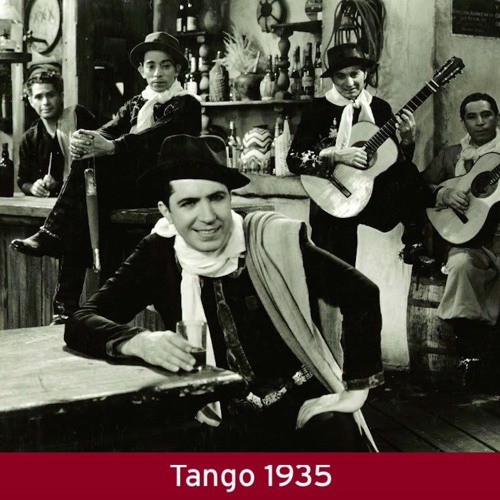
Tango 1935
Dag Stenvoll y Michael Lavocah · 6 de may de 2020 · 2:37:22
1935 sits just before tango's golden decade of dance orchestras, so the mood is romantic and song-led rather than danceable. Carlos Gardel's death in a June plane crash devastates Argentina (national mourning, three suicides, five days with no tango on the radio) and the vacuum it leaves opens the door for Juan D'Arienzo, who gets his first record deal weeks later and ends the year adding pianist Rodolfo Biagi. Francisco Canaro dominates output (84 of roughly 250 tango sides released that year) in a mature, smooth period with singer Roberto Maida, while older figures like Roberto Firpo and Julio De Caro fade in relevance even as their innovations (piano accompaniment, violin vibrato, complex arrangement) still shape the sound. The show also covers women vocalists (Ada Falcón, Mercedes Simone, Imperio Argentina, Azucena Maizani), who mostly worked as soloists rather than orchestra singers, and detours into European and Polish tango, noting Polish tango's largely Jewish musician community, later destroyed by the Nazi invasion. Radio El Mundo also launches this year, setting up tango's growing radio presence.
0% escuchado
faltan 2:37:22
Lo que sigue, como se publicó
Tango 1937Episodio 6 · 13 de may de 2020 · 2:56:20Lo que este episodio dio a Tangopedia
Datos dichos en el episodio, cada uno citado al minuto en que se dice.
D'Arienzo got his first record deal in mid-1935, cutting his first sides just weeks after Gardel's death, and was 'beginning the road to fame' by year's end.
Gardel died on 24 June 1935 in a plane crash in Colombia, an event that traumatised Argentina for a long time.
After Gardel's death there were three suicides and no tango played on the radio for five days; Canaro had to delay the opening of his new show by a day.
Gardel was famously afraid of flying and told D'Arienzo he feared dying in a plane crash; his mother initially refused to believe the news of his death because he wouldn't have flown.
Gardel's body took until February 1936 to reach Argentina (by boat via New York, then overland through South America), and his statue wasn't built until 1937.
Capítulo · 3:02
The year tango lost its king, and found D'Arienzo
Argentina's biggest star dies in a plane crash. Weeks later, an unknown bandleader cuts his first record.

D'Arienzo's very first recording, a waltz rather than a tango, played instrumentally as most bands did at the time.
♪ Música · 2:30 · La letra, en la página del tango
Verlo bailado · 36
An old classic D'Arienzo would record three or four times; cut the same session as Desde el alma, a week after Gardel's death.
Solo en el episodio
Capítulo · 17:32
Two years to grieve a king
Carlos Gardel died in June 1935. His body didn't come home until February 1936.

Recorded in the Paramount studios in Queens for one of Gardel's Hollywood films; about a horse race and, by extension, love.
Solo en el episodio
♪ Música · 2:42 · La letra, en la página del tango

A Gardel/Lepera film song whose lyrics about life being 'just a puff of wind' feel eerily tied to his death three months later.
Solo en el episodio
Capítulo · 28:21
The singer who said the birds taught him
He never sang for dancers. He never joined a dance orchestra. And he might be tango's most unusual voice.
A vals canción backed by guitars, chosen to show a singer Lavocah calls his favourite voice with Canaro.
Solo en el episodio
♪ Música · 3:07 ·
One of only two 1935 recordings by Corsini, backed by guitars; Lavocah says Corsini 'was taught to sing by the birds'.
Solo en el episodio
Capítulo · 36:16
The year Canaro recorded a third of all tango
One bandleader. 84 recordings. A third of everything tango released that year.

Played alongside the instrumental El buey solo to show Canaro's mature, smooth 1935-38 period with Maida.
La letra, en la página del tango
Verlo bailado · 19

A playful instrumental; Lavocah notes the square, metronomic beat under Canaro's changing textures.
Verlo bailado · 7

Picked as part of a run of women singers; Falcón is described as a mezzo-soprano backed by Canaro's orchestra.
♪ Música · 2:45 · La letra, en la página del tango
Verlo bailado · 9
Simone's only 1935 recording; Dag calls it one of the two songs that most surprised and delighted him preparing the show.
Solo en el episodio
A film star's guitar-backed recording, explicitly not for dancing but, Dag says, beautifully sung.
Solo en el episodio
♪ Música · 2:11 ·
The other surprise favourite; Lavocah and Dag flag that the better-known version is Miguel Caló's 1936 recording.
Solo en el episodio

An early, De Caro-influenced Caló, still years from the simpler 'winning formula' of his 1940s band.
A five-minute potpourri of half a dozen unlabeled De Caro numbers for four bandoneóns, meant for listening, not dancing.
Solo en el episodio

A very well-known title; Lomuto is noted as hugely popular in 1935, second only to Canaro in record sales for Victor.

An energetic instrumental with mock sound effects of a collapsing shelf; Dag floats Donato as an early bridge to D'Arienzo's style.
Verlo bailado · 10
Capítulo · 1:29:58
Why old tango violins 'wail'
Those old violins aren't out of tune. They're tuned differently -- and that changes everything.

Chosen to showcase Firpo's distinctive violin sound and deep, pre-1939 vibrato.
♪ Música · 2:13 ·
Verlo bailado · 1

An unusual, wailing instrumental ('carcajada' means guffaw) that Lavocah ties to Firpo's particular violin style.
Verlo bailado · 1
Capítulo · 1:41:38
The bandoneón's accent: why Europe never got the sound
The bandoneón is a German instrument. European tango still couldn't play it right.
Capítulo · 1:43:35
Tango's lost continent: the Jewish musicians of Polish tango
A whole tango tradition, almost entirely Jewish, was wiped out in a single month.
A Polish tango pick to illustrate a separate European tradition; Aston reportedly recorded about 1,000 sides.
Solo en el episodio
A Hungarian-born, Berlin-based bandleader's 1935 recording, played to contrast with the Polish track.
Solo en el episodio

Chosen to show Fresedo's romantic style and Roberto Rey's non-porteño, upper-class singing accent.

A slow, old-style Fresedo number with unusually spooky harmonies in its B section.
Capítulo · 2:04:19
The pianist who showed up to drink champagne and changed tango forever
The regular pianist didn't turn up. So D'Arienzo asked the guy drinking at the bar.
Rodolfo Biagi's recording debut with D'Arienzo, cut on New Year's Eve; the waltz gives the piano less room to shine.
Solo en el episodio
♪ Música · 3:00 ·

Biagi's other debut side, also cut December 31st; both host and guest hear new energy from his piano.
The show's traditional closing number, this week in Donato's version.
Solo en el episodio
♪ Música · 2:30 · La letra, en la página del tango
An after-party bonus pick of European tango, played after a listener compared von Géczy's track to this bandleader.
Solo en el episodio
♪ Música · 2:19 ·

The Laurenz composition Laurenz himself couldn't record in 1935 for lack of a contract, so Canaro cut it instead.
♪ Música · 2:28 ·
Verlo bailado · 5
From Juan Maglio's old-guard repertoire; Lavocah points out the two distinct violin lines (Matos and Mancuso).
Solo en el episodio
♪ Música · 2:31 ·

A sweet, energetic waltz, still from before Biagi joined the band.
♪ Música · 2:30 ·
Verlo bailado · 65
Seguir por todos los episodios
Tango By Year es de Dag Stenvoll y Michael Lavocah, publicado aquí con su permiso. El audio se reproduce desde SoundCloud.