Tango 1926-1927
Dag Stenvoll y Michael Lavocah · 2021-03-03 · 2:56:45
Dag Stenvoll was sick, so Michael Lavocah ran the whole show alone, playing from Dag's playlist plus his own picks. The episode sits at the start of electrical recording (Victor from March 1926, Odeon from November 1926, both labels staying quiet about it so old acoustic stock would still sell), just as tango's six-piece sextets were recording prolifically because there were no written arrangements yet. Lavocah tracks the 'old guard' (Firpo, Canaro's stand-in band, Fresedo, Lomuto, Maglio, Guido) against Julio De Caro's sextet, already building the harmonic vocabulary that Troilo, Laurenz and Pugliese would use. Working-class 'arrabalera' singers Rosita Quiroga and Azucena Maizani are set against the more polished new arrival Libertad Lamarque. Lavocah names Osvaldo Fresedo his favourite orchestra of 1927, just before Canaro and Lomuto are lifted to a new level by singer Charlo.
Lo que este episodio dio a Tangopedia
Datos dichos en el episodio, cada uno citado al minuto en que se dice.
The term 'orquesta típica' began in 1909 as a marketing label coined by Greco and Canaro, so by 1926-27 tango's orchestral sound was already about 15 years into its development.
Victor introduced electrical recording in Argentina on 1 March 1926; Odeon didn't follow until November 1926. Neither label announced it publicly, by a gentleman's agreement, so buyers wouldn't stop purchasing the older acoustic-era stock still on shelves.
Victor introduced electrical recording in Argentina on 1 March 1926; Odeon didn't follow until November 1926. Neither label announced it publicly, by a gentleman's agreement, so buyers wouldn't stop purchasing the older acoustic-era stock still on shelves.
The only way to spot an electrical recording at the time was tiny markings: Odeon restarted its matrix numbering at 1 with a small 'e'; Victor later added 'VE' (Victor Electrical) to its labels, but gave no visible sign when the format first switched.
The only way to spot an electrical recording at the time was tiny markings: Odeon restarted its matrix numbering at 1 with a small 'e'; Victor later added 'VE' (Victor Electrical) to its labels, but gave no visible sign when the format first switched.
Discos que suenan · 35
Transcripción
Transcripción automática del audio, luego puntuada; puede haber nombres mal oídos. Toque una línea para escucharla. El episodio es en inglés, y su transcripción también.
Good evening everyone and welcome to 1927, with a little bit of 1926 thrown in for good measure. But I'm just going to call it 1927 because that's easier to say. And you enjoyed 1928 so much we weren't sure about it, but you loved it. So we thought, why not? And here we are. Before I go any further, I have to explain why Dag is on silent mode. He's here watching with us in the background, but he's indisposed. Dag is a little bit sick, nothing to worry about. He'll be right as rain in a few days. So he actually sent me his playlist but don't worry Dag, I'm not going to play it. I'm going to ruin your carefully crafted playlist. I have the power and play for myself, as it were.
Now what shall we tell you to introduce this year? You could look at it in one of two ways. You could look at it as going even further back into the past, further back than we've ever been before into the prehistory of tango. Or you could take a longer view and say, tango's been developing for quite a long time. When did the orquesta típica start? 1909, when it was used as a marketing term by Greco and Canaro. So we're 15 years in to the development of tango music as we open this evening. And it's a time when music is developing very fast, and that process is helped along by the arrival of electrical recording.
In 1926, electrical recording was introduced in the United States the previous year, and then of the two big record companies, Victor and Odeon. They both introduced in 1926, but at different times.
It's lovely to see all these messages for Dag. I'm really touched because I miss you, Dag. And it's not the same without you. And we want you to be well. But yeah, just a couple of days, you'll be fine.
Capítulo · 2:58
The Revolution Nobody Announced
In 1926, tango's sound quietly changed forever -- and the record labels told no one.
So returning to the 1926 story, the first to introduce the new system, i.e. with microphones, which weren't used before, before it was just the acoustic horn cutting directly to the wax, was the Victor Company in March, on the 1st of March. Now, Odeon weren't able to follow until November. Was this a competitive advantage for Victor? No, it wasn't. They kept quiet about it. Why did they keep quiet about it? Because in the record shops there were lots of old acoustic discs on the shelves. And if they told everyone, oh, now they're new electrical recorded records, they're much, much better. No one would buy the old ones.
So Odeon and Victor came to a gentleman's agreement. Victor made no announcement at all. They didn't even start the numbers from one again. You couldn't tell. The labels were identical and they introduced the records. The first matrix number was 375 or something, not number one. And they just carried on. And then when Odeon started in November, they also started without any announcements, but they put a one for the matrix numbers. They started again at one with a little e beforehand written very, very small, so if you knew what you were looking for you could see. And after that time Victor put V E on their labels, which stands for Victor Electrical, and that was the only way you could tell before then there was nothing at all. So it's kind of very fortuitous that electrical recording arrives just at the time we want it to, just when tango music becomes really interesting.
Now I'm just going to pause my video and show you once again the event photo. So this is an advertisement from Odeon. Odeon called themselves Disco Nacional Odeon. Sometimes we write DNO for short and this is their advertisement, their regular advertisement in the magazine Caras y Caretas, faces and masks, which was a sort of upper middle class magazine, colour cover, not a cheap magazine. And it's really quite interesting when you look at it. This is from the 20th of November. So on the left hand side, Canaro has got his picture there under a drawing of the Eiffel Tower. Why? Because Canaro is not in Buenos Aires. He's been in Paris. He's been there for a year. A year and he's just now embarking on a little adventure to the United States which doesn't work out very well because like a lot of Argentines he didn't like the United States, so all the Canaro recordings that are made in 1926 he's not involved because he's not there. But there are quite a lot of them, 232. This is an era when people record a lot and the order on the right hand side tells you quite a lot of things.
So the first artist that's mentioned is Gardel and his records are more expensive than everybody else's. The dollar symbol refers to the Argentine peso and his records cost three pesos 25 cents but everyone else's are only three pesos. And then you get Firpo, Canaro and Fresedo, they're the main three. Lomuto gets a smaller mention. Then there's a couple of jazz bands, which I will attempt to pronounce. El Euterio Ibarren and Adolfo Aviles. Adolfo Aviles we know better because D'Arienzo played in that band, but it concentrated on jazz. And the order is telling us something. It's telling us who was the most famous, the most prestigious. It's a bit like a league table. It's a Victor aren't involved. And if we could find a similar advert to show you for 1927, you'd see Canaro would go up one place. He'd overtake Firpo because he's recording more and more records and becoming more and more successful.
And this is a time when people are recording prolifically. Just while we were listening to the warm-up music, I was looking through my old discographies. Here's one. This is the Canaro one. It's quite fat. And the smaller one of Fresedo just to see how many recordings people made. Now you know that in the 40s people recorded one record a month typically. So two tracks on a record so 24 numbers a year. 20, 22, 24 as a rule of thumb. That's what was normal. I'll give you the numbers for the top three. Canaro in 26, 232. In 1927, 354. Firpo, very similar. In 26, 225 records, almost as many as Canaro. And then in 27, 216. He's beginning to fall off, yeah. Canaro has leapfrogged him. Fresedo, 188 in 1926 and 225 in 1927. So those three artists between them have recorded something like 1300 songs, just those three artists. It's an incredibly prolific period.
Well, why is it so prolific? Because there's no arrangements. You've got a small group of six people. Everyone knows what to do. They know how to create their part just from simple sheet music and off you go. The director doesn't have to do very much other than establish the style. Maybe make some decisions. So let's start listening to some music and I'm going to use the advertisement as a guide and start with Carlos Gardel. Work my way through those artists. I'm not going to tell you who my favourite artist for 1927 is, but I've got one. I have a clear favourite, but maybe that will become obvious as we go along. And we'll take a little excursion this evening as well to Europe to listen to, I think, two different orchestras, one Argentine and one not.
“I'm not going to [tell] you who my favourite artist for 1927 is, but I've got one. I have a clear favourite.”
Canaro is in Paris, of course, and he's there for a whole year. So that period, 1926, that's really when the sound of tango is imprinted on Europe and you could argue that European tango is a copy of the Canaro 1926 style. It's kind of like that. He makes an impression, he plays there for a whole year and then it carried on and didn't develop really after that. So we need to listen to those European bands a little bit and then we'll listen to the bands on the Victor label and that will include Julio De Caro, who's really doing some interesting stuff in these years with his brother Francisco and their sextet. Not forgetting the female singers, Libertad Lamarque, who's 18 years old, has just arrived in the city, cuts her first record when she's still 17, and Azucena Maizani and Rosita Quiroga. And you've heard those voices before on this show but they're different, aren't they, to sophisticated voices like Libertad Lamarque and Mercedes Simone. They are voices of the working class from the Arabellas, from the outskirts of tango, and it's working class people who identify with that sound and those records.
We're going to begin with Carlos Gardel and I think you may be a bit surprised by this one, at least I hope you are. This is from 1926 and it's a malonga that you have heard performed by Piazzolla when he was Fiorentino's backing orchestra in 1945. It's a malonga called Soy una Fiera and Fiera is a word that means something like a wild animal. There's a tango called Bernabé La Fiera. Bernabé was a star football player who was a really tough, you know, Maradona Argentine style centre forward and when he hit the ball it went like a thunderbolt. So Soy una Fiera means I'm a beast.
Lavocah opens with a Gardel milonga, noting it has the groove Piazzolla later gave Fiorentino in 1945, even though the danceable milonga rhythm as a dance form supposedly wasn't 'invented' until 1932.
♪ Música · 1:46 ·
So apparently the malanga for dancing was invented in 1932. But that was 1926. It's not meant for dancing but you could, isn't it? It's all there, it's just no one's had the idea yet. Just the idea. Great stuff. Andreas is reminded of the melody of Tordtasos. Well, Molonga wasn't really about making different melodies, was it? It was about improvising. Two poets rapping with each other. Contrapunto. I say a verse, you improvise a verse, I improvise a verse, you improvise a verse. The pajada, the verse dual. Molonga was very much related to that. So in a way, the tune was not very important at all. It didn't really matter. So a lot of the tunes are very, very similar. And that also explains the confusion that Sebastián Piano and Romero Manzi had when they were asked to compose a molonga. It's like, well, what's that about? You just improvise them, don't you?
So now I'm going to play one more Gardel number. It's called Por Un Cariño.
A tender Gardel love song, which Lavocah compares to the 1959 Pugliese/Jorge Maciel recording of the same title.
♪ Música · 2:29 · La letra, en la página del tango
Isn't that beautiful? So beautiful. It's 59 when it was recorded by the Pugliesi Orchestra with the voice of Jorge Maciel under the same title. So tender and lovely. For you, I'll be left without God, without faith and without you. Tender love song.
OK, two's enough to be getting on with. Who's next on our programme? Next person on the advertisement was Roberto Firpo. There's a lot of Roberto Firpo that's really great from these years. I could play a lot. I'll try not to play too many. Let's pick one for starting. Perhaps a slightly stronger one. Firpo is a romantic at heart, which doesn't mean that he makes music like Fresedo. But he makes music that's got strong melodies, but often with quite a melancholy tint. These will all be from 1927. We'll begin with Criolla Linda.

Lavocah starts his Firpo run with a strong, melancholy-tinted number, calling Firpo a romantic with real melody underneath.
♪ Música · 2:00 ·
Gorgeous, isn't it? Just gorgeous. I love the cello lines. Again, the left hand of Firpo, although he's probably not playing anymore. He's just conducting, so I'm not sure who the pianist is. But following on in Firpo's style, lots of left hand drive from the piano. And quite a strong, not as strong as, but very much pleasant. Let's have another.
A second Firpo instrumental, intense and heavy-beated with complex violin harmonies; the title is never stated in the transcript.
♪ Música · 2:30 ·
Just gorgeous, isn't it? What an intense melancholy. The pace is really quite slow, but it's only sustained by this really heavy beat that once again makes us think ahead to the beats of Tissali and Pugliesi. And the violins are really quite complex. They've got this very deep wailing vibrato that we associate with Firpo. But in the B section, so after 30 seconds, you could hear the harmonies, two different voices, and then this weeping in triplets. Gorgeous. So the first one, more soft. This one, a bit more intense. And then a third one, my comment in my music library is just mad.
A third Firpo instrumental played straight after the second; again the title is not said on air.
♪ Música · 1:30 ·
Oh, my God. Come on. That's awesome, isn't it? They're having so much fun. Could you hear what Firpo did with the piano? So it's very easy just to focus on the violin effects because they do the fireworks. But before the firework goes off, when you have this... And could you hear in the piano, again in the left hand, very low, he modulated between two notes very fast. So the piano is again pushing.
So let's move on to Francisco Canaro, who is absent as our programme begins. He's in Paris, but it's okay because he's left a complete replacement orchestra back at the club in Buenos Aires and continues to fulfill his engagements no problem and it's a very good lineup. Minotto and Luis Riccardi, so the first bandoneon and the main pianist are running the band and Canaro's not there so they're kind of free to do what they like, but they behave more or less. Now I wasn't really sure where to start but I am going to play a track from 1926. We're on the Odeon label. Odeon don't introduce electrical recording until the beginning of November. The first matrices are given to Carlos Gardel but he doesn't like them. He's experimented with electrical recording in Barcelona and you can hear that it's different and he's not sure that the technology is ripe.
So the first recordings, 1, 2 and 3, never issued. 4 and 5 are given to Roberto Firpo and 6, 7 and 8 are given to the orchestra of Francisco Canaro. Now one of those tracks, the first of them, Electrical Recording No. 6, Take 1, is a version of A Media Luz, the old Donato classic. Now this has got quite a slow pace, but listen to how the bandoneon of Minotto comps. It gives the backing more than the piano does, almost. It's one of the first recordings where you can really hear the left hand of the bandoneon doing something. Francisco Canaro, 8th November 1926, A Media Luz.
One of Odeon's first electrical-recording matrices, made by Canaro's stand-in band (run by Minotto Di Cicco and Luis Riccardi) while Canaro himself was in Paris; notable for the bandoneón carrying more of the backing than the piano.
♪ Música · 2:31 · La letra, en la página del tango
So if tango is a walking dance, then I think we know that in 1926 people were not in as much of a hurry as we were. Everything we've heard tonight has been under 60 beats per minute. Just let me have a look on the list. Yeah, 58, 58, 54, 58. Less than one beat per second and, you know, a normal comfy dancing for tango is in the low 60s. That's what you'd expect with the D'Arienzo number. And when a waltz like D'Arienzo's Fibras gets up to 70 or 72, then that feels really fast. But here we're under 60. So it's really for walking like this, you know, with your whole body. But he does pick the pace up a little bit. It's not all like this. Let's go forward into March 1927 with a really quite adventurous version of Derecho Viejo.

An adventurous, playful version from March 1927, picked to show the band picking up the pace after a run of sub-60bpm tracks.
Lo bailan

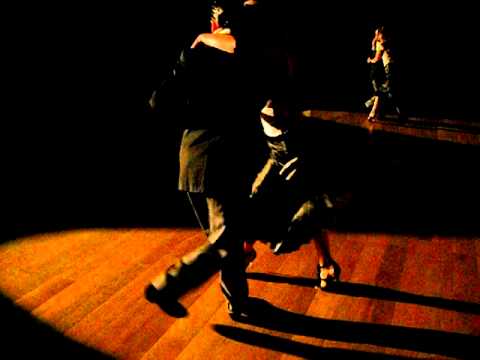


♪ Música · 2:00 · La letra, en la página del tango
It's cracking, isn't it? Really inventive and playful. There's plenty more like that, but I really should move on to other orchestras. If you like that, listen also from the same year to Retintin and Nobleza de Arrabal, which is really excellent. And in Nobleza de Arrabal you start to hear what they call... Let's just listen to it actually. Retintin, that'll be for your homework. But let's listen to Nobleza de Arrabal.
Now, Nobleza de Arrabal is a Francisco Canaro composition from some years previously. What's different about it is what they call the canyengue slapping. Now, the word canyengue means so many different things. But what it means here is the slapping of the back of the bass by the bass player. So you get really free syncopation, and it's something that many of the orchestras are using. We're going to hear it a lot, perhaps a surprise, with Fresedo's orchestra, the King of Romance. He uses it even more than Canaro does and it's a really strong element in the syncopation in these years and then it kind of fades away. It becomes like a special trick but here, back in the late 20s, it has a more fundamental role.
Chosen to illustrate 'canyengue' slapped-bass syncopation, which Canaro's band and especially Fresedo's used heavily in this period.
♪ Música · 2:30 · La letra, en la página del tango
Yeah, crazy syncopation from the basser, really important instruments. You probably recognised the melody from the performance of Canaro with Nelly Omar from the late 40s. We may even have played it on this show. I can't remember if we played that particular one when we played some Neilio Canaro numbers. Now we have one vocal number and then we'll move on to Fresedo, and the vocal number comes from the competitions.
The advertisement you saw earlier and that was used as the event photograph was part of a very carefully orchestrated marketing campaign. Max Glucksmann ran the Odeon company in Argentina and he had had to assume complete control when the First World War cut Argentina off from Germany. And this wasn't the only country which experienced the same change. So he was the local man for the Odeon company, which is based in Berlin. But after that, he had to go it alone. And he was a great entrepreneur. He had very good business sense. He was also good at employing the right artistic director to choose his artists for him. He ran a radio station. He ran newspapers.
Capítulo · 43:14
The Rigged Contest That Still Gave Us a Classic
Buenos Aires's biggest tango competition had a dirty secret.
And one of the things that he did to create excitement around his musical empire was there was a tango competition once a year, which ran, I think there were seven competitions, annual competitions around this time. Although sometimes there was one both in Montevideo and one in Buenos Aires. So the idea was you entered your tango, the judges made a pre-selection and then the chosen orchestra, which would be one of the orchestras on his label. One year might be Canaro, one year Lomuto, one year Firpo. They would play all the finalists. I don't know how many finalists there were. Let's say there's 20 or something like that.
And then the audience would write the name of the one that they wanted to win on the back of their ticket stub. And they put it in a jar when they went out and they count the votes and whoever got the most would win. But we know from what happened to another tango that the contest was actually fixed. But never mind about that. Why am I telling you this story? Because that's where we get this beautiful tango. Noche de Reyes. Noche de Reyes is, if you're not from a Hispanic country, you don't know what that means. It's Epiphany, the night of the three kings. I don't know how it is today, but one generation ago in Spain and I guess maybe in Portugal the same, people didn't get their presents on Christmas day. They got them when the three kings arrived because they were the first people to bring Christmas presents. But the lyric's not about that. It's about something else. I'll post it in the chat window.

One of the winning entries in Max Glucksmann's annual Odeon tango competition; the lyric, despite the festive title, is a jealousy-murder story.
♪ Música · 2:56 · La letra, en la página del tango
Yes, not a very happy lyric, huh? But very effective, really casts its spell, really casts a mood. So that was one of the winners of the 1927 Max Glucksmann competition for best tango. About the lyric, it's the same old story. The man kills both. He kills both the lover and his woman. Yes, dear, oh dear, oh dear.
Moving swiftly onwards. Let's listen to some Fresedo. Fresedo is the king of romance, and he's still very romantic in this early period, but there's more body underneath. There's just six players. It's a sextet, like the other bands that we've been listening to. So two violins, two bandagnons, one of those bandagnons being Fresedo himself, piano and double bass. But there's more force in this playing than there is in Fresedo's later period. It's a little bit more earthy, more connected to the ground. Some of the songs are very soft and sweet, some of them a bit more robust.
Let's start somewhere in the middle with something that I find really super playful. This is a tango you know from all kinds of places, a very popular tango of Agustin Bardi. Probably the most famous recording today is D'Arienzo's recording from the late 30s. But here's for a say, though, with Lorenzo.

An Agustín Bardi composition, played for its playful pizzicato violin; Lavocah notes D'Arienzo's later recording (from the late 1930s) is the most famous version today.
♪ Música · 2:00 ·
Like that, didn't you? Isn't it wonderful? So yes, the band gives a very strong beat on the one, but then there's this pizzicato on the two. Boom. Which creates, in a soft, playful way, that we don't notice it so much. It's almost like a Biagi feeling. Quite a strong up-down bouncing going on. What's with the pizzicato? How does he get so many notes?
Tango violinists make their pizzicato differently to classical violinists. Classical violinists generally, as they hold the bow, use just this finger, one finger, and tango violinists use three fingers so they're able to get three notes from each stroke and you can hear how useful that is. What I notice about it is it's very expressive but it's also quite restrained. Nobody's actually showing off really and musically the band could have done more but they didn't. Fresedo had made a conscious choice three or four years before this moment. He was walking down the same path as Julio De Caro and he decided, no, I'm not going to go that way, I'm going to go a different way, a way that emphasizes the melody and the romance even if that means giving up some complexity. But still very, very satisfying. We need to listen to some more.
Okay, sticking with the theme of playful violins and really wonderful pizzicato, another tango that you know very well, Tinto y Verde.
Another playful, pizzicato-heavy Fresedo number, picked to show violinist Adolfo Muzzi's three-finger pizzicato technique.
♪ Música · 3:15 ·
You're all in love. I love it. At least everyone typing in the chat window. I guess the people who don't like it are not saying anything. I think it's delicious. And what really surprises me is that if I said to you, just give me a couple of words to describe these tangos, you'd say things like romantic, soft, playful. But when the band makes an attack on the beat, they hit it really hard. Everyone together, but it doesn't create a harsh, disturbing feeling. The overall feeling doesn't change, remains soft and playful. How does he do that? I don't know. It's miraculous.
“How does he do that? I don't know. It's miraculous.”
One more thing, yes. Just listening to that with you, I noticed that Muzi, Adolfo Muzi, who's playing all this pizzicato very beautifully on the violin, at one point he put a 3-3-2 accent on his violin pizzicato. But it's just a moment, yeah? It's there and it's gone. Easy to miss. It doesn't matter if you do miss it. Maybe subconsciously we thought, oh, that was nice and syncopated. That's all.
So I had 14 tangos from Fresedo on my playlist for this evening after I really worked hard to cut it down. And that is rather too many. I don't know how many, Dag, how many you had. So I'm going to play at least one more, probably two more. So so far we've listened to a music that, well, we've heard its general qualities, but these particular themes have been really quite playful and not emotional numbers. So let's get to see some different aspects of Fresedo from this time. How about something that's a bit darker in color? This is Carta Blanca.

A darker-coloured Fresedo track, shown as a contrast to the playful ones played just before it.
♪ Música · 2:30 ·
That had a bit more darkness to it, didn't it? Some melancholy tinges creeping into that light, playful Fresedo touch. The first violinist is called Adolfo Muzzi, right through this period. People keep on asking. So I'm really delighted that you appreciate his qualities. He's really special. The band wouldn't sound the same without him. Mmm. We're going to hear one more. And it's going to be different to the three that we've heard, not just, you know, another one the same. This is a late entrant in the best ever version of La Cachila competition. Fresedo records it in 1927. I think this is really one of the sweetest, tenderest versions. Here we go.

A late, sweet and tender entry to the same Max Glucksmann 'best version' competition; Lavocah calls Fresedo his clear favourite orchestra of the year on the strength of this run.
♪ Música · 2:30 · La letra, en la página del tango
So maybe I'm not surprising if I say that Fresedo is far and away my favourite orchestra in this year, 1927. Now there's some strong competition. How do I justify my choice? Well, Canaro and Lomuto are about to be elevated by the arrival of Charlo. Charlo's nobility, his inherent quality and taste, raises their orchestra to another level and adds some freedom of phrasing. But we don't have that here, even though there's lots of things to like. So Canaro and Lomuto are not going to hit their peak for another year, but Fresedo is already at his peak. Fresedo is never better than in this period, maybe 1931 in the height of the Great Depression when he allows himself to feel a little bit more sad.
Fresedo was born into a rich family and life came very easily to him, although he did have to struggle against his parents to pursue his vocation. So he's not really given to sadness. He likes melody but not melancholy. And then in 31 you get a little touch of melancholy in Fresedo. It's a very special period, very hard to find the music well transferred, but this period 27 to 28, before he goes off on another expedition, he goes off to Europe, he's at his best. It's all of this quality for me. This is tango for 4 a.m. in the morning, you know, when you're tired but you want to keep dancing. I would dance to this for an hour, no problem.
Now let's listen to one Lomuto track, just one I think, and then we're going to change the colour and energy because we've spent quite a lot of time maybe in some similar feelings. Lomuto is a bit like Canaro's apprentice but with a heavier bass to him. This has got beautiful violin playing right from the very outset. This is called De Rincón a Rincón, from corner to corner.

Lavocah calls Lomuto 'Canaro's apprentice with a heavier bass' and picks this one for its strong violin playing from the very start.
♪ Música · 2:18 ·
A smoking-and-kissing love song that Lavocah pairs with Corsini's warm, 'countryside' voice, as a change of mood after the Lomuto track.
So now we changed. We went to Ignacio Corsini with his beautiful, more natural countryside voice here singing a very city lyric for Fumando espero. There's lots of tangos that relate to smoking and tobacco. Well, several, let's say. And in an age... I've never smoked. I smoked one cigar in Cuba 20 years ago, and it was very nice. That was it. But in an age when everybody smoked, why not make a comparison between these two sensual pleasures? One of smoking and the other of kissing. There's a video of a female singer performing it in an old black and white movie on YouTube, but I can't remember who it was.
OK, so we've listened to some Corsini, let's listen to some of the female vocalists. And there's some really great stuff from this period. Now the two established female stars are Rosita Quiroga and Azucena Maizani, both of whom are what we would call Arrabalera, women from the arrabal. So they're not trying to sound like sophisticated girls from the cabaret. They're trying to sound just like what they are. Normal girls from the barrios, from the poor suburbs. Let's start off with Rosita Quiroga and the very first electrical recording made in Buenos Aires. La musa mistonga.
Now maybe some of the Argentines can give me a hand with the meaning. Musa is easy, that means muse, as in an artist's muse. But what does this Lunfardo word mistongo mean? It means something like poor and broken. Something like that. So that's the connotation, the broken down poor muse, the muse from the arrabal, which is a poor, broken down area, not full of city slickers. So we'll listen to that one and then we'll go straight on and listen to her recording of a tango that you know and love in other versions. Puente Alsina.
I would guess that the most famous version today for dancing would be Pugliese with Jorge Vidal, but maybe there's others that you like to dance to as well. So, Rosita Quiroga. First, La musa mistonga and then Puente Alsina.
Called the very first electrical recording made in Buenos Aires; Lavocah reads the lyric as the voice of the poor barrio criticising the sophistication of the city centre.
♪ Música · 2:55 ·
It's not an easy lyric to translate. I was looking at it and I could see it would be a really difficult to translate. But something of her feeling comes through, doesn't it? It's really the voice from the Arabelle criticising the life of the centre.
Just look at the first verse. La musa mistonga del raro lenguaje, the broken muse, with its rare speech, its strange, unusual speech, que abrevó en las aguas de los madrigales, which drank in the water of madrigals, so the very traditional romantic songs of the truberas, y a llegar al pueblo se torno selvaje, but when it got to the city, it turned savage. So this is really quite a critical tango of what the city centre life is doing to the pure life of the barrios. Let's listen to her Puente Alsina now.
Capítulo · 1:20:29
The Bridge the City Paved Over
A song written for a neighbourhood that was being destroyed.
Quiroga's version of a lyric mourning a barrio being redeveloped and paved over; Lavocah prefers Pugliese/Vidal's 1950 version for drama but likes this one just as much.
♪ Música · 3:01 ·
Anyone who knows any porteños know that they're people who are very much attached to their barrio. Perhaps this has its roots not just in Latin life because they're Latin emigrants culturally speaking but also due to the fact that emigration meant that they were far away from extended family so then the barrio became more important and the lyric actually speaks about this directly. So in the second bit I posted the center part. Buenos Aires was redeveloped a number of times.
So the spur for this lyric is that the barrio, as the person who knows it as they grew up, is being redeveloped and streets are being paved and destroyed. And it makes him feel terrible because as a perhaps first or second generation emigrant, that's his home. It's all the land that he knows. Por qué solo llevan mi barrio, mi todo? Why are they taking it away? Mi barrio es mi madre que ya no responde. That's the line where you understand this lyric. My barrio is my mother. Mi barrio es mi madre. In black and white, it's written there. Que ya no responde. But it doesn't answer me anymore. Why not? Because it's being destroyed by the developers. That's what Puente Alsina is about.
“Mi barrio es mi madre. In black and white, it's written there. Que ya no responde. But it doesn't answer me anymore.”
Beautiful interpretation. I like also very much the one of Pugliese and Vidal from 1950. That's more dramatic and more powerful, but I like this one just as much, but for a different set of reasons. Now, Azucena Maizani, we're going to save for later on, but we will now listen to the new girl on the block, Libertad Lamarque.
Now, Libertad Lamarque, actually she's from Rosario, and she arrives in Buenos Aires at 17, because her parents moved there in order to further her career. And her father, he also has a business, so he brings that business with him. It's not like she's the only thing in their life, economically speaking. And by the end of her 18th year, she's on radio, she's made records, been on stage and theatre, and she's a star, she's made it. But you'll hear immediately that this is a completely different kind of voice, the voice of Libertad Lamarque. It's a sophisticated voice that maybe suits how tango is going to develop more. This is called Y se apagó el pochito. I think that means my cigarette butt went out. Pocho is a little cigarette stub. Pochito, even smaller. Y se apagó. It's gone out.
Introduces Lamarque's more sophisticated vocal style, contrasted with the rougher 'arrabalera' sound of Quiroga and Maizani.
♪ Música · 2:18 ·
Capítulo · 1:28:45
The Tapes That Shouldn't Exist
The original masters were melted down in 1962. So why does this still sound so good?
Somebody's asked how comes the sound fidelity is so good for such an old record. I don't know the answer for sure. There are two possibilities. One is that there simply was a really really good quality shellac left behind. Somebody bought one, played it once and left it in the cupboard. It could have happened. The other thing that happened is that the masters were destroyed in 1962 but the first LPs came out a little bit earlier. So when an LP was made as part of the process you had to make a tape. When a shellet record is made you have a physical master and then you have a bit of wax and you press one onto the other. It's as direct as that, no intermediate steps. But there are more intermediate steps to make an LP because there's lots of different numbers on one face. So tape has already come in in 1950, 1952. So they make a tape master to prepare the LP from.
Now those were physically much smaller objects than the metal masters. So when all the original master recordings were destroyed, the tapes that had been prepared to make LPs were were left. They remained in the studio and that's why sometimes we're able to recover something in very good quality. Not necessarily from the LP itself, although that can also be a good option, but from the tape master that remains in the archive of the record company. Now we have to qualify that sometimes they did things to the sound before it even gets onto the tape because in the 1960s 1970s what was happening in the 70s bands like Pink Floyd were experimenting with all kinds of weird modern effects so people did the same there's lots of reverberation on the LP reissues not on all of them more with the ones from the Victor company than the Odeon company but sometimes these kinds of post-processing they're even on these tapes that they have and And we're never going to see those tapes anymore now because there's no money in tango music. And our dear friend Carlos Puente, who goes banging on the doors of the record companies, is no longer let in to recover all the treasures that lie within. So for the time being, until we all become millionaires, we'll have to make do with what we've got.
So now it's time for a little trip to Europe. We're going to listen to two orchestras. The first will be the Bianco-Bachicha Orchestra. Now I've got a very special affection for this orchestra but it could be because when I first started dancing my teacher really loved it and she used to play it a lot. Unusually for Paris-based orchestras both the principles are Argentine. That wasn't very common. In the orchestras that played in Paris very often the violinists would be recruited locally. Bandagnon players couldn't be recruited locally. That was generally the limiting factor in trying to make a tango sound in Europe. You just couldn't get good bandagnon players. But here we've got an excellent bandagnon player, Peciccia or Juan de Ambrogio. So there's no deterioration in the band sound because they've got to use Europeans.
and it's in emotion a bit like Firpo although the sound, I have to say, is it's nothing like Firpo at all but there's an intense melancholy to the sound to illustrate that this is from 1926 recorded on the European Odeon label in Paris, this particular one this is Anguish Angustia.
A Paris-recorded Argentine band with an intensely melancholy sound Lavocah has a personal fondness for, built around bandoneonist Juan de Ambrogio ('Bachicha').
♪ Música · 2:58 ·
Gosh, I'm really curious what you think of that because it's different, isn't it? It's not like the Argentine bands, really, although it is an Argentine band. Creates a slightly different atmosphere. That's quite a lot of good stuff. I'm I'm very cautious to play lots of this because I, I think maybe it's a very particular taste and I'm a bit worried that not everyone's going to like it. If you like that, seek out in particular the track Negro. You know Negro from the Orquesta Típica Victor. But this same style of vocal, Juan Rezzano, although he's not the only vocalist they have. They have another vocalist, Cohen, who performs in a very similar style. So it's a particular vocal style that they're looking for consciously.
The version of Negro by the Bianco-Bachicha Orchestra, my opinion, very special. If you like the OTV one and you like this sound, you will love that, definitely. So let's not play that because it's kind of in a similar vein. there's also a really intense version of no te quiero mas no te quiero mas I don't love you anymore como te quería the way I used to love you me dedico a la gurufa now I'm going out drinking life's like that what you're going to do about it one of the best versions of no te quiero mas the guy really means it but he sings it in this really dissipated manner But we won't play that one either. We will play it instead. In fact, tango, I think we played a couple of weeks ago. This is Aserín Aserán, Seesaw, the one about the woodworkers who went on strike. Here it's given instead a comic interpretation.
A comic, spoken-dialogue version of the strike-themed tango Lavocah says the show had played a few weeks earlier under its other title, 'El Aocado'.
♪ Música · 2:58 ·
OK, I don't think you'll hear anything else as weird and bizarre as that tonight. That was my joke. Got to play something a bit weird. Yeah. But do you remember the other title of Aserín Aserán is El Aocado? And we listened to that in a recent show. I've really got it in my head that we had it quite recently, but I can't remember which year it was. So there's a lot more of that. Not weird ones like that, but more like the first one. There's also a very special compasita, which I'm not going to play.
Time for another orchestra. So, yes, I promised you two bands from Europe. A couple of months ago, I discovered something that really surprised me. It's a name I know, Dajos Béla. Dajos Béla was like a Hungarian Jew who ran an orchestra. He was very successful in Germany right through the 1920s. And then, of course, once the Nazis came to power in Germany, things went very badly for him. And he went on a permanent tour and he eventually settled. Guess where? Buenos Aires. And turned himself into a jazz band because there's no point trying to be a tango band, not arriving in Buenos Aires in the late 1930s. there are already quite a few of those, but his repertoire was pretty varied back in Europe. And I discovered this tango of him recorded in Europe. I'm not sure where. This is a French record pressed by Odeon in Paris of Dajos Béla from 1926 called Charmeuse.
A French Odeon pressing by a Hungarian-Jewish bandleader who later fled the Nazis and settled, surprisingly, in Buenos Aires as a jazz bandleader.
♪ Música · 3:00 ·
OK, that's the end of our little excursion to Paris. Now one of the things about these very early years is that we've got less variety in rhythms, because milonga hasn't really happened yet as a dance phenomenon. There's just a tiny number of milongas which are thought of still as folk songs. So tango warts and milonga, there's no milonga. And actually the waltzes are still quite rare.
I was really surprised looking at that because even by the following year the number of waltzes is picking up. But here in 1927 there are relatively few. But there are some. So I'd like to play a little waltz tander for you now. I'm going to start off with Carabelli.
Now Carabelli was still a jazz band at this time. Some of the orchestras, like the orchestras of Canaro and Lomuto, were still recording under both rubrics. The band was a Típica, they were bandoneons, but they had musicians in them who could play wind instruments. And in 1926, you could still see some discs from Canaro saying Francisco Canaro Orquesta Típica, and others saying Francisco Canaro Jazz Band. And the same with Lomuto. But Carabelli at this time played jazz full time and didn't play any tango.
Only later he started to experiment with tango because he thought, oh, that's the way music is moving in my city. But he starts out really a well-educated musician, but a jazz musician. So we're going to listen to him first. And this is a waltz that you know. It's El Aeroplano.

A waltz by a full-time jazz band only later drawn into tango; Lavocah and listeners debate whether a flute or piccolos are audible in the background.
Lo bailan

♪ Música · 2:05 ·
A lot of conversation in the chat window. So yes, there was something like a flute playing very fast variations quietly in the background. Do you remember, you must have seen the video of Fresedo playing with his orchestra in the 1933 film Tango. And you see the harp, but you see in the back row three or four piccolos playing. So possibly that's what it was. Hard to be absolutely sure. It's a jazz band. It's not a Típica.
So a number of different woodwinds and something reinforcing the bass line, possibly a tuba. Hard to be 100% sure. The Victor company used a contra bassoon, so it's like a bassoon but bigger and deeper to reinforce the bass recordings for the OTV, and Carabelli also recorded with the OTV, and this is 1927. So in terms of tango archaeology it's more likely to be a contrabassoon. We don't know of tuba in those Victor Houth recordings. Quite a lot going on.
Well now we'll listen to another orchestra, a guy who's coming to the end of his career, Juan Bautista Guido, a giant of the real old guard. So today everything we've listened to today we call old guard but that's not what it really means. The new guard starts coming into life like in 1924. So the old guard is like 10 years before everything we're listening to now, really. It's a term that historians use differently to modern dancers and that's okay so long as we know what we mean. But here's someone from the real old guard, Juan Guido on the Victor label with the waltz that you know, Uruguay.
An old-guard waltz on the Victor label, featuring violinist Elvino Vardaro, who recorded on nearly everything Victor put out in this period.
♪ Música · 2:00 ·
Did you recognise the violin player? Whenever you discover that something is recorded on the Victor label, in the old days, you should suspect that the violinist is Elvino Vardaro, because he was contracted to the Victor label in those years. And he's playing on everything, providing he's free. He's not free for some of the period in 1929 and 1930, when he's trying to form the Vardaro Pulisic Estet. But in other years, he's free. So Juan Maglio, except in 2930, all the records have Vardaro playing the violin. And that was Vardaro playing violin there.
But now I've suddenly realised I need to play you something else. So the style of violin that Vardaro plays has a name. Vardaro does, of course, have a unique tone. But there's a name for this kind of style of violin playing. We call it singing violin, which often has a loose obligato winding around the melody. But there were other people who played a very similar style back in the early 20s.
Now we're going to listen to one track from a violinist called, excuse me if I don't pronounce this correctly, Agesilao Ferrazzano. Now Ferrazzano was a top player. For example, in 1916 when Firpo made the first ever performance of La Cumparsita he was playing. Really a top guy. But in 1928 he went on tour to Europe and he liked it there so much that he decided to stay and he never came back. Well he popped back for a bit. So he disappears from the tango scene. But we're going to listen to some recordings that he made on the Victor label in 1927. So yeah, a Victor recording but not Vardaro, Agesilao Ferrazzano. This is just a trio. There are some orchestra recordings but it's better to hear a trio version because then you can compare the violin sound to what you've just heard. This is a very well-known tango you know most especially from Juan D'Arienzo. This is Don Esteban.
A trio recording chosen to compare another 'singing violin' stylist to Vardaro; Ferrazzano had played on Firpo's first-ever performance of La Cumparsita in 1916.
♪ Música · 3:00 ·
Okay, that wasn't Elvino Vardaro. The tone didn't quite have the same quality, but was it so different? It was a similar style. There were other people playing in the way that Vardaro played. Vardaro was the best, but there were others. That's really interesting to hear that. It just broadens our understanding of how violin sounded back in those days. So we seem to have moved across to different kinds of music. There's still quite some exciting things to play for you. Hmm. What should we have next?
Let's listen to Agustín Magaldi, probably the second most successful male vocalist after Carlos Gardel. This is a track that I didn't know, but it was in Dag's playlist, which I got at nine o'clock this morning when he told me that he couldn't play tonight. So I've had a busy day. And this is a really interesting tango. It's called En la celda, which means in the cell. It's a tango about being a prisoner. And it's not the only one by any chance. El penado catorce means prisoner number 14. The word penado means prisoner. Like the English word penal, penado.
So there are several of these. Who's the guy? There's a photograph of Osvaldo Pugliese visiting a famous tango musician in prison. So prison was kind of, I don't know how to express this adequately. The idea that there were some people engaged in a petty kind of crime that might end them up in prison was more widespread than it is today. There was more of that kind of crime, maybe. And this has got a very special feeling and lyric. I've never heard anything like this. And it's one of the best selling discs.
The Victor Company would send, I was about to say records, but that would mean physical records. They didn't send physical records, but the Victor Company's headquarters are in Camden, New Jersey. That's why when you pick up an RCA LP, it sometimes says RCA Camden. Camden is the name of a town in New Jersey, which is the state next to New York. New York's quite a small physical state. So the Camden plant, the huge RCA record factory in Camden, is very close to New York City. And that's where the RCA company keeps its worldwide records.
Capítulo · 2:02:56
The Prison Song That Outsold Everyone
A song about an innocent man in prison became the best-seller of 1927.
So from Argentina they would send card index records of everything back to headquarters in Camden, New Jersey, and if a record really sold a lot of copies they would write the number down. And I've no way to interrogate a database, so just from looking individually at different records, this record sold the most of anything that I've discovered in 1927. Don't forget in the 20s records are still luxury items that are expensive for people to buy. When you look at the price of a record it doesn't really change in absolute peso terms over decades, so in other words it becomes cheaper and cheaper and cheaper by orders of magnitude. So records are luxury items.
This record you're going to hear sold 16,000 copies. Now that was a lot. Sheet music might sell tens or hundreds of thousands of copies. That was another way that music was distributed into households. Sheet music, because every household had one person who could play music. Just to give you a benchmark, a record of Julio De Caro in 1927 would sell between 15 and 1800 copies. So this record of Agustín Magaldi outsold Julio De Caro in this time by 10 to 1. And the record of Rosita Quiroga, which we heard the first electrical recording, that sold 14,000 copies. Also a very well-selling record for the day. Agustín Magaldi, In the Cell, En la celda.
A prison-themed tango that, per Victor's own sales ledger, sold about 16,000 copies, roughly ten times a Julio De Caro record from the same year.
♪ Música · 2:39 ·
I know I'm despised by the world, but they don't know I'm innocent. I swear on my mother's life. It wasn't me, the murderer. Goodbye, my noble friend. Remember me to my brothers. Just don't tell my mum that I'm suffering. Tell her I'm just doing fine.
Now, there's a social tango. Not many of them, but they exist. Something completely different, really. Totally outside our conception of what tango lyrics are meant to be about. Very, very beautiful.
Now there's another artist in 1927 doing something very new. It's a pianist who's made quite a good impression. Carlos Gardel had made a few recordings back, not by guitars, but with a small group with a piano and violin. And this pianist had played in that. And the pianist's name is Rodolfo Biagi. So he gets to record just one record, two sides, two numbers on the Victor label in 1927, but they don't make much of an impression and he disappears from sight again for a little while. And we are going to listen to just one of those numbers, and it's the spookiest thing ever recorded in tango. This is Rodolfo Biagi, Cruz Diablo.
“This is Rodolfo Biagi, Cruz Diablo... it's the spookiest thing ever recorded in tango.”

A one-off two-sided Victor record by the pianist (not yet a bandleader) that Lavocah calls the spookiest thing ever recorded in tango.
♪ Música · 3:00 ·
Love it. Really something very unusual. So before we move on to Julio De Caro, who's not going to be the last band tonight, or the last artist let's say, we need to listen to briefly a couple of the traditional artists signed to the Victor label. Now Victor generally didn't sign the traditional artists because they were all signed to Odeon. And around 1925 their best-selling artist Osvaldo Fresedo had deserted to Odeon, and that's partly a sign of what I was talking about earlier. Do you remember I was talking about how Fresedo had experimented with really advanced music, the music that later came to be called Dakarian music in 22, 23, but then he changed his mind.
So Fresedo's desertion of the Victor label for Odeon, Odeon the label of Gardel, Firpo and Canaro, by moving there he's showing I'm not trying to make leading edge music. And to replace him they started the Orquesta Típica Victor. It's a house orchestra so they needed another band to replace sales, but also if you've got an orchestra called the Típica Victor it doesn't matter who leaves, the orchestra can carry on, you can just replace them. Clever huh? And this is, it's difficult music to categorize. Some of it is extremely simple and quite square, other of their tracks are really very advanced but you don't notice. So let's listen to one and I'm curious to hear what you think. There's real feeling in this track. This is the Orquesta Típica Victor, De mi barrio, from my barrio.
A house-band track chosen to show how unpredictably simple or advanced OTV's playing could be from one side to the next.
♪ Música · 2:30 ·
Charming, her. And there's plenty more like that. You know where to find it. But we need to move on to another orchestra, another traditional orchestra on the Victor label. So benefiting in this year from the presence of Elvino Vardaro on violin. And it's the orchestra of Juan Maglio, a real old-timer, made his first records in 1912. The first big-selling record star of tango.
So this is an orchestra that I feel is really neglected. I'd like to hear lots more of it at the Encuentros. It has a much stronger beat for dancing and sometimes is extremely charming. I could play half a dozen, but I'll probably play just one. Here's a tango with a very strong melody that I don't know from any other band. This is called Little Bell, Campanita.
Lavocah argues this strong-melody, strong-beat band is the direct ancestor of D'Arienzo's later sound.
♪ Música · 2:30 ·
I'm so happy that people like that. It's simple dance music, but then you can say the same of D'Arienzo in the late 1930s. And we wouldn't complain about dancing to that all night. For me, Maglio is the main influence on Juan D'Arienzo. There's an absolute direct line between what you've just heard. Strong beat, not one and two and, but ba ba ba ba, all the four beats strongly. Simple violin lines. Even the repertoire. When you look at the late 20s repertoire of Juan Maglio, all the waltzes are the ones that are selected by D'Arienzo. This is musically speaking the main influence on D'Arienzo.
Capítulo · 2:21:16
Where D'Arienzo's Beat Really Came From
You know this sound. You've just never heard where it started.
So as you all like it so much, let's play one more. And I'm not really sure what to pick. I'd like to pick something that's a little bit contrasting. That was quite a happy one. Let's pick something that's a bit more crazy. This is La Chiflada.
A second, wilder Maglio track played on request after listeners responded to the first.
♪ Música · 2:30 ·
There's a little private conversation going on in the chat window, which I'm involved with, because at one point the counter melody went, which is from classical music, and Manuel thinks it's Liszt. I've been trying to trace this for about six months now. So if you know exactly which classical piece of music that is, please let me know, because there's at least three different tangos from different eras that use it. Manuel's posted a link. Thank you for that. As you can imagine, I don't have time to look at it now, particularly with Dag being out of action, but I'll very happily look at that later on.
Right, where were we? We'd listen to a couple of Juan Maglio. It's time to listen to Julio De Caro and his orchestra. Now this is the most advanced music that's being made in 1927. Other bands are going to follow with a similar conception in 28, 29, such as the band of Luis Petrucelli, who was first bandoneon for Canaro, first bandoneon when the band forms in 1924, or the band of Cayetano Pulisi, the violinist who's D'Arienzo's first violin right through the 40s. But in 1927, he's pretty much still out on his own, really pushing the boundaries, creating the vocabulary that bands like Laurenz, Troilo and Pugliese are going to use. So it's extraordinary stuff.
I'd like to start maybe somewhere not very obvious, with Mala Junta. Now, Mala Junta, which means bad company, you'll remember probably the Pugliese version, and one of the first things that happens is that the band, the members of the band in chorus, laugh. They go, ah, ha, ha, ha, ha, ha, ha, ha, and I think that's what they're doing to us. They're having a laugh at us and saying, huh, music has changed. Wake up, Julio De Caro, Mala Junta. I'll explain about the band and Yon pair afterwards. There's a fantastic bandoneon variation at the end with two players involved. We'll talk about that afterwards.
The most harmonically advanced track of the night, with the band laughing in chorus at the start and a striking two-bandoneón variation at the end.
♪ Música · 2:49 ·
Wow! It's amazing, isn't it? Once your ears are tuned in and you're very attentive, because the beats are not that strong, Dakaro positions the double bass player a long way from the microphone, but in this environment, and we've been listening to music together for two and a half hours, so we're all tuned in and attentive, so creative. Everything they do is interesting. The music moves around the orchestra very quickly.
Now, the bandoneon pairing there, the bandoneon pairing of Julio De Caro changes several times in this period in the late 1920s, when he's making his name. So it starts off with Luis Petruccelli and Pedro Maffio as the bandoneons in that order in 1924. But Petrucelli and Maffio both get really pissed off with Di Caro because Di Caro's name goes onto the billing, which they have to do, because the record companies insist we need a name. And all the musicians had agreed, this is going to be a cooperative, we're all going to be equally important, it's not going to be anyone's name. So they both quit and Maffio only returns because he'd lost all his money gambling and he needed to earn some cash.
So then Laurenz comes in as second bandoneon, and through most of 1926, we have Maffio and Laurenz as the bandoneon pair. And then at the end of November, more or less, Maffio quits. And then Laurenz... So again, each time the second bandoneon gets promoted to first bandoneon, as somebody leaves. So Laurenz comes in, and then when Maffio leaves, he's promoted to first bandoneon, and the second bandoneon is one of the Blasco brothers. You'll always recognize them in the photographs because they've got terrible eyesight and they've got these round glasses. In English, we call them bottle ends, where the glass is really, really strong and it distorts the photograph of their eyes behind them.
Now, with Laurenz and Blasco, which is what you've just heard, Blasco is basically trying to copy Laurenz and Laurenz is a spectacular player, so it's very spectacular playing, nothing wrong with that, but go back before November 26, the previous period when it's Maffio and Laurenz. Maffio and Laurenz do not sound the same and that's why the De Caro buffs, and I know that we have one or two of them listening with us tonight. That's why they prefer that period, because the two bandoneon players, and there's only six people in the band and only two bandoneon players, but when it's Maffio and Laurenz, they play slightly differently. So that means it's not quite as spectacular, but you have more range of expression because Pedro Maffio is more introvert. He likes the dark, soft, velvety sounds, and Pedro Laurenz is more extrovert. He likes the brilliant, shining, fast sounds. And it's having both of those people playing together in the De Caro Orchestra that really creates its reputation at that time.
So let's go back and listen to an example with Pedro Maffio and Pedro Laurenz. So we're going back to 1926. This is a really spectacular tango that ought to be much better known than it is. This is Farolito de mi Barrio.

Played to showcase the Pedro Maffio/Pedro Laurenz bandoneón pairing that De Caro aficionados prize over the later Laurenz/Blasco combination.
♪ Música · 2:12 ·
And if you like that, I'm going to make specific recommendations for you to listen to. Have a listen to these ones. I'm not going to play them now. It's your homework. Gigolo. And Amorado, of course, which we know more from Pedro Laurenz in the 40s and later from Oswaldo Pugliese, and La Rejoela as well. That's another one from this time and not quite so unique to their style, but kind of a bit of a crossover with a more general style, their version of Gaggio Ciego. More of a dance beat in Gagosieco. Worth a listen.
So now we're going to listen to the female vocalist that I delayed playing to you before. Azucena Maizani, another voice of the poor barrio. The barrio itself speaking to us. I'm going to play two songs by her. The first one is one of the huge hits of this time. There are many, many different recordings. It's the tango when the milonga weeps, Cuando llora la milonga.
One of the biggest hits of the era, sung by Maizani as another voice of the poor barrio.
♪ Música · 1:37 ·
A voice from the Arrabal. Azucena Maizani.
Now, before we move on to the compasitas, I want to play one more from her. And it's something totally unique. It's called Apología del Tango. Now, Apologia, it's a bit of a false friend in English. In English, the word apology means saying sorry for something. But Apologia is a Latin word. And the Latin meaning, an ancient meaning, it means an argument made in defence of something. When I create a reasoned argument defending a position, that's an apology. That's the original meaning of the word apology, apologia.
So this is Apología del Tango. An apology, a reasoned defence, an impassioned argument made in defence of tango. And for me it's Azucena Maizani's greatest track. The lyrics of this poem, it's a poem being declaimed. We're used to that a bit later in the glosas, although those are quite rare and the recorded examples are even rarer. Here, Azucena Maizani speaks this entire poem in her own natural voice, not trying to be super dramatic. And it begins with two lines that are so famous that I think every Argentine must know them.
Tango, how you've done me wrong and I love you all the same. That's quite a complex thought at the heart of tango. I don't know if that catches you or not. I think for me, I do understand it, but it's quite an intuitive understanding. I'm not sure I could explain that to you if it doesn't make sense. Anyway, let's listen to it and I'll try to find the lyric out and post it to you in the chat window. Apología del Tango. Tango's Apology.
“Tango, how you've done me wrong and I love you all the same.”
Capítulo · 2:42:55
Tango's Love Letter to Itself
A song that apologises to tango -- and loves it anyway.
A spoken poem, not a sung lyric, which Lavocah calls Maizani's greatest track and opens with lines he says every Argentine knows by heart.
♪ Música · 1:58 ·
I'm really sorry, I just can't translate that for everyone, but the language is quite complex, but I think you catch the feeling from her performance, something really special. So nearly three hours are up. I've got two compasitas to play for you and then it will be time to say goodnight. Thank you so much for joining us into this voyage into what to us at least is tango's far away and distant past. And we send out best wishes to Dag, but yeah, he'll be fine in a couple of days.
I'm sorry I couldn't respond to everything in the chat window, but it was a bit busier for me tonight as it was just myself trying to host you all. I hope you still enjoyed your time. Nevertheless, we've got two special compasitas to play for you. The first one is one of the solo, well, not solo, the duo bandoneon recordings that were made around this time, and it's Pedro Maffio and Pedro Laurenz. So this is from June 1926. So De Caro is aware that his bandoneon pair are attracting a lot of attention. So therefore he gets them to record some bandoneon duos. So we'll listen to the Maffio Laurenz, La Compartita. It really is astonishing how much they're able to do just as two bandoneon players.
And then we'll go straight on and listen to the Canaro Compasita from 1927, which is not heard very often. Canaro recorded the Compasita several times, but in his old period he recorded it three times, 27, 29 and 33, and nearly all the versions that you hear are from 1933. This 1927 version is a little bit different and you'll hear, if you're familiar with the Canaro Compasita, that this is maybe a bit different to what you're used to. So thank you very much. There'll be no after party. That's it for tonight. Thank you.
Capítulo · 2:47:20
Two Bandoneóns, No Orchestra
Just two musicians, no band -- and it's astonishing.

A bandoneón-duo recording De Caro had his two players make once their playing started attracting attention on its own.
♪ Música · 3:00 · La letra, en la página del tango

The least-heard of Canaro's three old-period recordings of the song (1927, 1929, 1933); closes the show since almost everyone knows the much more common 1933 version instead.
Lo bailan · 3 de 4


Tango By Year es de Dag Stenvoll y Michael Lavocah, publicado aquí con su permiso. El audio se reproduce desde SoundCloud.