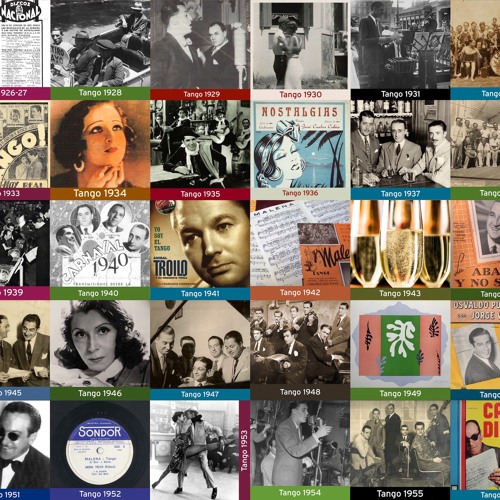
Tango By Year, by year
Dag Stenvoll and Michael Lavocah · 1 Sept 2021 · 4:24:01
This is episode 38 of Tango By Year, a one-off reunion special that Dag Stenvoll and Michael Lavocah broadcast together in Norwich four and a half months after the main series' last 1943 episode. Instead of one year, they play roughly fifty recordings in chronological order from 1926, the year electrical recording reached Argentina, through 1955, the year they both call the end of tango's golden period, tracing the sextet era and the Dicarian school, the 1931 crash that wiped out many orchestras, D'Arienzo's rhythmic revolution from 1935, the early-1940s flowering of the 'big four,' wartime lyric censorship from 1943, and the genre's early-1950s second wind under Salgán, Gobbi, a returning Di Sarli and an increasingly ambitious Pugliese. 1952 and 1958 are explicitly skipped. They close, outside the stated range, with Troilo reciting his own 1968 poem 'Nocturno a mi barrio' over bandoneón and guitar, closing both the episode and the series itself.
0% heard
4:24:01 left
Up next, as released
Tango By Year, by year: The afterpartyEpisode 39 · 10 Nov 2021 · 3:43:55What this episode gave Tangopedia
Facts said in the episode, each now cited to the minute it is said.
Electrical recording (microphones) reached Argentina in 1926; before that all recording was acoustic, with a horn driving a stylus straight into wax.
In Julio De Caro's orchestra Maffia was the number-one bandoneón and Laurenz the number two, so Maffia usually took the solo even in passages that suited Laurenz's style better.
Bands of this period were sextets (piano, double bass, two bandoneóns, two violins) though they still called themselves orchestras; the format grew to three-and-three by the late 1930s and four-and-four by the 1940s.
The 1940s 'big four' were D'Arienzo, Di Sarli, Pugliese and Troilo; the late-1920s equivalent was a 'big three and a half': Canaro, Fresedo and Firpo, plus the less commercially successful Julio De Caro.
Fresedo stopped recording in 1928 to go travelling, cutting short what Lavocah calls his best period, 1926-28.
Opens the episode with a bandoneón duet so listeners can hear the two players who, with Ciriaco Ortiz, most influenced Troilo's bandoneón style: Maffia dark and velvety, Laurenz brighter and more attacking.
Only in the episode
♪ Music · 2:52 · The lyrics, on the song's page

Picked as Lavocah's favourite orchestra and favourite Fresedo period (1926-28): sparse, playful, still showing off Fresedo's own bandoneón.
♪ Music · 3:23 ·

A showcase for pianist Francisco De Caro's melody writing; so purely melodic and undanceable that Pugliese, who loved it, never recorded his own version.
♪ Music · 2:50 ·
Watch it danced · 34
Picked to show the strong, even, no-arrastre four-beat pulse that the hosts say directly influenced D'Arienzo's 1930s sound, with Elvino Vardaro as uncredited session violinist.
Only in the episode

An instrumental from Canaro's arranged 'Serie Sinfónica,' chosen as proof of his creative peak in 1929, with Ada Falcón as his muse.
♪ Music · 3:11 · The lyrics, on the song's page
Watch it danced · 1
A cello-led instrumental chosen because Maffia's recording rescued a forgotten tango and is the reason Troilo later recorded his own version.
Only in the episode
Played to demonstrate Firpo's heavy dragging arrastre beat, an acknowledged ancestor of Di Sarli's and Pugliese's rhythm; no title was stated on air.
Only in the episode
♪ Music · 2:52 ·

One of the first milongas ever recorded, picked to show it is a folk rhythm, not yet dance music; the lyric is a jealous rant at an ex-girlfriend's new boyfriend.
Only in the episode
♪ Music · 2:33 ·
Chosen to represent the orchestras whose careers the 1931 economic crisis and talking pictures cut short; Brignolo also composed Chiqué, played earlier.
Only in the episode
♪ Music · 1:41 ·
Chapter · 59:52
The Tango His Best Friend Never Got to Record
He wrote it for his friend — then lost the contract before he could record it.

A soloist's vals chosen to show the non-dance side of the catalogue; the song Di Sarli, Discépolo's close friend, never got to record because he lost his contract the same year it became a hit.
♪ Music · 3:10 · The lyrics, on the song's page

Di Sarli's last recording before an eight-year gap, chosen to show his mature sound was already fully formed by 1931.
♪ Music · 2:01 ·

An unusually wild instrumental with a manic mid-song piano break, picked as an atypical Lomuto track.
Chapter · 1:16:52
The Elevator Accident That Created a Solo
A broken leg turned a trio recording into one of tango's rawest solo vocals.
A rare solo vocal recording, made because trio member Roberto Fugazot had just broken his leg in a lift accident and could not sing his part.
Only in the episode
♪ Music · 2:34 · The lyrics, on the song's page
Chapter · 1:22:40
The Milonga a Diva Didn't Want
The song behind every milonga tanda was rejected twice before it was a hit.
The first-ever recording of the song that later became Canaro's famous 1933 milonga, after Azucena Maizani, who had commissioned it, turned it down.
Only in the episode
A bandoneón solo with guitar backing, picked to demonstrate the 'conversando' technique Troilo later adopted from Ortiz, Maffia and Laurenz.
Only in the episode
♪ Music · 2:46 ·
Chapter · 1:32:38
The Record So Advanced the Label Said No
RCA Victor heard the future of tango in 1933 and rejected it on the spot.
The only surviving recording of Vardaro's own, highly advanced orchestra, which RCA Victor rejected as a record at the time.
Only in the episode
♪ Music · 3:16 ·
Picked as one of Maizani's last strong numbers before the era of star soloists faded, accelerated by Gardel's 1935 death.
Only in the episode

Rodolfo Biagi's first-ever recording session with D'Arienzo, played as the start of the orchestra's new rhythmic era, though it was not yet commercially successful.
♪ Music · 2:22 · The lyrics, on the song's page
Watch it danced · 19

Charlo's solo, guitar-backed version of Juan Carlos Cobián's hit, used as the image for the original Tango 1936 event.
Only in the episode
♪ Music · 3:19 ·

Laurenz's first recordings, chosen as a masterpiece full of marcato-to-syncopation shifts, already road-tested live for two years before being recorded.
♪ Music · 3:14 ·
Watch it danced · 68

Troilo's only 1938 recording, a one-off test disc for Odeon that did not sell, leaving a three-year gap before his next session; chosen to show his extrovert-to-introvert mood shift already present at the end.
♪ Music · 2:47 · The lyrics, on the song's page
Watch it danced · 24

An instrumental chosen to show Biagi building his signature off-beat piano feel into the whole orchestra after leaving D'Arienzo.
Watch it danced · 72

Di Sarli's December 1939 comeback recording, introducing his 17-year-old new singer nicknamed 'Terremoto' for his powerful voice.
♪ Music · 2:31 · The lyrics, on the song's page
Watch it danced · 130

A very fast New Year's Eve vals from D'Arienzo's fastest period, introducing Mauré as the voice that would later pull the orchestra toward a more lyrical style.
♪ Music · 1:46 ·
Watch it danced · 336

Chosen for Castillo's street-smart delivery and the 'life is short, live it' lyric, picked as advice for dancers returning after the pandemic.
The lyrics, on the song's page
Watch it danced · 244
Chapter · 2:23:01
The Singer Who Had to Quit His Day Job
He was a tango star by night and a gynaecologist by day — until his fans found out.

From Troilo and Fiorentino's first vocal recordings in 1941, an up-tempo track picked to show the mood shift from extrovert verse to a more introvert chorus already seeded there.
The lyrics, on the song's page
Watch it danced · 448

Chosen for D'Agostino's unusually clean, spacious 'crystalline' piano playing on a classic number.
♪ Music · 2:04 ·
Watch it danced · 2
Picked as a landmark of the new, more lyrical 1942 style, and of the crooner approach Berón brought that Caló initially disliked.
Only in the episode
♪ Music · 2:04 ·

Chosen to show how a listener can identify Laurenz's phrasing by its characteristic volume waves within each phrase.
♪ Music · 3:01 · The lyrics, on the song's page
Watch it danced · 43

Picked as one of the best examples of counter-melody in tango, where a violin line answers and weeps against Rufino's vocal.
The lyrics, on the song's page
Watch it danced · 44

Tanturi's new singer after Castillo went solo, chosen for the thick, creamy violin sound typical of the orchestra's period.
The lyrics, on the song's page
Watch it danced · 187

An instrumental favourite from Pugliese's second year recording, chosen for its freedom of piano phrasing and liquid double-bass playing.
Watch it danced · 9

An uncommonly-played track chosen to show Marino's full operatic vocal range; the lyric is about a funeral and the title refers to a city in northern Morocco.
♪ Music · 2:45 ·
Watch it danced · 8

Laborde's first recording, learned and cut in only three days before the band left for Montevideo.
♪ Music · 3:08 · The lyrics, on the song's page
Watch it danced · 146
Picked as one of the best milongas ever, unusually danceable both to its melody and its rhythm.
Only in the episode
Introduced as a new singer with a dark, bass-baritone voice who, like Edmundo Rivero, started out with Salgán's orchestra before moving on; the orchestra's name could not be made out.
Only in the episode

One of two Troilo classics played back to back, introduced with the story of Argentine dancers rushing the floor for a Troilo-Ruiz tanda while European visitors sat out.
♪ Music · 3:57 · The lyrics, on the song's page
Watch it danced · 34

Played as Rivero's whispered masterpiece, noted as partly Manzi's own farewell letter written while dying of cancer.
Watch it danced · 13

An instrumental tribute to Troilo from De Caro's favourite, final recording period, said to show Pugliese's influence folding back into his old teacher.
Watch it danced · 39
Chapter · 3:32:12
Six Years to Finish One Tango
He wouldn't let it be recorded until it was perfect — even though it was already being danced to.

The third piece of Pugliese's 'triptych' to be recorded, though the first written, held back roughly six years until Pugliese judged it finished.
Watch it danced · 88
An instrumental tribute to composer Agustín Bardi, picked to represent the new, more complex 'musician's band' sound that began before 1950.
Only in the episode

Picked to show Maciel's voice used very differently than it later was with Pugliese, and Gobbi's more milonguero, classically-interesting style.
♪ Music · 2:48 · The lyrics, on the song's page
Watch it danced · 10

The 1951 of two recordings of this song, preferred by the hosts over the better-known 1952 version for its subtler, more relaxed vocal.
♪ Music · 3:10 · The lyrics, on the song's page
Watch it danced · 21

An instrumental chosen to show D'Arienzo's 1950s return to his 1930s hard-beat, mostly-instrumental repertoire with a stronger four-bandoneón section.

Picked for Serpa's unusual, non-porteño voice and the recurring theme of the sea in Di Sarli's work, who was born on the coast.

Called a personal favourite by both hosts, an instrumental built around melting violin work from Camerano, rarely heard at milongas.
♪ Music · 1:56 ·
Watch it danced · 39
Chapter · 4:06:57
Give Everything, or Don't Dance
A legend of the milonga once dragged a man outside to teach him this lesson.
A solo, guitar-backed vocal version, chosen over the more famous Biagi/Ortiz recording for the expressive quality of Rivero's voice alone.
Only in the episode
♪ Music · 2:04 · The lyrics, on the song's page
An instrumental closing the main 1926-1955 survey, described as a precursor to 'Adiós Nonino' and a symbol of tango moving from dance music to concert music.
Only in the episode
Played as a deliberate epilogue outside the 1926-1955 range: Troilo himself, not a singer, recites his own love poem to his barrio over bandoneón and guitar.
Only in the episode
Chapter · 4:16:41
A Love Letter to a Barrio, Spoken by the Man Who Never Left
His last recording wasn't sung at all — it was spoken, at a funeral's afterthought.
Follow through every episode
Tango By Year is Dag Stenvoll and Michael Lavocah's, published here with their permission. The audio plays from SoundCloud.