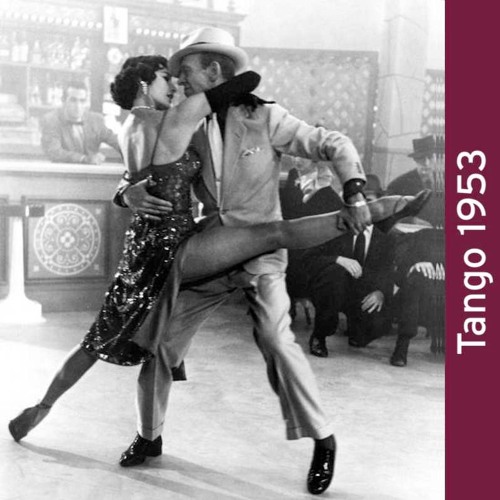
Tango 1953
Dag Stenvoll and Michael Lavocah · 27 Jan 2021 · 3:26:02
Dag Stenvoll and Michael Lavocah call 1953 a tricky year: on the surface the big four (D'Arienzo, Di Sarli, Troilo, Pugliese) are going strong, but D'Arienzo and Di Sarli have stopped developing, and Troilo is recording less since the 1951 deaths of two close friends, Homero Manzi and Enrique Santos Discépolo. Outside the dance hall, tango faces three challenges: rock and roll, mambo and above all folklore, which gets a push from a new Law of Live Music that backfires for tango because cinema owners hire cheap folk groups. The show leans on the advanced end: Elvino Vardaro's one-off all-star disc, Gobbi, Pugliese's two great Morán discs, Salgán, Lucio Demare's solo piano, and Troilo with Berón and Casal, then closes with Ranko Fujisawa singing Sur with Troilo and Grela before General Perón. A short afterparty plays other rhythms: a rumba, milongas, a folk-tango fandango and a zamba.
0% heard
3:26:02 left
Up next, as released
TBY Lost Afterparty III - 1947Episode 30 · 3 Feb 2021 · 2:45:26What this episode gave Tangopedia
Facts said in the episode, each now cited to the minute it is said.
In 1950 D'Arienzo went back to the style of the late 1930s, rejecting the 1940s, and for the rest of the 1950s there is no development in his music.
Di Sarli's music was never about development; it has a timeless quality, so standing still matters less than for D'Arienzo.
Troilo is losing force in 1953, with fewer recordings than expected; his heart has not recovered from 1951, when two close friends and big musical names, Homero Manzi and Enrique Santos Discépolo (heard 'Omar Omanzi and Di Scepolo'), died.
In the 1950s tango faces three challenges: rock and roll (strong only from about 1956), mambo (hits Argentina about 1955) and folklore, which is already having an impact.
A new law required a share of the music played in cinema and theatre intervals to be live; it backfired for tango because owners hired cheap, unknown folklore musicians, giving folklore an extra push.
Now playing
Caminito del indio / chacarera (unclear)Atahualpa Yupanqui · Atahualpa YupanquiOpening warm-up: Yupanqui with guitar, a chacarera, introduced by Dag as 'Atahualpa and Chacarera' to mark folklore moving into the mainstream.
Only in the episode
♪ Music · 1:52 ·
Chapter · 5:15
The law that helped the wrong music
Argentina tried to protect tango. It helped folklore.
A vals by Ciriaco Ortiz's trio (bandoneón and two guitars), picked because Di Sarli also recorded it that year with Serpa but nobody hears this version at milongas.
Only in the episode

Castillo's version of the Donato classic about a bachelor flat at Corrientes 348; Dag points to how Castillo phrases 'Corrientes'.

A bitter vals about friends and women paying back with treason; Lavocah suspects irony. A listener hears Peruvian rhythm in it.

Charlo, a veteran who was the big singer of 1928, still sings in tune; the milonga is not for dancing and still has a flute that sounds pre-1920.
Only in the episode
♪ Music · 1:50 · The lyrics, on the song's page

Salgán on the small Te-Ka label with the young Goyeneche; Lavocah calls the lyric one of the most beautiful and important in the canon.

A knife-fight song with a very strong rastra and what Lavocah calls the strongest violin marcato in tango; the open texture lets you hear the bandoneón.
♪ Music · 2:22 ·

Lavocah prefers it to Troilo's version, for the spacious texture that puts the moaning low bandoneón line in dialogue with the violins.
Watch it danced · 5
Chapter · 38:45
Why Di Sarli's tangos are so short
Di Sarli plays slow. Why are his records so short?

A Di Sarli milonga (his own composition, recorded before in 1945) picked for its cadencia, the swing of a phrase.
♪ Music · 2:18 ·
Watch it danced · 10

A duet by Varela's orchestra; a sweet piece that Lavocah says he plays mixed in at milongas.
♪ Music · 0:44 ·
Watch it danced · 8

Played for historical interest: Polito, D'Arienzo's pianist after Biagi, with a simple banging-the-beat band that sounds like the early 1940s.
♪ Music · 2:31 ·

An energetic instrumental, in better fidelity than before because D'Arienzo is now on tape masters; has the Puglisi one-note violin solo.
Chapter · 1:00:20
One disc, then nothing
The best violinist in tango got one record as a leader.
Chapter · 1:03:20
Pugliese's joke
Pugliese handed out a wild arrangement. Then took it back.
One side of Vardaro's only disc as a leader, Argentino Galván's arrangements, issued on Columbia's celebrity C-series; Vardaro's violin goes from a line to double stopping to very fast articulated notes and still sounds like tango.
Only in the episode
♪ Music · 2:53 ·
The other side of the same disc: a Bardi tango; Domingo Mancuso, the high violin from D'Arienzo's 1930s band, is fourth violin and there is a cello.
Only in the episode
♪ Music · 2:54 ·

Lavocah on Gobbi: modest violin, tempo that flexes organically, but a milonguero orchestra and still inspiring to sextets today.
♪ Music · 3:20 ·
Watch it danced · 164
Morán in a tango Troilo also recorded (which Dag heard in 47 or 48); the double title comes from the Uruguayan composer's old lyric and the Argentine one, kept after a copyright tussle between Sadaic and Montevideo.
Only in the episode

Lavocah's note on it: 'From darkness to light'. Pugliese adds far more than the 1930 composition holds; Camarano's violin and Ruggiero's bandoneón.
The lyrics, on the song's page
Watch it danced · 332

An extreme interpretation: Morán sings both verses, violins at white heat, a long near-empty passage and a Biagi-style fake ending.
The lyrics, on the song's page
Watch it danced · 8

The B side of the October disc, an instrumental; start time approximate (lost in a long Whisper gap).
Watch it danced · 104

Solo piano; Lavocah hears the link to Weimar cabaret and Chopin. Demare had dissolved his orchestra in 1945.
Watch it danced · 5
A soft recording where Spitalnik puts together an orchestra to back Calderón, a former Troilo singer; very sensitive accompaniment.
Only in the episode
♪ Music · 2:54 · The lyrics, on the song's page

With guitar backing, which they prefer to his orchestra recordings; Lavocah reads his own English translation of the lyric.
Only in the episode
♪ Music · 2:55 ·
A radio recording of the guardia vieja composer on bandoneón with a second bandoneón and double bass, introduced with 'I'll speak in the language of eternity, the bandoneón'.
Only in the episode
♪ Music · 1:46 ·
Troilo-Grela quartet; you hear the vibrato, and the conversando phrasing he learned from Ciriaco Ortiz.
Only in the episode
♪ Music · 2:52 · The lyrics, on the song's page
Chapter · 2:09:10
The dream that wrote Mensaje
A dead poet dictated this lyric in a dream.

First recording of the song (Troilo-Rufino version is 1965); the lyric from Cátulo Castillo, said to have been dictated by Homero Manzi in a dream.
♪ Music · 3:40 · The lyrics, on the song's page

Spitalnik's 1948 arrangement re-recorded, more expressive; first time in Tango By Year.

One of the songs of the year, a very long and heavy lyric.
♪ Music · 3:36 · The lyrics, on the song's page

A vals duet; they say Troilo's 1950s singers get better the more you hear them.
Chapter · 2:31:00
A Japanese singer, Troilo and Perón
She came to Buenos Aires on holiday and ended up singing Sur with Troilo.
Live radio recording from the Teatro Cervantes (heard as 'Teatro de Cépolo') with Troilo and Roberto Grela accompanying, Perón in the audience; Troilo's greeting precedes the song.
Only in the episode

Closing track by tradition; Laurenz has only two recordings of it (the first in 1926). A modest, introverted bandoneón in the Troilo style.
♪ Music · 3:14 · The lyrics, on the song's page
Afterparty: an Argentine Latin band playing a rumba, with a funny lyric about a girl with a wasp waist and a rich father.
Only in the episode

Played as the opposite end of the milonga spectrum from Di Sarli's: it 'rattles along like a racehorse'.
Watch it danced · 14
Chapter · 2:55:36
The milonga Troilo wrote and never recorded
Troilo wrote a milonga and never recorded it.
A Troilo-written milonga from 1953 that Troilo never recorded; Canaro did.
Only in the episode
♪ Music · 3:10 ·

A band mixing folk and tango with an African drum, benefiting from the government's push for native music.
Only in the episode
A zamba from the folk group's first EP; the first folklore track on the show.
Only in the episode
♪ Music · 3:30 ·

A different take on a song linked to Caló and Berón; not dance music but 'the tango version of jazz'.

The second of Demare's two 1953 solo piano recordings, of a Cobián tango.

Last record: Julio De Caro's composition, finally interpreted by Troilo, with some striking discords.
♪ Music · 2:51 ·
Follow through every episode
Tango By Year is Dag Stenvoll and Michael Lavocah's, published here with their permission. The audio plays from SoundCloud.