Tango 1952
Dag Stenvoll and Michael Lavocah · 2 Sept 2020 · 3:29:41
By 1952 the single direction tango had in 1950-51's up-tempo revival has fractured: Troilo and Pugliese keep developing their sound, while D'Arienzo and Di Sarli mostly repeat what already made them famous, with D'Arienzo even pulling back from the previous year's instrumental experiments toward straight vocals. The 'big four' orchestras dominate the year almost completely, crowding out the newer bands that had broken through in 1950-51. Several singers move from orchestra employee to independent star with their own guitar or small backing group, including Ángel Vargas, Edmundo Rivero, Jorge Vidal and Nelly Omar. Odeón introduces tape mastering this year, prompting Pugliese to re-record much of his back catalogue, not always for the better. The episode closes with an attached 'lost afterparty' set stacked with Di Sarli and a run of milongas, plus a solo cortina from gypsy-jazz guitarist Oscar Alemán.
0% heard
3:29:41 left
Up next, as released
Tango 1933Episode 18 · 16 Sept 2020 · 3:41:38What this episode gave Tangopedia
Facts said in the episode, each now cited to the minute it is said.
Preparing for the show, Michael kept finding himself picking songs from these four orchestras; the newer bands that broke through in 1950-51 mostly failed to sustain that level.
the "big four" orchestras (Troilo, D'Arienzo, Pugliese, Di Sarli)
Tango's single direction from the 1950-51 up-tempo revival has fractured: Troilo and Pugliese keep developing, while D'Arienzo and Di Sarli mostly repeat their established styles, with D'Arienzo even regressing from 1951's instrumental experiments back to mostly vocals.
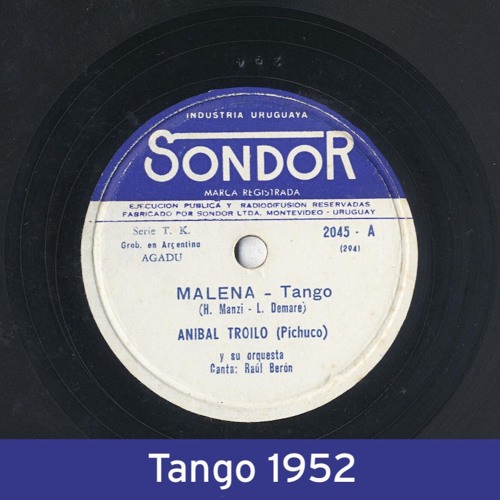
The 1952 re-recording of Malena adds violins and cellos "weeping" after the opening piano, on top of the arrangement Héctor María Artola made for the 1942 Fiorentino version.
Berón stayed with Troilo for about four years before being sacked after Troilo asked him to turn his microphone volume down in a noisy cabaret and he turned it back up.
By the 1950s there are more good singers than bands to employ them, the reverse of the 1940s, when orchestra leaders had to hunt for and build up their own vocalists.
Now playing
Kiss of FireGeorgia Gibbs · 1952Dag's cold open: an American pop hit built on the tango El Choclo, used to set up the whole episode's theme of tango splintering and reaching odd corners of 1952 pop culture.
Only in the episode
♪ Music · 1:19 ·

A later re-recording of Malena with Berón, picked to show that tango's single spirit (heard in the 1942 Fiorentino version) has now fractured into separate, incompatible directions.

Troilo's only vocal recording of El Choclo; the hosts note the song is one of the few tangos that survived in the catalogue as both a pure instrumental and a sung number.
Watch it danced · 1

Michael calls this the best of Troilo's three recordings of the piece, and maybe the best recording of it by anyone, balancing the band's early vigor against its later, more symphonic style.
♪ Music · 2:08 ·
Chapter · 21:20
Troilo's Pianist Got His Own Song, From His Best Friend
He played piano for Troilo until 1943. In 1952, Troilo paid him back with a tango.

A tribute composed by Alfredo Gobbi for his friend, pianist Orlando Goñi, who played for Troilo until mid-1943; played instead of a Goñi recording because Goñi himself barely recorded anything that year.
One of the year's biggest tango hits, with guitar backing: an old man gets a second chance at love with a younger woman but still can't stop acting the macho.
Only in the episode
♪ Music · 2:12 ·
Chapter · 34:14
The Milonga With 300 Years of Hidden History
Every line repeats the same word, for a reason going back to colonial Spain.
Rivero's own composition, built on wordplay he traced back roughly 300 years to a Spanish colonial satirical poem; Michael connects it to Violeta Parra's Chilean version of the same lineage.
Only in the episode
Chapter · 39:11
A Melody So Beautiful No One Ever Danced To It
Tango's most beautiful unplayed melody, written by the quiet brother at the piano.

One of the most beautiful tango melodies ever written, composed by the orchestra's pianist, Francisco De Caro; no dance orchestra is known to have picked it up.
♪ Music · 2:28 ·
Watch it danced · 1

A lyric Dag first misread as an old lecherous man, but which is actually a tragic cabaret girl pretending to enjoy herself while cold and sad inside.
♪ Music · 2:13 · The lyrics, on the song's page
Watch it danced · 1

A deliberately old-fashioned Uruguayan orchestra with a hard 'saloon piano' sound, chosen for Miranda's voice and a lyric both hosts call an early feminist tango.
♪ Music · 1:34 ·
Watch it danced · 15

Laurenz's own co-composition (with Pedro Maffia) slowed right down from the famous, more energetic 1940 vocal version, giving it a more mature '50s feel.

Dag picked this from a brand-new reissue; it opens with an unusually long spoken introduction, and the bandoneón imitates the whistling signal old-time street policemen used at night.
♪ Music · 4:58 ·
Chapter · 1:06:20
The Policeman's Whistle Hidden in a Bandoneón
A tango cop walks his beat, and the bandoneón imitates his whistle.
A tango the hosts picked to show Echagüe's street-edged voice, played right before the instrumental that closes the D'Arienzo set.
Only in the episode
♪ Music · 0:01 ·

Called the explosive instrumental closer of the night's D'Arienzo set, with the whole band "on fire" and a rhythmic triplet trick Michael treats almost as an etude.
Watch it danced · 467
A new-to-the-show orchestra Dag picked because it recorded a tribute to the lyricist Pascual Contursi.
Only in the episode
♪ Music · 2:00 ·

Vargas's first year truly flying solo with his own backing band, after years underpaid as the draw in D'Agostino's orchestra.
♪ Music · 3:10 ·
Watch it danced · 3

Michael calls this 1950s Di Sarli at its most vigorous, with Serpa's resonant voice and a lyric Michael rates as perfect.
♪ Music · 0:10 ·
Watch it danced · 7

An unusually mature vals lyric: not a simple love story, but a man singing that he wants something lasting rather than a fleeting night.

One of the rare recordings where Di Sarli, who almost never shows off on piano, lets rip about 30 seconds in; Michael calls it "Beethoven."
♪ Music · 2:57 · The lyrics, on the song's page
Watch it danced · 3
Named for the 33 men who led Uruguay's war of independence against Spain; Michael calls it a resistance song with the same thunderous left-hand piano as La cachila.
Only in the episode

Pugliese's sole 1952 vocalist after losing baritone Jorge Vidal; several orchestras (including Troilo) recorded this song that year.
Watch it danced · 1
A rare Pugliese vals, picked despite Michael saying it is nearly impossible to build a coherent set from his handful of waltzes.
Only in the episode

Paired with Parados to show Pugliese's trademark contrast of power and beauty.
Watch it danced · 8
Built around a violin solo by Alcides Camerano, answered quietly by the rest of the section before the whole violin line unites.
Only in the episode
Chapter · 2:00:55
The Singer Who Quit to His Boss's Face
He told the Maestro exactly why he was leaving, and never looked back.

Vidal's own solo recording with guitars, composed by Enrique Santos Discépolo, with a bleak chorus about three hopes, two betrayed and one dead.
Only in the episode
♪ Music · 2:19 ·

A guitar-backed milonga the hosts call hypnotic, likely including a guitarrón (a deeper-toned guitar a fifth bigger than normal).
Only in the episode
♪ Music · 2:39 ·

Salgán's own instrumental take on a song the show had already played in its Tango 1942 episode as a Troilo/Fiorentino vocal recording.
♪ Music · 4:11 · The lyrics, on the song's page
Chapter · 2:15:19
Troilo Heard the Future Before the Singer Did
One of Goyeneche's earliest recordings, and Troilo already knew where it was going.
One of Goyeneche's very first recordings, well before he became known as a reciting, speak-singing "diseur" of Argentine song.
Only in the episode
♪ Music · 1:44 · The lyrics, on the song's page

A vals most listeners won't know, originally composed and recorded by Feliciano Brunelli in 1949; Michael calls Salgán's piano playing "goosebump material."
♪ Music · 2:30 · The lyrics, on the song's page

Fresedo's own composition, first recorded in 1933 with Roberto Rey singing; Michael still prefers the original for the spirit of its era.
♪ Music · 2:01 · The lyrics, on the song's page
Watch it danced · 64

Closes the main show; Dag reads out a contemporary 1952 magazine review praising Troilo's restrained, ensemble-balanced version over directors who overdo the solos.
♪ Music · 2:00 · The lyrics, on the song's page
Chapter · 2:34:08
The Jazz Guitarist the Nazis Threw Out of Paris
He survived occupied Paris, then came home and recorded gypsy jazz in Buenos Aires.
A cortina break: Argentine gypsy-jazz guitarist Oscar Alemán, who was thrown out of occupied Paris by the Germans and came home to keep recording.
Only in the episode
♪ Music · 3:22 ·
The faster of the two Alemán cortina tracks, played straight after Saudade.
Only in the episode

A milonga with a joke ending Michael says is risky to play at a real milonga, since dancers enjoy the first three minutes then give the DJ a look when the trick lands.
Watch it danced · 1
Valentino made what many call the greatest recording of Cualquier cosa with Domingo Federico in 1951, then switched to this lesser-known orchestra in 1952, which Michael says deserves to be better known.
Only in the episode
♪ Music · 2:26 ·

A Troilo milonga re-recording that rarely gets aired because the famous 1940s original is usually preferred; Michael, after hearing it, still prefers the 1940s version.
♪ Music · 1:30 ·

Written by Astor Piazzolla for Troilo's early-50s band; Michael likes that it is one of Piazzolla's less overdone arrangements for the orchestra.
Watch it danced · 10

Italian for "tomorrow"; one of Michael's favorites, with Pomar's more proper, straight voice contrasted against Serpa's style elsewhere in the night.
Watch it danced · 4

A 1952 re-recording the hosts call stronger and more vigorous than Di Sarli's original 1945 version.

Dag calls this the strongest arrastre (dragging bass pull) ever recorded in tango, growling and raw, compared to the smoother, more reverberant later RCA Victor remake used in beginner tango classes.
Watch it danced · 163

One more Serpa vocal, closing out his 1952 appearances in the episode.
♪ Music · 2:24 ·

A melody by pianist Juan Carlos Cobián, a personal friend of Di Sarli's from their shared Bahía Blanca days, that Michael says doesn't get played often enough.
♪ Music · 2:01 · The lyrics, on the song's page
Watch it danced · 13
Chapter · 3:18:35
The Shavings Under Your Feet
This tango's title isn't what it sounds like.

Michael flags a double piano glissando in the first phrase and mid-piece discords before a violin solo; together with Carasucia and Don Juan he calls it a trio of older songs transformed by Di Sarli's own interpretation.
♪ Music · 2:30 ·
Closing the night: originally a zamba Pugliese and his first wife listened to while courting, later arranged for orchestra at his request by newly joined bandoneonist Roberto Pepe, which Michael says gives it a countryside rather than city feeling.
Only in the episode
♪ Music · 4:35 · The lyrics, on the song's page
Follow through every episode
Tango By Year is Dag Stenvoll and Michael Lavocah's, published here with their permission. The audio plays from SoundCloud.