Tango 1950
Dag Stenvoll and Michael Lavocah · 1 Jul 2020 · 3:47:48
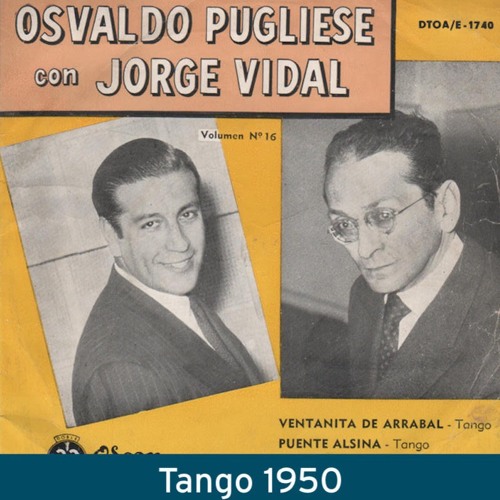
Dag Stenvoll and Michael Lavocah call 1949-50 the biggest change tango music ever had: it emerges from the crisis brought on by government censorship and repression, new local labels break the long Victor-Odeon duopoly, and about nine orchestras record for the first time. Dag plays many obscure new bands (Mancione with Fiorentino, Kaplun, Salgán, D'Alessio, Gobbi, Francini-Pontier) alongside the soloists Marino, Castillo and Rivero. Troilo is out of contract after leaving Victor in 1949 and does not record for around a year, but pushes Piazzolla's modern arrangements; Varela leaves D'Arienzo mid-year, taking singer Laborde, and D'Arienzo has already turned toward the simpler 50s style; Di Sarli does not record; De Caro makes his warmest, best music. Pugliese in 1950 is Dag's favourite year, with Jorge Vidal and Alberto Morán, and the long second hour is a Pugliese fest. The show ends with Rivero's La cumparsita (Buccino orchestra) and a long afterparty.
0% heard
3:47:48 left
Up next, as released
Troilo specialEpisode 13 · 8 Jul 2020 · 4:24:19What this episode gave Tangopedia
Facts said in the episode, each now cited to the minute it is said.
1949 to 1950 is the biggest change tango music ever had: after a crisis brought on largely by government censorship, the censorship lifts and tango refines and reinvigorates itself, with an explosion of new activity.
Mancione signed Fiorentino for two years, though he did not last that long. Victor may have recorded Mancione to fill the gap left by Troilo, who changed label that year.
Away from Troilo, Fiorentino's phrasing is freer and he sits more at the front of an orchestra less flexible than Troilo's.
Mancione told an interviewer that Fiorentino was late for a recording session of Te aconsejo que me olvides because he had missed a flight from Mar del Plata that crashed after takeoff, killing everyone on board except a small child.
Kaplun led his orchestra from the violin, as few did (about half are led from the piano, most of the rest from the bandoneón); he had played the strong violin marcato in early Lucho Demare and was with Miguel Caló before Francini; only about ten sides exist and they did not sell.

A new orchestra whose signing of Fiorentino for two years boosted its popularity; Fiorentino phrases more freely here than with Troilo.
♪ Music · 2:19 · The lyrics, on the song's page
Chapter · 9:33
The plane Fiorentino missed
Tango's most famous singer was late to a recording, and that saved his life.

A violinist-led orchestra on the new Teca label; Dag picks it for the sharp marcato, colourful changes, bow work and an unusual modulation at the end.
Only in the episode
♪ Music · 2:29 ·
Chapter · 19:30
A compliment from Pugliese
Pugliese hugged a rival and said: you captured something of my soul.

Salgán's own tribute to the composer Agustín Bardi, witty and idea-packed with his bubbling upbeat 'umpa umpa' accompaniment.
♪ Music · 2:36 ·
An instrumental from one of D'Alessio's few sides on Teca, slower and not like the well-known Di Sarli version of 1940.
Only in the episode
♪ Music · 2:46 · The lyrics, on the song's page
Chapter · 31:00
The singer with a transfer fee
A tango bandleader paid a football-style transfer fee for a singer.

A tango whose title means 'kill her': the narrator is urged in dreams to kill his lost love but blames himself instead.
♪ Music · 2:50 ·
Watch it danced · 5

Hugo Duval's first recording with Biagi, a country waltz with galloping horses and chirping birds, with less reverb than later Columbia sides.
Watch it danced · 3

Dark and emotional Gobbi that Dag says reminds him more of Troilo than Pugliese; Maciel, later Pugliese's singer, sings with exquisite phrasing.
♪ Music · 2:34 · The lyrics, on the song's page
Watch it danced · 10

A second recording (after 1945) of an instrumental Dag cannot tell apart from the first, likely made again after the switch to tape masters.
Watch it danced · 2

A waltz, not the Desencanto tango, apparently the only recording of this piece, sung by Lemos with a very fine vibrato.
Watch it danced · 7
Chapter · 57:40
The gentle De Caro
Tango's great modernizer made his warmest music at the end.

Lavocah's top track of 1950 and the best Mi dolor by far; Marcucci wrote it c.1930, and De Caro's warm 1950 band lets the bandoneóns open it and keeps the singer back for more than two minutes.
♪ Music · 3:12 · The lyrics, on the song's page
Watch it danced · 5
Chapter · 1:03:55
Why Troilo vanished for a year
In 1949 Troilo walked out of Victor, and the repertoire went in the bin.

One of the tangos of the year and Francini-Pontier's most danceable number; Lavocah thinks the double bass here first shows the 'strappata' effect.
♪ Music · 1:48 ·
Marino as a soloist; Artola, Troilo's main arranger in 1941-42, leads the backing orchestra.
Only in the episode
♪ Music · 3:35 ·
A Castillo waltz with a backing that puts a pizzicato emphasis on beat two, a pattern similar to La bien pagá.
Only in the episode

Dag's pick for Piazzolla's 'étude for modern tango', Troilo's first take on Piazzolla's ideas; cello and double bass carry the intro, then Troilo's bandoneón solo.
♪ Music · 3:21 ·
Watch it danced · 3

Played for Ruiz, whom Rotundo poached from Troilo for a transfer fee and a car; the quality of the orchestra rises when he sings.
Watch it danced · 1
Rivero as a soloist with guitar backing after leaving Troilo; Dag prefers his guitar recordings in this period.
Only in the episode
♪ Music · 3:35 ·
Rivero with Buccino's orchestra, a lyric about a girl who renamed herself in a French style for the cabarets; the orchestra is not Troilo, but Rivero lifts it.
Only in the episode
A solo piano recording of Visca's own composition, melancholic, simple and 'naked', found by Dag through Bernhard's DJ database.
Only in the episode
♪ Music · 2:37 ·
Chapter · 1:53:04
Lomuto's last session
The elder statesman recorded his final tango weeks before he died.

Lomuto's last recording, made on 27 October 1950, very sad and darker than his usual sound.
♪ Music · 2:39 ·
Watch it danced · 4

The first of the 'double Vidal'; Vidal's deep baritone is described as like an earthquake.
♪ Music · 2:50 · The lyrics, on the song's page
Watch it danced · 7

A lyric about a man who gives a coin to a beggar and recognises a former cabaret hostess from the old marketplace; Lavocah explains 'se le dio vuelta la taba'.
Watch it danced · 15
Chapter · 2:08:10
The beggar from the old market
A coin, a covered face, and a woman he once knew.

One of only three compositions by violinist Julio Carrasco, with wild orchestral aggression and one of the most beautiful violin solos in tango.
Watch it danced · 207
Chapter · 2:13:50
Take it all, but not her
A tango where a man offers his brother everything he owns, except one thing.

A late-1920s tango whose lyric is a man telling his own brother to take everything but not his woman; Lavocah calls it one of Morán's best.
Watch it danced · 10
The only one of the year's four La cumparsita recordings worth hearing, Rivero's only recording of the song; Dag bridges to next week's Troilo special.
Only in the episode
♪ Music · 2:53 · The lyrics, on the song's page
Replayed at the afterparty because listeners asked to hear it again.
Only in the episode
♪ Music · 3:05 ·

A rarely heard Gobbi instrumental whose long opening 'chicharra' (a sound effect like a cicada) Lavocah calls sexy.
Watch it danced · 1

A tango from the woman's point of view warning a man that girls are not toys, in a vigorous De Angelis year.
♪ Music · 2:41 ·
Watch it danced · 6

Salgán's debut record, a Pugliese composition; the famous bandoneón variation from the trio section is played on the piano, in the middle of the tango.
♪ Music · 3:09 ·

A Di Sarli-like orchestra filling the gap left by Di Sarli's absence, but with an ordinary bandoneón marcato rather than the violin-led Di Sarli one.
♪ Music · 2:19 ·

First of three D'Arienzo instrumentals; the chromatic opening scale shows where the 1950s style is heading.
♪ Music · 2:40 ·
Watch it danced · 2

Second of the three D'Arienzo instrumentals played as a small set.

A less known third D'Arienzo instrumental that mixes well with the other two; Dag mentions listeners in Belgium play it.
Watch it danced · 8

A charming milonga written by Troilo; Troilo, out of contract, did not record it until later.
Watch it danced · 1
A selection of tangos by Aníbal Troilo arranged by pianist Julio Medovoy; Lavocah wanted Dag to hear what the 'other' Caló did.
Only in the episode
♪ Music · 2:38 ·

A song Rivero sang with Troilo; Dag asks what it would have sounded like with Troilo in 1950.
Only in the episode
♪ Music · 2:03 ·

A warmer treatment of an exciting but cool piece; Pugliese had recorded it in 1948 to support De Caro's comeback.
♪ Music · 1:47 ·

A vocal number by the same singer as Mi dolor, showing another side of De Caro; the double bass is now clearly audible.
♪ Music · 2:34 ·

First of the Pugliese fest: an advanced instrumental that Lavocah says is Beethoven.
♪ Music · 2:50 ·
Watch it danced · 3
Lavocah calls it '200 proof' Morán, in a tandita of Morán sides.
Only in the episode

A Mario Canaro piece (main version by Francisco Canaro) that Pugliese turns into drama and tension, as he did with Pinta brava in 1949.
Watch it danced · 3

A very little known instrumental; Lavocah thought the title meant horsefly, but the chat suggested it means a horse.
♪ Music · 2:50 ·
Watch it danced · 1

An instrumental very few people know, a killer with no respite from intensity.

A long-lyric milonga about a benefit dance for a man out of jail that gets out of hand.
The lyrics, on the song's page
Watch it danced · 15

Dag explains barra as a gang of friends, an Argentine Spanish word with no English equivalent.
Watch it danced · 1

The final song of the night, the last of the remaining Vidal numbers.
Watch it danced · 3
Follow through every episode
Tango By Year is Dag Stenvoll and Michael Lavocah's, published here with their permission. The audio plays from SoundCloud.