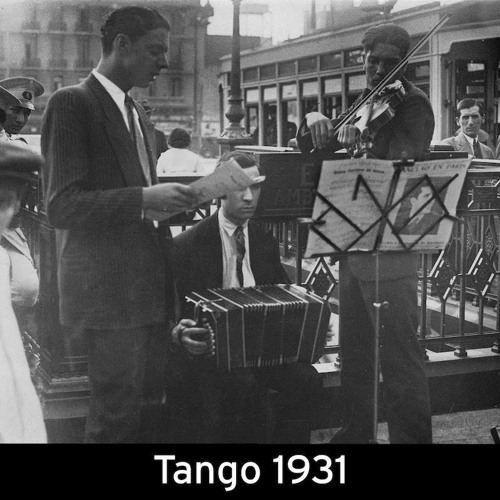
Tango 1931
Dag Stenvoll and Michael Lavocah · 31 Mar 2021 · 4:07:30
Stenvoll and Lavocah take 1931 as a year of Depression and crisis: Villa 31 is founded behind Retiro, labels are going bust, and Di Sarli loses his Victor contract and falls back to accompanying singers until 1939. The big three orchestras are Fresedo, Firpo and Canaro (with Lomuto's help), and the music takes on a darker, slower edge: Fresedo, famous for sweetness, shows the Depression most, and Firpo is in a sad mood after losing money. It is also a great year for women singers (12 or 13 recorded) and Spanish-flavoured tango, and a year of sextets that are about to be pruned away by the recording crisis of 1931-32. The afterparty adds Canaro in the good-bad-ugly slot, Charlo, Minotto Di Cicco, a Juan Maglio tanda and a long stretch of Fresedo.
0% heard
4:07:30 left
Up next, as released
Tango 1943Episode 37 · 14 Apr 2021 · 5:51:57What this episode gave Tangopedia
Facts said in the episode, each now cited to the minute it is said.
The Great Depression reached Argentina late because agricultural exports insulated it in 1929; by 1931 Villa 31, a slum behind Retiro station, was opened for Polish immigrants sleeping in goods carriages.
Many labels are about to go bust and many artists have been dropped; Di Sarli loses his contract and ends up backing Mercedes Carné.
Canaro made about 180 recordings in 1931 while Di Sarli made perhaps ten; the sweetness is mixed with playful tangos for dancing.
A brothel tango from about 1870 by Casimiro Alcorta; Francisco Canaro published the score as 'arranged by' him, and Di Sarli's version is now the best known.
Fresedo shows the effects of the Depression more than any other orchestra: slow, spacious and melancholic, with a 1931 sound unlike his sweet 1940s one and unlike his earlier 20s music.
Chapter · 2:15
Villa 31 began in 1931
Buenos Aires's best-known slum was founded in the year of this recording.
One of the songs of the year, a Discépolo composition of 1930 recorded at least ten times in 1930-31; this one is led by Carabelli with the violin forward.
Only in the episode

One of the first recordings of a tango best known from Pugliese and Morán in the mid-1940s.

Stenvoll skips Francisco Canaro and picks his brother Juan; a very old tango, originally from 1870 by Casimiro Alcorta and later published by Francisco Canaro.
Chapter · 18:20
The king of sweet goes dark
Fresedo's 1931 sound is nothing like his 1940s sweetness.
A Canaro-brand tango Stenvoll finds more varied than Canaro's usual songs of the time.
Only in the episode
Chapter · 23:50
The year Di Sarli lost his contract
In 1931 Di Sarli was dropped by his label.

A Di Sarli favourite waltz that he returned to at least twice later; Lavocah says the melody came from a composer who could not write music and had Di Sarli write it down.
Only in the episode

In Stenvoll's opinion the best of Di Sarli's last 1931 recordings before he loses his contract; a man cursing the woman who left him.
♪ Music · 2:07 ·
A house orchestra that made very few records; the same song D'Arienzo recorded in 1935. Steady rhythm and a lovely violin solo near the end.
Only in the episode
Firpo's piece after losing money in the stock market: hardly any beat, a floating melancholy like the melancholy of a ghost.
Only in the episode
Chapter · 44:40
Firpo lost it all
Roberto Firpo's next composition was called Deep Sadness.
An instrumental with a much better beat for dancing than the previous one.
Only in the episode
♪ Music · 6:06 ·
A slow, introvert, melancholic waltz without the usual bouncy beat; the ending is very sudden.
Only in the episode

A heavy lyric in which a woman loves a man who is awful to her; Lavocah calls it the tango version of Billie Holiday's 'My Man'.

Features a cello played by Donato's brother Ascanio; the Donato band was a family band.
Chapter · 1:00:48
The family band
Three Donato brothers in one orchestra.
An instrumental whose whole band stops for a piano interlude; Lavocah calls it bonkers and a challenge to Canaro's more complex sinfónica recordings.
Only in the episode
Played with Mar de fondo; Lavocah says these two are better than most of what Canaro did that year.
Only in the episode
A woman sings from a man's point of view; Tania was born in Spain and took her stage name from a Russian girl in her drama class.
Only in the episode
A man at a bar who makes you drink with him; another drinking-to-forget lyric.
Only in the episode
A waltz with guitars that D'Arienzo recorded in 1936; Vicente Spina is first guitar.
Only in the episode
♪ Music · 2:38 ·
Chapter · 1:36:52
Was it Biagi?
Possibly the young Biagi on a 1931 Juan Guido session.
Lavocah's research suggests Biagi may be the pianist on Guido's 13 January 1931 session, after turning down Gardel's offer to go to Spain.
Only in the episode
Stenvoll's favourite singer; her horse dies, which was serious business then, as Lavocah says with 70 tangos listed about horses.
Only in the episode
A Spanish-flavoured tango from the Barcelona side of tango.
Only in the episode

A masterpiece by Eduardo Arolas with a rare piano solo; played slowly and spaciously, 'a tango for 3am'.

Maglio's violin comes in at once; played as a prototype of the D'Arienzo band.
Watch it danced · 1
A strong walking beat with a big role for the piano, 'just as Biagi will'.
Only in the episode
Maizani's own composition, a rare lyric written by a woman; the pianist is Orestes Cúfaro.
Only in the episode

The last of the evening's women singers.
Fiorentino early in his career; the opening notes imitate a church bell. Lovely cello by Néstor Feria.
Only in the episode
A waltz with a singer named Rafael, played after the Carillón.
Only in the episode
A difficult lyric about violence in a relationship, defended by Lavocah as a profound study of emotion; Corsini was said to have learned to sing from birds in Sicily.
Only in the episode
An arrangement with a cello, musical saw, pizzicato violins and a piano solo, one of only two versions that year.
Only in the episode
Jazz break before the afterparty: Armstrong on fire.
Only in the episode
The original version of the Blues Brothers song, which is from 1931 and not the 40s.
Only in the episode
Lavocah: 'I shouldn't like this tango but I do', an earworm.
Only in the episode

Lavocah's trump card to defend 1931 Canaro; a lunfardo word for the mud of the barrio streets.
Watch it danced · 1
A waltz Lavocah loves, played after reiterating that Sueño de juventud is not for dancing.
Only in the episode
Played to show the short period when Minotto led his own band instead of being Canaro's bandoneonist; first bandoneón is Ángel Ramos.
Only in the episode
Lavocah compares a decade-earlier 'Griseta' to the 1941 Di Sarli and Rufino song.
Only in the episode
♪ Music · 2:16 ·
A run of Maglio tangos that drew a strong positive reaction from the chat.
Only in the episode
Closing section: Lavocah says Fresedo in 1931 is so different from his output in any other year.
Only in the episode
A Discépolo tango, 'prophet of despair and cynicism'; 'what a sucker'.
Only in the episode
♪ Music · 3:15 ·
Follow through every episode
Tango By Year is Dag Stenvoll and Michael Lavocah's, published here with their permission. The audio plays from SoundCloud.