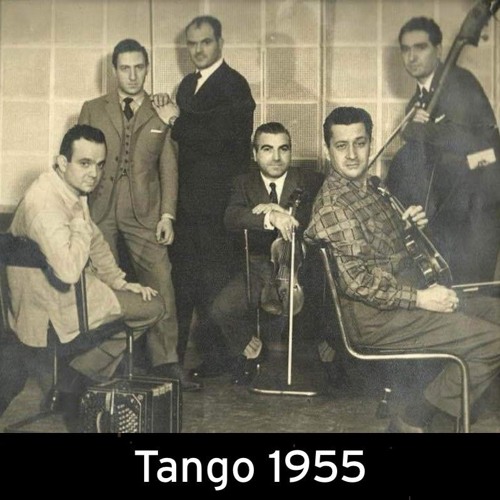
Tango 1955
Dag Stenvoll y Michael Lavocah · 9 de dic de 2020 · 3:14:43
1955 is, in Lavocah's words, the end of tango's golden age, politically and musically at once. Pugliese is jailed for six months as a Communist political prisoner from January to July; in June the military bombs the Casa Rosada and Plaza de Mayo, and in September the Revolución Libertadora finally topples Perón, after which Peronist-linked artists are banned, including singer Nelly Omar (for the next seventeen years) and folk singer Antonio Tormo. Musically the traditional dance orchestras largely stagnate: D'Arienzo mostly recycles old hits and Troilo records only about six songs all year, while Pugliese keeps moving forward the moment he is released (recording Emancipación that September) and Piazzolla, studying in Paris with Nadia Boulanger, records a landmark set of non-dance, self-composed sides. Alongside Pugliese a small 'evolutionary' wing pushes further still, from Alfredo Gobbi's dense, far-ahead-of-its-time Camandulaje (which Pugliese himself only dares record in 1973) to Jorge Caldara's post-Pugliese experiments. The show closes with a long bonus set of extra 1955 recordings and the hosts announcing an upcoming all-amor 'Love Special' and a run of 'lost afterparty' episodes for January.
0% escuchado
faltan 3:14:43
Lo que sigue, como se publicó
TBY Love SpecialEpisodio 25 · 30 de dic de 2020 · 4:08:21Lo que este episodio dio a Tangopedia
Datos dichos en el episodio, cada uno citado al minuto en que se dice.
Lavocah calls 1955 the end of tango's golden age: traditional orchestras like D'Arienzo are mostly re-recording old hits, and Troilo manages only about six songs all year, while Pugliese and Piazzolla alone keep pushing the music forward.
1955
Pugliese was arrested in a café on 10 January 1955 with a violinist, both Communist Party members, and was incarcerated for exactly six months, released on 10 July.
1955
On 16 June 1955 the Argentine military bombed the Casa Rosada and Plaza de Mayo, killing hundreds of civilians; Perón survived that coup but was finally toppled in September by the better-organised Revolución Libertadora.
1955
Troilo's new 1955 pianist, Osvaldo Manzi, also substituted for Pugliese's orchestra for about six months in 1957, after Pugliese was too shocked to play following another political crackdown that saw communists imprisoned on a ship in the Río de la Plata; Manzi is the pianist heard on the recording of Pata Ancha.
Roberto Pansera, who arranged Troilo's 1955 Intermezzo, is the same arranger who changed Eduardo Fresedo's sound in 1950.
Lavocah opens with this as the precursor to 1967's Adiós Nonino, and as the moment Piazzolla, recording his own compositions in Paris, marks the end of the dance era.
Solo en el episodio
♪ Música · 1:59 ·
Figari's own composition, played to show the ex-Troilo pianist's new solo band still carries Troilo's punch.
Solo en el episodio
♪ Música · 1:17 ·
An instrumental milonga played straight after Figari's tango to show the other side of his new orchestra; the exact point it starts within the continuous recording is approximate.
Solo en el episodio
Rivero's guitar-backed version of a tango dancers know from a Biagi/Ortiz recording of the early 1940s.
Solo en el episodio
♪ Música · 1:56 · La letra, en la página del tango

An old composition dancers know from D'Arienzo's versions; Lavocah plays it to show Troilo's new pianist, Osvaldo Manzi, even in a year Troilo barely records.
♪ Música · 3:00 ·

Arranged by Roberto Pansera; played straight after El Irresistible as the more forward-looking of Troilo's few 1955 sides, so the exact split point between the two tracks is approximate.
Verlo bailado · 4
A bandoneón-and-guitars quartet recording of a 1925 Julio De Caro composition, picked for its intimate, basement-club feel.
Solo en el episodio
♪ Música · 3:12 · La letra, en la página del tango
A Donato composition from the early 1920s sung from a woman's point of view, which the hosts call a bit of 'girl power.'
Solo en el episodio
♪ Música · 2:37 ·

D'Agostino's own composition, played with its famous glosa about a real, now-vanished café on the old, narrow Calle Corrientes.
♪ Música · 2:48 · La letra, en la página del tango
Verlo bailado · 381
Vargas's intimate solo version, played against dancers' memory of the angrier D'Arienzo/Echagüe recording, including a second verse unknown from that version.
Solo en el episodio
♪ Música · 2:30 · La letra, en la página del tango

An instrumental by Mariano Mores played as one of the last recordings before the orchestra's amicable breakup after ten years.
♪ Música · 2:09 ·

A late discovery for Stenvoll this week, picked for the extra colour and melodic hold Laborde brings compared with Echagüe.
La letra, en la página del tango
Verlo bailado · 18

Played as something lighter after D'Arienzo, and to tell the story of the song's real, uncredited composer.
♪ Música · 2:04 · La letra, en la página del tango
Verlo bailado · 1
Capítulo · 1:06:47
The ghost who wrote a hit and never got credit
Francisco Canaro's name is on the sheet music. He didn't write a note of it.
Capítulo · 1:09:03
Silenced for seventeen years
These are the last recordings she made before she vanished from the airwaves for seventeen years.
One of Omar's last recordings before her seventeen-year ban, played to mark that moment.
Solo en el episodio
♪ Música · 2:38 ·
Omar's own composition, a slow, sad countryside milonga about death, played alongside the vals as her final sides before the ban.
Solo en el episodio

A Gardel composition, played to note that Gardel himself recorded it in March 1935, months before his fatal plane crash, and that Goyeneche's phrasing here is still early.
♪ Música · 2:21 ·

The fourth of Di Sarli's recordings of his own composition, oddly pitched up a key with no singer to justify it, which Lavocah reads as tango drifting from its roots.
♪ Música · 2:29 · La letra, en la página del tango
Verlo bailado · 131

An old Charlo composition, played to showcase Serpa, Lavocah's favourite of Di Sarli's two stable singers.
♪ Música · 2:56 ·

Played against dancers' memory of Rufino's fast 1939 version to show how much slower and more 'melodic wash' Di Sarli's 1955 sound has become.
La letra, en la página del tango
Verlo bailado · 8
An 'expedition to non-Argentine tango' (after Finland two weeks earlier), a Turkish recording Stenvoll bets Lavocah has never heard.
Solo en el episodio
♪ Música · 2:42 ·

Her first solo recording since splitting from Donato in the early 1940s and withdrawing from public life; a comeback the hosts feel the title fits.
Solo en el episodio
♪ Música · 3:07 ·
A solo recording for Vidal's powerful bass-baritone voice, arranged by Galván, the sideman who wrote many early Troilo arrangements.
Solo en el episodio
♪ Música · 2:53 ·
Morán's own backing band after leaving Pugliese the year before, picked to show him singing at full intensity again, without Pugliese's restraint.
Solo en el episodio
♪ Música · 2:33 · La letra, en la página del tango
Capítulo · 1:57:34
The bandleader who carved a piano into his prison table
In 1955 Argentina's most beloved tango bandleader was a political prisoner -- and even the guards were starstruck.

A Gardel-era song from the mid-1920s, also famous from Di Sarli/Rufino, re-recorded to showcase Maciel as the refined heir to Morán's high-octane role.
♪ Música · 3:12 · La letra, en la página del tango
Verlo bailado · 143

A happy-go-lucky Donato number from 1940, transformed into a rare Pugliese vocal duet.
La letra, en la página del tango
Verlo bailado · 10
Capítulo · 2:10:13
The song that dared to say his name
Weeks after his release from a political prison, a radio glosa said his name on air -- twice.

Pugliese's first recording after six months in jail, an 1910s tango whose title literally means 'emancipation,' played with the original on-air glosa that named him.
♪ Música · 3:04 ·
Verlo bailado · 396
The first of two unusual, non-dance versions of La Cumparsita played before the break; an instrumental bandoneón-and-guitars quartet reading.
Solo en el episodio
♪ Música · 2:32 · La letra, en la página del tango
Capítulo · 2:18:21
The one time Alberto Castillo sang La Cumparsita
There's only one known recording of Alberto Castillo singing La Cumparsita -- and it's not the lyric you know.

As far as Stenvoll knows, the only recording of Castillo singing La Cumparsita, using the alternate 'Si supieras' lyric.
Solo en el episodio
A swing-guitar number by the Argentine jazz guitarist newly returned from Paris, played to open the bonus afterparty set.
Solo en el episodio
♪ Música · 2:00 ·
A second, more delicate Piazzolla Paris side, played to encourage listeners to go and seek out the rest of that session.
Solo en el episodio
♪ Música · 1:59 ·
An Argentine (not Japanese) recording by the bandoneonist who spent a couple of years working in Japan during the political turmoil; the title as announced was not clearly caught.
Solo en el episodio
♪ Música · 2:11 ·
Capítulo · 2:36:23
The tango that waited eighteen years to be played right
Alfredo Gobbi wrote a tango so advanced in 1955 that Pugliese didn't dare record his own version for eighteen years.

Gobbi's own composition, called by Lavocah the 'bleeding edge' of 1955 tango; Pugliese liked it enough to record it himself, but not until 1973.
♪ Música · 2:29 ·
Verlo bailado · 3
A song that, per Stenvoll, sold 35,000 copies and saved Montero's place in the orchestra after a shaky start; its title was not stated on air.
Solo en el episodio
♪ Música · 2:15 ·

A second Montero number played straight after the first, with Montero's street-edged, bass-baritone delivery.
♪ Música · 1:33 ·

Played as a guess-the-singer game; Stenvoll can imagine it as a Pugliese/Morán number, though it was not recorded by them.
♪ Música · 2:55 ·
Verlo bailado · 1

A guitar-backed vals played as one of the few 1955 waltz recordings; Lavocah also mentions Alberto Morán's version of a different vals in the same breath, so the two may be conflated in the transcript.
Solo en el episodio
♪ Música · 5:47 ·
Capítulo · 2:59:01
A bus-stop breakup becomes a tango
Two men waiting for a night bus watched a couple dance their last tango together -- and wrote a song about it.

An instrumental Lavocah especially loves for how far Di Sarli stretches the melody, composed by the same man who wrote El Recuerdo.
♪ Música · 4:29 ·
Verlo bailado · 9

A big song of 1954-55 (Miguel Caló recorded it in 1954); played as what Stenvoll calls Di Sarli's especially special take.
La letra, en la página del tango
Verlo bailado · 9

Played last of the three, with the story of its composers witnessing a real breakup dance at a milonga and writing the song about it that night.
La letra, en la página del tango
Verlo bailado · 110
Capítulo · 3:09:41
The American who out-sold every Argentine in the US
Every Argentine orchestra that tried to make it in America failed. The biggest tango star there wasn't even from Argentina.
A 'mystery' closing track: the third of Cugat's three recordings of the song, rearranged as a Mambo, chosen to crown a segment on tango's history in the United States.
Solo en el episodio
♪ Música · 4:30 · La letra, en la página del tango
Seguir por todos los episodios
Tango By Year es de Dag Stenvoll y Michael Lavocah, publicado aquí con su permiso. El audio se reproduce desde SoundCloud.