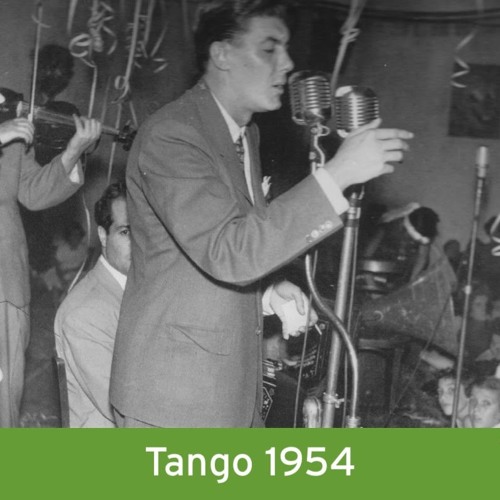
Tango 1954
Dag Stenvoll and Michael Lavocah with Jesús Mela · 28 Oct 2020 · 3:35:42
On the surface 1954 looks like 1950-52, but Lavocah argues the wide base of tango is shrinking: small venues are closing, imported music and a rising folklore boom compete, and a law that forced 50% Argentine live music ended up employing cheap second-rate folklore acts. The top layer is intact, with Pugliese (new singers Miguel Montero and Jorge Maciel arrive in mid-year, Alberto Morán leaves) and Di Sarli (back at Victor after three years on Music Hall) as Stenvoll's two lighthouses. D'Arienzo repeats his late-1930s style, new tangos are scarce so bands recycle foreign songs, and a hint of kitsch and reverb creeps into the sound. Soloists with guitars (Rivero, Marino, Vargas, Chanel) and Japanese singer Ranko Fujisawa add variety, and guest Jesús Mela, son of Pugliese's presenter Luis Mela, recites his father's gloss live before a Pugliese record, as it was done at the milonga.
0% heard
3:35:42 left
Up next, as released
Tango 1934Episode 22 · 11 Nov 2020 · 3:30:06What this episode gave Tangopedia
Facts said in the episode, each now cited to the minute it is said.
By 1954 tango's wide base of small venues is shrinking, with places like Café Nacional on Corrientes (where Pugliese debuted in 1939) closing; the top layer of recording orchestras looks unchanged. The song Qué te pasa Buenos Aires, recorded in 1956, is about this.
A law required at least 50% Argentine music in live shows, but because bands cost more than cheap acts, it ended up giving work to second-rate folklore artists in cinemas' ad breaks. Foreign music was imported more and more after the war, and the folklore boom was starting.
Stenvoll sees Pugliese and Di Sarli as the two lighthouses of the year, though much of what else he found is not danceable.
In the 1950s small kitschy elements creep into tango, and reverb is added to master tapes, giving a glossier sound; the big crossover hit of 1954 was Hernando's Hideaway, from the musical The Pajama Game, with tango versions by De Ángelis and Rodríguez.
Vargas tried to quit D'Agostino and go solo in 1943 but failed and had to beg for his job back. A 1950s magazine interview quotes him as saying he was finally earning his own money working for himself.
Now playing
Bell Bottom BluesAlma Cogan · Alma Cogan · 1954Pop song from the warm-up, played for contrast before the programme began.
Only in the episode
♪ Music · 0:37 ·
Chapter · 2:27
The tango pyramid is shrinking
In 1954 the base of tango started to disappear.

Federico's own composition, a soft and sweet instrumental with a pizzicato opening and, as far as Stenvoll knows, its only recording; chosen as the sweet half of a contrast pair.
♪ Music · 3:24 ·
Watch it danced · 87

The contrast to Muy suave: a hellish lyric, and Podestá's first recording with Caló since about 1943.
The lyrics, on the song's page
Watch it danced · 48

Picked for its rich orchestral texture and the dark voice of Luis Correa; the last chords turn to a major key and change the mood.
♪ Music · 2:45 ·
A guitar-backed waltz by a soloist with only about nine recordings, most from this year; Stenvoll hears a darker Corsini. It is hard to recognise as the song D'Arienzo made popular in 1937.
Only in the episode

A slower, glossier D'Agostino with reverb now added to the tape, and a singer who sounds like Ángel Vargas; set against the 1939 version with Rita Morales.
Vargas as a soloist, with more authority than in his D'Agostino years; the lyric (by a woman, Maruja Pacheco Huergo) is an unusually calm goodbye.
Only in the episode
One of only four Biagi recordings of the year; sharp and accentuated like his early 1940s sound. A Mexican song that Fresedo first turned into a tango.
Only in the episode
♪ Music · 3:10 ·

A waltz composed by Ignacio Corsini that Stenvoll had not heard at milongas; used to show D'Arienzo repeating himself.
Watch it danced · 11
Chapter · 46:45
He gave a Japanese woman a stage
She did not speak a word of Spanish and Buenos Aires loved her.
A very slow waltz sung in a mix of Japanese and Spanish by the Japanese singer who had made a hit in Buenos Aires the winter before.
Only in the episode
♪ Music · 2:45 ·
A slow, sad milonga; the only older recordings Stenvoll found are Rivero 1955 and Pugliese-Maciel 1964.
Only in the episode
One of the songs of the year, recorded at least seven times; Chanel's tour-de-force version about a mother who goes out dancing while her son starves.
Only in the episode
Chapter · 1:04:26
The gloss before Pugliese
At the milonga, the orchestra was announced with a poem.
Played directly after Jesús Mela's recitation of his father's gloss, with no explanation, as at the milonga. Lyrics are a confession to a police officer ('Comisario, arrésteme, sargento') from a man who killed his unfaithful partner and friend.
Only in the episode
Second Pugliese number after the gloss: an old man in La Boca, sole mio, mamma mia, drinking and crying for the past.
Only in the episode
Chapter · 1:13:30
Why Morán left Pugliese
Thousands of fans, and he still left bitter.

Morán's last recording with Pugliese, in March 1954; picked for the singer who left the band that year.
♪ Music · 3:05 ·
Watch it danced · 139

A darker, slower rendition of a song owned by Troilo and Fiorentino; arranged by Julio Carrasco, and a performance that escapes comparison.
The lyrics, on the song's page
Watch it danced · 13

An instrumental that is the only recording of this tango; Camerano's violin solo is called stunning.
♪ Music · 3:15 ·
Watch it danced · 39
The only Pugliese recording of D'Arienzo's 1935 breakthrough hit, and a signpost on the way to Pugliese's mature, open sound.
Only in the episode
Rivero with guitars in a version Stenvoll prefers to his orchestral recordings; lyrics by Enrique Santos Discépolo, a song D'Arienzo and Mauré made famous.
Only in the episode
♪ Music · 2:44 · The lyrics, on the song's page

An instrumental in which Troilo leaves out one note of the melody, creating a syncopated feeling.
Watch it danced · 1

Mariano Mores' milonga from a 1953 film, rhythmical and playful, danceable partly because there is no singer.

A much more introverted take on a Roberto Rufino composition, with Marino's voice given space as a soloist.
♪ Music · 3:30 · The lyrics, on the song's page
Watch it danced · 1
Chapter · 1:56:11
A French waltz that was Argentine first
Edith Piaf's La foule wasn't French.

A waltz with simple accompaniment, a tango version of an Argentine song later made famous in France as La foule.
Only in the episode
♪ Music · 2:19 · The lyrics, on the song's page
A joyful, swinging waltz duet with an upright-piano sound; as far as Stenvoll knows the only recording of it.
Only in the episode
An instrumental composed by Racciatti himself, with a ridiculously long variation at the end; likened to a house party of amateur musicians.
Only in the episode
♪ Music · 3:00 ·

Merello's comeback studio version with Canaro; a no-nonsense lyric ('those who say I'm bow-legged haven't seen me in my nightdress').
Only in the episode
♪ Music · 2:57 · The lyrics, on the song's page
One of two Music Hall instrumentals from January 1954 (dates uncertain), played for the dirtier sound and as a bracket with Muy suave's pizzicato.
Only in the episode
♪ Music · 2:40 ·

Scrambling left-hand piano, a wailing bandoneón opening and an A-B-A-C structure with astounding B and C parts.

A Discépolo waltz composed around 1939 that Di Sarli recorded three times, one of only about 20 waltzes in his career.
♪ Music · 2:30 · The lyrics, on the song's page
Watch it danced · 3

A song belonging to Rufino, reinterpreted by Di Sarli and Serpa; about grief, with a final chord that leaves some light.
Chapter · 2:33:59
Di Sarli's own voice
The only time Di Sarli speaks on a record.

Di Sarli's return to the studio with RCA Victor, opened by a spoken introduction by Di Sarli himself to his friends and 'the music I most love, the tango'.

Closing track, as the show's tradition: one of at least four 1954 renditions, with nice piano and a variation Stenvoll thinks may be Varela himself.
♪ Music · 2:43 · The lyrics, on the song's page
After-party: a short two-minute solo piano version by D'Arienzo's stand-in pianist.
Only in the episode
♪ Music · 2:17 · The lyrics, on the song's page

After-party: Lavocah points out that on this tape master you can hear the bandoneonists snapping their instruments shut after running out of air in the first 10 seconds.
♪ Music · 2:10 ·
Watch it danced · 1

After-party: a waltz with an amazing Podestá vocal, played for the Podestá-Caló pairing.
♪ Music · 3:30 ·
Watch it danced · 6

After-party: a lyric about a man buying every toy in a shop on the Night of the Three Kings for poor children, because as a child he had only bread.
♪ Music · 2:47 · The lyrics, on the song's page
Watch it danced · 33
After-party: Rivero's guitar version avoids kitsch in a song about a criminal praying for his dying mother; music by Roberto Chanel, same lyricist as Fatal y tanguera.
Only in the episode

After-party: an innovative and influential composition by Salgán, a musician's musician with little following among dancers.
♪ Music · 3:07 ·

After-party: a waltz whose last 30 seconds goes completely off the rails; Goyeneche was learning to accompany a wild orchestra before finding fame with Troilo.
♪ Music · 1:57 ·
Chapter · 3:16:07
The dirty El choclo
Di Sarli recorded El choclo twice in 1954. One is dirty.
After-party: the RCA Victor version, the one everyone knows, played in contrast to the Music Hall one.
Only in the episode
♪ Music · 0:48 ·
After-party: the earlier, dirtier Music Hall version (about six months earlier), which Stenvoll prefers for its emotional contrast.
Only in the episode
♪ Music · 2:41 ·

After-party: Di Sarli and Pomar staring into existential dread, a Discépolo song.
Watch it danced · 216

After-party: a sentimental tango about the narrow old Corrientes street before it was widened; not a milonga number.
♪ Music · 3:13 ·
Lavocah's classical surprise: Callas, who became a star in 1953, in the aria used as the theme of the film Diva.
Only in the episode
♪ Music · 4:38 ·
Follow through every episode
Tango By Year is Dag Stenvoll and Michael Lavocah's, published here with their permission. The audio plays from SoundCloud.