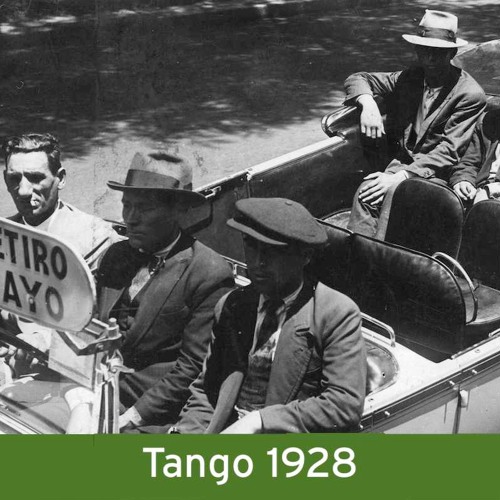
Tango 1928
Dag Stenvoll and Michael Lavocah · 13 Jan 2021 · 4:05:29
The earliest year in Tango By Year so far, 1928 is a golden age of a different kind from the 1940s: more than a thousand recordings, a big three of Canaro, Firpo and Fresedo (plus Gardel), and new-guard bands (Julio De Caro, Pedro Maffia, Luis Petrucelli) making advanced music that sells poorly but shapes everyone else. Charlo joins Canaro and Lomuto as estribillista, the Odeon-Glucksmann Gran Concurso tango contest produces a batch of hits, and Fresedo, at his intense best, leaves for Europe in October, which gives Carlos Di Sarli his break with Victor. Stenvoll builds his selection from listener suggestions, and Lavocah talks about the old guard (Maglio, Guido), Cobián's New York disappearance, guitar-backed soloists such as Rosita Quiroga, Mercedes Simone, Azucena Maizani and Corsini, the Orquesta Típica Victor, and Firpo's El amanecer. After the show Lavocah plays more Canaro, De Caro, OTV, Fresedo and Firpo and ends with Gardel's Ramona.
0% heard
4:05:29 left
Up next, as released
TBY Lost Afterparty II - 1944Episode 28 · 20 Jan 2021 · 3:12:11What this episode gave Tangopedia
Facts said in the episode, each now cited to the minute it is said.
1928 has a big three, not a big four: Canaro, Firpo and Fresedo, plus Gardel as the fourth big name; none of the 1940s big four is yet at the top.
The new guard (Julio De Caro, Pedro Maffia, Luis Petrucelli) were beginning to record and influence the scene in 1928 but not selling many records; they would take a while to be recognised.
Canaro and Lomuto both started using Charlo as an estribillista in 1928, when estribillistas had hardly been used before; Charlo, spotted by Odeon's artistic director Goddard, first recorded with Canaro in February, and his voice lifts both bands.
More than a thousand recordings were made in 1928; Stenvoll had about 100 on his computer and used listener suggestions to build the list.
Troilo played in Maglio's orchestra for a few months as a boy of 15 or 16 (c. 1929-30) and said Maglio barely understood the music by then: on the night they opened at a new café Maglio did not turn up, then sat down, listened to the band and said 'I don't understand this music any more'. The band was maintaining the Maglio brand.
Chapter · 6:08
Maglio didn't recognise his own band
Juan Maglio sat in the audience and said: I don't understand this music.
One of two Maglio tangos, played to show his new, irresistible four-strong-beats compás and stop-time that remind one of D'Arienzo.
Only in the episode
♪ Music · 2:35 ·
The second Maglio tango, with Viván singing; Maglio's music is more complex than before because younger musicians are evolving his style.
Only in the episode
A quite fast waltz, unusually fast for the period, which Stenvoll believes is at the right speed.
Only in the episode
♪ Music · 2:08 ·

Discépolo's first tango, perhaps the most popular of the year, with guitar backing; a man sees his ex coming out of a nightclub, ruined, and decides to get drunk.
Only in the episode
♪ Music · 2:25 ·
A waltz also known from Di Sarli's early-1940s version and Nelly Omar with Canaro; here with guitars.
Only in the episode
♪ Music · 2:18 ·
Chapter · 26:00
Why Di Sarli started in 1928
Fresedo's departure gave Di Sarli his break.
Di Sarli's first recording ever, with his sextet for Victor; the walking beat, double bass and left-hand piano are already present.
Only in the episode
♪ Music · 2:41 ·
Both Canaro and Lomuto recorded the same tango with Charlo; Lomuto's has more weight and is less sweet.
Only in the episode
♪ Music · 2:22 ·
Chapter · 40:00
The tango contest that made the year's hits
In 1928 a record boss ran a tango competition to sell records.

An instrumental with a nice violin counter-melody and a bandoneón variación at the end; a Pedro Maffia composition.
♪ Music · 2:10 · The lyrics, on the song's page

A second instrumental that many listeners will not have heard.
A first for the programme: a darker female voice from an older era, with a violin counter-melody and a bandoneón played by Cortis.
Only in the episode
♪ Music · 2:35 ·

A composition by Sebastián Piana and Pedro Maffia; the accompaniment is weaker than in the first song.
Only in the episode
Chapter · 1:02:45
The bandoneonist who played without a break
Minotto could play in both directions without a pause.

A man waiting for his lover in a room; Charlo jumps up an octave, 'how long I have waited', and has beaten death to be with her. Stenvoll says it 'kills me every time'.

A lyric about a blind street violinist who one day isn't there; the bandoneón variación without a break is probably Minotto.
Watch it danced · 1
Two near-identical recordings, one with Charlo as estribillista and one a week later with Charlo as soloist; this is the soloist version.
Only in the episode
♪ Music · 2:53 ·
Her own composition, a bleak plea to a policeman not to arrest a boy who stole for his dying mother; guitar backing.
Only in the episode
♪ Music · 2:11 ·

With a good rhythm and bandoneón variación, probably Petrucelli; the cotton-dress title refers to poverty.
♪ Music · 2:35 ·
Watch it danced · 1
Chosen for its melody and bandoneón variación; Laurenz is first bandoneón and De Franco second, giving a Laurenz-style dynamic.
Only in the episode
♪ Music · 2:48 ·
Chapter · 1:36:10
The Prince of Wales danced to De Caro
In 1925 the Prince of England had a tango band at his ball. It wasn't Canaro.
Chapter · 1:37:15
The divorce that cost $50,000 and a career
She paid him to leave: $50,000, in New York.

Cobián's last year of recording before he leaves; Fiorentino is not yet at his Troilo best, and Vardaro plays violin.
♪ Music · 2:26 ·

A tango with a lesser-known singer, perhaps named after a racehorse or football player; Lavocah notes there is a whole genre of football tango.
♪ Music · 1:45 ·
Watch it danced · 1

One of the Gran Concurso tangos of Max Glücksmann's competition, a medium hit; Stenvoll prefers the Fresedo version. The orchestra stops and Famá sings with guitar.
♪ Music · 3:10 ·

Not the Pedro Laurenz tango of the same name; Stenvoll's note says 'six-star masterpiece'. A heavy lyric looking back to knife fights.
An old-timer orchestra that now sounds old-fashioned, with Vardaro as a session violinist; a Juan de Dios Filiberto composition with a slightly square beat and a charming, sad melody.
Only in the episode
Vardaro with Oscar Alemán and Gastão Bueno Lobo on guitars; the trio recorded only about three sides, a record-company idea.
Only in the episode
♪ Music · 2:40 ·
An instrumental of a Schiammarella tango later made famous by Pugliese; complex, dense music with Vardaro and a second violin who plays a separate line.
Only in the episode
♪ Music · 2:13 ·
A Paris-based band which makes advanced, joyful music with whistling and a musical saw; a surprise of the year for Stenvoll.
Only in the episode
♪ Music · 2:52 ·
Her own song, sung quietly and matter-of-factly about a woman's heartbreak.
Only in the episode

Firpo, 'in my view the best band of the year' for Stenvoll; a cabaret lyric.
♪ Music · 3:00 ·
Another cabaret tango, 'poetry of the cabaret', with a groove and a piano that points toward Di Sarli.
Only in the episode
A sad instrumental by Alfredo Eusebio Gobbi, father of the Gobbi of the 1940s.
Only in the episode
♪ Music · 2:50 ·

A hypnotic Firpo waltz that reminds of Maglio's waltzes of the year.
The traditional closing piece: a rare guitar duo version, one of three guitar-backed versions that year (others by Oscar Alemán and Gardel).
Only in the episode
♪ Music · 2:51 · The lyrics, on the song's page
After-party: Armstrong's 1928 band is the only good jazz of the year; he says black musicians were forced to play white people's jazz.
Only in the episode
♪ Music · 3:14 ·
After-party: a Gran Concurso tango later known from Di Sarli, here completely different, about two men fighting over a woman.
Only in the episode
♪ Music · 2:08 ·
After-party: a hit of 1928 with many versions, set in a tenement house where a policeman is sent to room 32 after gunshots.
Only in the episode
♪ Music · 2:09 ·

After-party: a Discépolo piece, played because Maglio has one of the strongest beats of 1928.
After-party: an untypical Maglio with a bandoneón variación that begins after only 19 seconds, which Lavocah thinks may be a record; the lineup is unknown because members changed monthly.
Only in the episode
♪ Music · 2:09 ·

After-party: a Pedro Maffia composition entered in the 1928 Gran Concurso and a top-prize winner; complex advanced music played by Canaro with exquisite phrasing.
♪ Music · 2:33 ·

After-party: a more typical romantic Canaro with phrasing and a hesitation in the melody at the start.
♪ Music · 6:22 ·
After-party: De Caro having fun, with crazy sounds, shouting and interesting rubatos.
Only in the episode
♪ Music · 2:51 ·

After-party: an infectious early record sped up in transfer; Lavocah worked to get a version at the right speed.
The lyrics, on the song's page
Watch it danced · 7
After-party: a Western hit (Song of the Swamp, or Chloe) translated into Spanish.
Only in the episode
♪ Music · 3:08 ·

After-party: a sad Fresedo, one of his intense 1928 recordings.
♪ Music · 2:43 ·
After-party: a popular tango by Gerardo Matos Rodríguez, here a slightly unexpected version.
Only in the episode
♪ Music · 1:48 ·
Chapter · 3:43:20
A tram ride at 4am
El amanecer was written on a tram at four in the morning.

After-party: Lavocah calls it one of the most romantic tango melodies; Firpo wrote it after a 4am tram ride home, with hammering factory workers heard in the percussion.
♪ Music · 1:52 ·
Watch it danced · 5

After-party: Lavocah's 'compasita of the night' with 3-3-2 syncopation, pizzicato on top and the double bass slapping the bow on the strings.

After-party: a link to last week's D'Agostino-Vargas version from 1941, here 13 years earlier with Vardaro on violin.
♪ Music · 2:41 ·
Watch it danced · 4
After-party: Gardel's Spanish version (lyric by Caricomo) of the worldwide hit song from the 1928 silent film starring Dolores del Río, which Lavocah thinks is better than any English version.
Only in the episode
Follow through every episode
Tango By Year is Dag Stenvoll and Michael Lavocah's, published here with their permission. The audio plays from SoundCloud.