Song
Ojos negros
Ojos negros is a tango composed by Vicente Greco around 1910, widely regarded as one of the most melodically refined works of the Guardia Vieja period and frequently recorded in instrumental versions by later orchestras. Lyrics by Pedro Numa Córdoba were added after Greco’s death; authorship of the music has been the subject of persistent informal claims involving Prudencio Aragón.
1927: 2, 0; 1932: 1, 6; 1942: 1, 1; 1945: 1, 17; 1947: 1, 0; 1948: 1, 11; 1949: 1, 0; 1951: 2, 0; 1952: 1, 0; 1953: 1, 0; 1958: 1, 0; 1963: 1, 0; 1967: 1, 0; 1968: 1, 0; 1969: 1, 0; 1970: 2, 0; 1971: 1, 0; 1972: 1, 28; 1974: 1, 0; 1977: 1, 0; 1979: 1, 0; 1980: 1, 42; 2003: 1, 0
Raúl Garello’s 1980 version holds 40% of its dancing (42 of 105).
How we know
Of the dances to its 26 recordings in our catalogue. Dances count filmed Occasions on TangoTube.
Aníbal Troilo recorded it in 1948, 1953 and 1970. 5 other orchestras recorded it more than once.
How we know
Takes in our catalogue by the same orchestra in different years; the canon’s first orchestra is named.
Ojos negros is a tango whose music is attributed to Vicente Greco and whose best-known lyrics are by Pedro Numa Córdoba.[13][14] The piece is dated to approximately 1910, during the Guardia Vieja, and is distinguished from Greco’s other compositions by its use of a 4/8 meter rather than the more common 2/4 of the period.[14] Greco, a bandoneonist, flautist, and guitarist who led one of the earliest ensembles labeled Orquesta Típica Criolla, included the work among a series of pieces that helped establish the orquesta típica format in Buenos Aires cafés and cabarets.[15][16]
The melody has been described as one of the most admired in the early tango repertoire, and its quality relative to Greco’s other output led to an informal claim, reported by Irene Amuchástegui, that the core of the piece originated with Prudencio Aragón (also known as El Yoni or Johnny), a friend of Greco who is said to have given him an untitled score that Greco then registered with minor adjustments.[14] Such informal transfer of material was common before systematic copyright enforcement. A separate Russian romance of the same title, with words by Yevhen Hrebinka and music adapted from a waltz by Florian Hermann (first published as a romance in 1884), has occasionally been mentioned in connection with the tango, but sources treat the two works as distinct; a 1968 tango arrangement of the Russian piece by Florindo Sassone is likewise regarded as unrelated.[14]
Greco died on 5 October 1924.[15][16] After his death three sets of lyrics were written for the tango. The first, by Pedro Numa Córdoba, was sung in the theater by Lola Membrives. A second, credited to José Arolas (sometimes identified as a pseudonym of Numa Córdoba or as a relative of Eduardo Arolas), was recorded by Carmen Duval and by Jorge Ledesma with Alberto Mancione’s orchestra in 1951. A third, by Julián Porteño, was recorded by Enrique Dumas.[14] The Numa Córdoba text begins “Ojos negros y… soñadores / de mis amores / dueños ellos son” and continues with imagery of the eyes as crystal in which the singer sees affection.[13]
Instrumental versions have dominated the recorded history. Documented performances include Carlos Di Sarli’s orchestra on 5 July 1945 (RCA-Victor), Aníbal Troilo’s orchestra on 1 October 1948 (RCA-Victor), a later Troilo version on 21 December 1970, Osmar Maderna on 23 November 1946, and Osvaldo Pugliese on 20 July 1972 (Odeon).[13] Additional recordings appear by Horacio Salgán, Armando Pontier, Francisco Canaro (1932 and 1949), Francisco Lomuto (1927), and others.[17] The piece remains a standard in the repertoire of contemporary ensembles and is frequently programmed in both concert and milonga settings for its melodic clarity and rhythmic flexibility.[13][14]
Vicente Greco (born 3 February 1888 or 1886 according to differing sources, died 5 October 1924 in Buenos Aires) is credited with coining or popularizing the term Orquesta Típica Criolla for the bandoneón-led groups that moved tango from suburban venues into central cafés and the Armenonville cabaret.[15][16] His other well-known works include Rodríguez Peña, La viruta, El flete, and Racing Club. The attribution of Ojos negros to him is the version preserved in standard discographies and score publications, while the Aragón anecdote circulates as an unresolved oral tradition.[14][15]
The tango’s survival primarily through instrumental performance, rather than as a vehicle for a single canonical singer, has allowed successive generations of arrangers—from Di Sarli and Troilo to later quintets and chamber groups—to treat the melody as a flexible framework. Its 4/8 pulse and the relatively open harmonic movement of the original have supported both the denser orchestral textures of the 1940s and more transparent modern interpretations.[13][14][17]
Sources disagree on Greco’s exact birth year (1886 or 1888), but the death date of 5 October 1924 is consistently documented from contemporary records.[15][16] No definitive primary document has resolved the Aragón claim, which rests on later recollection rather than a registered score in Aragón’s name.[14]
Composition and early history
Attributed to Vicente Greco and dated circa 1910, the tango employs a 4/8 meter unusual for his other work of the Guardia Vieja period.[14] Greco’s Orquesta Típica Criolla was among the first organized groups to present tango in central Buenos Aires venues.[15][16]
Authorship questions
An account attributed to Irene Amuchástegui holds that Prudencio Aragón supplied the essential melody, which Greco registered after minor changes; the claim remains unverified by contemporary documentation.[14] A Russian romance of the same title is treated as a separate work.[14]
Lyrics and later recordings
Pedro Numa Córdoba’s lyrics are the most widely cited; additional texts by José Arolas and Julián Porteño appeared after Greco’s death.[13][14] Instrumental recordings by Di Sarli (1945), Troilo (1948 and 1970), Pugliese (1972), and others established the piece in the mid-century repertoire.[13][17]
References
- 13.Ojos negros. Tango - Todotango · todotango.com“Música: Vicente Greco Letra: Pedro Numa Córdoba”
- 14.La aventura del tango: Aquellos Ojos · agenciamundialdeprensa.com“Ojos negros debe su belleza intrínseca al compositor Prudencio Aragón”
- 15.Biography of Vicente Greco by Juan Silbido · todotango.com“numbers such as "Rodríguez Peña", "La viruta" or "El flete"... "Ojos negros"”
- 16.Vicente Greco - Wikipedia · en.wikipedia.org“He led the first group known as an orquesta típica”
- 17.OJOS NEGROS - tango.info · tango.info“Aníbal Troilo 1948-10-01 Carlos Di Sarli 1945-07-05”
Credit
- Music
- Vicente Greco
- Lyrics
- Pedro Numa Córdoba
Source: TangoCloud catalogue
Every recording
26 recordings · our catalogue, dances filmed on TangoTube · 21 more we know of
Choose A and B on two recordings to hear them one after the other.
- Juan D'ArienzoInstrumental · RCA Victor · Sep 18Not danced on film yet1969
- Carlos Di SarliInstrumental · RCA Victor · Jul 517 dances1945
- Aníbal TroiloRCA Victor · Oct 111 dances1948
- Aníbal TroiloTKNot danced on film yet1953
- Aníbal TroiloInstrumental · RCA Victor · Dec 21Not danced on film yet1970
- Osvaldo PuglieseOdeon · Dec 2028 dances1972
- Osvaldo FresedoOdeon · Oct 17Not danced on film yet1927
- Osvaldo FresedoInstrumental · Columbia · Oct 30Not danced on film yet1979
- Francisco CanaroInstrumental · Odeon · Nov 106 dances1932
- Francisco CanaroInstrumental · Odeon · Feb 17Not danced on film yet1949
- Francisco LomutoEarliest we holdInstrumental · Odeon · Jul 19Not danced on film yet1927
- Julio De CaroInstrumental · Nov 27Not danced on film yet1952
- Cuarteto Típico Roberto FirpoInstrumental · Aug 51 dance1942
- Osmar MadernaInstrumental · RCA Victor · Jan 9Not danced on film yet1947
- Armando PontierInstrumental · CBS Columbia · Jun 3Not danced on film yet1958
- Enrique FranciniCBS Columbia · Aug 27Not danced on film yet1970
- Enrique FranciniCBS ColumbiaNot danced on film yet1977
- Alberto MancioneJorge Ledesma · May 24Not danced on film yet1951
- Héctor VarelaInstrumental · Jul 14Not danced on film yet1967
- Florindo SassoneInstrumental · Odeon · Aug 19Not danced on film yet1968
Lyrics
Español
Ojos negros y... soñadores de mis amores dueños ellos son. Ojos que encantan a mi alma y que dan dulce calma a mi fiel corazón. Cuando en su cristal me suelo mirar me causa placer, porque en ellos yo suelo adivinar su mucho querer. Nunca jamás podré olvidar la expresión arrobadora de tu faz. Como divinos luceros son tus ojos negros dignos de admirar, y por ellos yo me muero y en sus pestañas quiero poder siempre besar.
English · machine translation
Black eyes and... dreamers of my loves owners they are. Eyes that enchant my soul and that give sweet calm to my faithful heart. When in their crystal I look at myself it gives me pleasure because in them I I usually guess their much love. I can never ever I will never be able to forget the rapturous expression of your face. Like divine stars are your black eyes worthy of admiration, and for them I die and in their eyelashes I want to always be able to kiss.
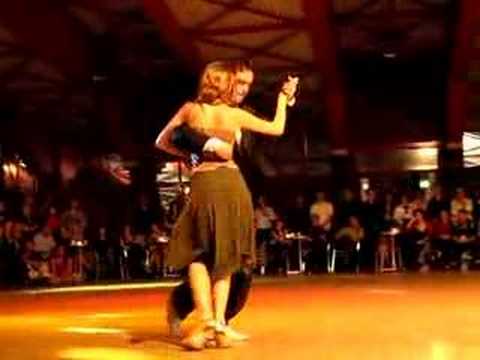
Danced to it
Music from 1927–2003 · danced on film 2008–2026
2008: 1, 2009: 1, 2010: 2, 2011: 1, 2013: 1, 2014: 2, 2015: 4, 2016: 7, 2017: 12, 2018: 1, 2019: 7, 2020: 4, 2021: 2, 2022: 3, 2023: 11, 2024: 5, 2025: 7, 2026: 1


Where it is danced
The places our videos show it danced, by performances filmed there.
What we don't know yet3 of 4 known
The year it was written.
Data: recordings, facts and sources
Composer1
Composed by Vicente Greco
Supported · 2In other catalogues3
TodoTango · tema/441
Single sourcetango.info · T0370021796
Single sourceMusicBrainz · ea5e0dfd-b3e0-4b7c-abfe-2b9b52144906source
Single sourceIs a1
Is a Tango
Single sourceLyricist1
Lyrics by Pedro Numa Córdoba
Single sourceListen
- Ojos negrosFrancisco Lomuto · no clip yet1927
- Ojos negrosOsvaldo Fresedo1927
- Ojos negrosFrancisco Canaro1932
- Ojos negrosCuarteto Típico Roberto Firpo · no clip yet1942
- Ojos negrosCarlos Di Sarli1945
- Ojos negrosOsmar Maderna · no clip yet1947
- Ojos negrosAníbal Troilo1948
- Ojos negrosFrancisco Canaro1949
- Ojos negrosAlberto Mancione · Jorge Ledesma · no clip yet1951
- Ojos negrosHoracio Salgan1951
- Ojos negrosJulio De Caro1952
- Ojos negrosAníbal Troilo1953
Ask Tangopedia
Answers only from cited facts, each with its source.