Tango 1933
Dag Stenvoll and Michael Lavocah · 16 Sept 2020 · 3:41:38
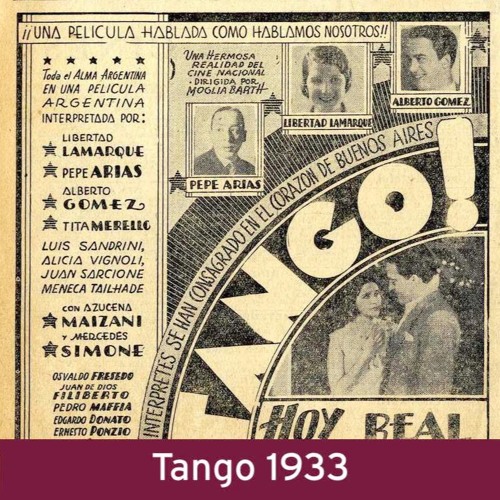
Dag Stenvoll and Michael Lavocah look at 1933, the year of the first Argentine talking film, after the double blow of talking pictures and the Great Depression has culled the most sophisticated bands and bankrupted about half the record companies. The scene is less diverse, dominated by Canaro, Fresedo and Firpo plus the Victor house bands, with solo singers (Gardel, Charlo, Mercedes Simone, Ada Falcón, Corsini, Imperio Argentina) the real stars on the film poster. Fresedo is in what may be his best year; the milonga becomes a mainstream dance-band rhythm; Charlo goes solo with Victor; Lomuto, Donato and Cirilo Ortiz make memorable sides. The centrepiece is Elvino Vardaro's experimental sextet with Troilo on bandoneón, whose single test pressing of Tigre viejo was rejected by Victor and survives as one Vaseline-covered disc. The afterparty adds Polish tangos, foxtrots and waltzes.
0% heard
3:41:38 left
Up next, as released
Tango 1939Episode 19 · 30 Sept 2020 · 3:55:18What this episode gave Tangopedia
Facts said in the episode, each now cited to the minute it is said.
Talking pictures and the Great Depression together caused a huge cull of musicians and orchestras in 1931-32, and about 50% of record companies went bust, leaving a less diverse scene by 1933.
The most sophisticated bands were eliminated: Marcucci, Petrucelli and Brignolo are gone, Maffia and De Caro have no contract at the start of the year, and Di Sarli is gone too.
The first Argentine talking film's poster puts the soloists such as Mercedes Simone in lights, with dance orchestras like Fresedo, D'Arienzo and Típica Victor in small print at the bottom.
The 1933 big three are Canaro, Fresedo and Firpo, none of them among the 1940s golden-decade big four; Típica Victor and Canaro bring a more European feel.
Fresedo's 1933 may be his best year: he has found a light, romantic style quite different from the heavier 1927-29 sextet, with a piano that is not the backbone of the orchestra.
Chapter · 1:56
Tango loses its experimenters
In 1933 half the record labels were gone and so were the boldest bands.

The first recording of Fresedo's own romantic composition, which ended the previous show, with the instruments he borrowed from American music.
♪ Music · 2:55 · The lyrics, on the song's page
Watch it danced · 2
A playful lyric full of wordplay on stuttering (such as saying 'jamón' for 'jamás'), impossible to translate.
Only in the episode
A waltz (not the tango Plegaria) by the Sureda brothers, sung with a glossa and a deep, organ-like bandoneón accompaniment.
Only in the episode
♪ Music · 2:30 ·

A rural-style argument between Charlo and Simone in the style of a payada duel, with Simone giving as good as she gets.
Watch it danced · 81
A Charlo composition, recorded after he left Odeon for a solo Victor contract; its lyric explains why Morán later wanted to sing it with Pugliese.
Only in the episode
♪ Music · 3:30 ·
A sweet introduction on a sad lyric; chosen to cheer up after Cobardía.
Only in the episode
♪ Music · 4:05 ·

A joyful track whose title means 'take it easy'; Dag thinks the violin solo may be Elvino Vardaro.

A socially critical lyric about cabaret luxury against starving workers, showing Gardel's willingness to sing anything.
Only in the episode
♪ Music · 1:55 ·

A 19-year-old singer and actress with guitar backing, a new voice in the series and an alto, easier to record than a tenor.
♪ Music · 2:43 ·
Chapter · 52:15
Women in dinner jackets
Tango's first women stars sang dressed as men.
A sweet guitar-backed milonga associated with female singers such as Rosita Quiroga and Azucena Maizani, who performed in men's clothes.
Only in the episode
♪ Music · 0:16 ·

A slower, different version from the 1942 D'Arienzo one; an OTV house-band recording.
♪ Music · 3:49 ·
Watch it danced · 2

A tango with a singer whose name suggests a non-Spanish, non-Italian origin; Vardaro's violin tone is mentioned as unmistakable.

The first recording of the song, which is better known from De Angelis's 1943 version; Dag loves the melody.
♪ Music · 3:25 · The lyrics, on the song's page

A playful, macho lyric ('what am I going to do?') by Lomuto himself; also recorded by Canaro with Ada Falcón and by Gardel the same year.
A rare male-female duet waltz, which Lavocah says is lucky to have survived.
Only in the episode
♪ Music · 1:51 ·
A Victor house band with a violin solo near the end; hosts debate whether it is Gobbi, concluding the tone is Vardaro's.
Only in the episode
♪ Music · 1:33 ·
Chapter · 1:28:48
Seven bars of Cirilo Ortiz
A waltz built from almost no notes.
A guitar-backed waltz in Ortiz's own name, an exquisite example of the 'talking bandoneón' with octave notes and very few notes.
Only in the episode
♪ Music · 2:53 ·
Replayed at Lavocah's request to hear how few notes Ortiz plays, a clear influence on Troilo.
Only in the episode

A rocking Donato waltz with a piano melody answered by a cello counter-melody, played by one of his brothers.
♪ Music · 2:45 ·

From Canaro's Serie Sinfónica; the 1949 Pugliese version made the piece famous, and the homework is to hear them back to back.
Only in the episode
♪ Music · 3:05 ·

A nostalgic milonga referring to the origins of tango around 1900, from the year milonga entered the dance orchestras.
The lyrics, on the song's page
Watch it danced · 7

Falcón's solo interpretation (backed only by Canaro) in a year with many Ventarróns; Dag nearly made it the last song.
Only in the episode
♪ Music · 1:53 · The lyrics, on the song's page

A Firpo tango with lovely violins at the end, played to show his romantic, sentimental sound.
♪ Music · 2:25 ·
Chapter · 1:59:42
The sextet Victor said no to
The best sextet of its day recorded one test and was told: not commercial.
A slow, melancholic Firpo waltz in poor sound, probably instrumental.
Only in the episode
Dag prefers her guitar-and-piano version to Gardel's 1933 recording with Canaro's orchestra; the lyric is about the mother of five brothers killed in the First World War.
Only in the episode
♪ Music · 2:41 ·
Chapter · 2:09:05
A tango about five dead brothers
Silencio is the sound of a mother after war.
The first recording of a Sebastián Piana and Homero Manzi milonga, an unusual sad milonga; its date is queried.
Only in the episode
♪ Music · 2:35 · The lyrics, on the song's page
A waltz of the same title as the Charlo tango, with guitar backing.
Only in the episode
Chapter · 2:22:46
The record that survived in Vaseline
One disc. Covered in Vaseline. Hidden in a cupboard.
A single test pressing never released; Vardaro's sextet with Troilo, with tempo and volume dynamics, solos by Pascual, Troilo and Vardaro.
Only in the episode
♪ Music · 3:34 ·
Played a second time after the discussion so listeners can follow the tempo changes and solos.
Only in the episode
♪ Music · 3:13 ·
Chapter · 2:38:00
Three Cumparsitas, one matrix number
Canaro recorded La cumparsita three times with the same record number.
Canaro's third recording (1927, 1929, 1933), a big-selling record with Minotto Di Cicco on bandoneón.
Only in the episode
♪ Music · 2:34 · The lyrics, on the song's page
Afterparty cortina: a US jazz recording by Clarence Williams.
Only in the episode
♪ Music · 3:03 ·
A Polish tango ('Love will forgive you everything') by a top-level artist, from a rich Polish tango year.
Only in the episode
A Polish tango with Hawaiian guitar and violin counterpoint behind the singer, to show how widespread the Hawaiian guitar was.
Only in the episode
A bizarre, intense song by the Russian pantomime artist, recorded in Warsaw with Jerzy Petersburski on piano; Lavocah calls it a shocker.
Only in the episode
♪ Music · 1:04 ·

A less well-known Donato waltz; first of three waltzes.

An exquisite violin solo with separately articulated notes and a special Famá performance.
♪ Music · 3:15 ·
Watch it danced · 1
A waltz of European origin; Lavocah lets listeners guess the title from the Spanish lyric about the 'old Paris'.
Only in the episode
♪ Music · 3:35 ·

Canaro's first milonga, a classic where the beat is not regular.
The lyrics, on the song's page
Watch it danced · 68
First of three Fresedo tangos in a year he was huge, partly because the competition vanished.
Only in the episode
A Fresedo tango with Ray, about a little lady from Córdoba.
Only in the episode
Third Fresedo tango of the set, whose title Dag translated as 'scram'.
Only in the episode

A foxtrot that sounds more Argentine, showing Fresedo's North American influence.
Only in the episode

A less well-known foxtrot with a singer in a more English style and a much slower pace.
Only in the episode

First of three Donato numbers, a fast tango relying on violin pizzicato, played as a bridge to what D'Arienzo would do.
♪ Music · 1:51 ·
Watch it danced · 1
Closing Donato number whose lyric begins 'What a plate, che!', which Lavocah says listeners will like even more.
Only in the episode
♪ Music · 2:02 ·
Follow through every episode
Tango By Year is Dag Stenvoll and Michael Lavocah's, published here with their permission. The audio plays from SoundCloud.