Venue
Confitería Ideal
Confitería Ideal, founded in 1912 by Galician immigrant Manuel Rosendo Fernández at Suipacha 384 in central Buenos Aires, is a Café Notable renowned for its Belle Époque interior and long association with high-society gatherings and later tango milongas.[10][11] After serving as a popular milonga venue from the 1970s, it closed in 2017 for extensive restoration and reopened on 16 November 2022 with a renewed emphasis on its original confitería functions.[12][13]
Confitería Ideal occupies a two-story building at Suipacha 384 in the Microcentro of Buenos Aires, a short distance from the Obelisco and Corrientes Avenue.[10][14] The establishment was founded in 1912 by Manuel Rosendo Fernández, a merchant from Pontevedra in Galicia, who invested heavily to create a restaurant and confectionery of European refinement.[10][11] Architect C. F. González designed the structure; materials were imported from Europe, including French chandeliers, Italian stained glass, Czechoslovak armchairs, Slavonian oak boiserie, marble staircases, and bronze and ironwork.[10][15] One floor is said to have housed one of the city’s earliest ice-cream factories.[10][11] The Flor de Lis motif, associated with the Bourbons, appears throughout the ceilings, walls, and display cases.[15]
From its opening the confitería functioned as a meeting place for the porteño bourgeoisie. Afternoon tea between four and six o’clock attracted young women employed nearby, English railway engineers and their families, teachers, merchants, and professionals.[15] Saturday “despedidas de soltera” were held exclusively for women, reflecting contemporary norms that discouraged mixed-gender socializing in such settings.[15] Presidents including Hipólito Yrigoyen and Marcelo Torcuato de Alvear ordered food—particularly the house palmeritas—from the premises; Yrigoyen’s preference for the pastries became part of local lore.[10][16] Writers such as Jorge Luis Borges and Adolfo Bioy Casares, along with performers including Carlos Gardel, Tita Merello, and Hugo del Carril, numbered among the habitués.[16][17] In the 1920s an “orquesta de señoritas” performed; by the 1940s tango ensembles occupied the upper floor.[18]
During the 1970s the owners closed most of the first floor and converted it into a dedicated salon for milongas, transforming the confitería into a dual-purpose venue that attracted both local dancers and international visitors.[10][11] The upper hall hosted classes and social dancing into the 2010s; Sunday afternoons could draw 150–200 dancers.[19] Filmmakers chose the interiors for notable productions: Alan Parker filmed scenes for Evita (1996) with Madonna, and Carlos Saura used the space for Tango (1998).[10][16] Distinguished guests included Maurice Chevalier, Vittorio Gassman, María Félix, Robert Duvall, and, in 1998, Yoko Ono, who remarked that Argentines should “do justice to themselves and not destroy their history and culture.”[10]
Quality and maintenance declined in later decades. Descendants of Fernández sold the property in 2016; new owners closed it in 2017 for a comprehensive restoration led by the architectural firm Pereiro, Cerrotti & Asociados.[10][12] Work recovered original decorative elements, including the large skylight and stained-glass details, and the confitería reopened on 16 November 2022.[10][12] Management indicated that permanent milongas would not return, as the revived concept prioritizes pastelería, tea service, restaurant, and retail confectionery.[20] The episode illustrates both the adaptability of historic porteño interiors and the commercial pressures that periodically reshape their social uses.
Founding and Belle Époque character
Manuel Rosendo Fernández opened the confitería in 1912 with a substantial investment in imported European fittings and the design of engineer C. F. González.[10][11] The resulting interior—marble stairs, stained glass, crystal, and carved oak—established it as a Café Notable alongside Tortoni and El Molino.[21] Early clientele included the English community connected to railway construction and the porteño upper middle class; the house is credited in popular accounts with inventing the classic sandwich de miga for English engineers seeking familiar bread.[15]
Political and cultural visitors
Presidents ordered pastries and meals delivered from the premises; Yrigoyen’s fondness for palmeritas is repeatedly cited.[10][16] Literary figures such as Borges used the tables for conversation, while film productions later exploited the preserved décor for Evita and Tango.[10][16] Yoko Ono’s 1998 visit and public statement underscored the building’s symbolic status as cultural patrimony.[10]
Milonga period and restoration
Conversion of the upper floor into a milonga salon in the 1970s created a new public for the space, with daily classes and social dancing continuing for decades.[10][19] Closure in 2017 enabled a multi-year restoration that recovered the original skylight and decorative scheme; reopening in November 2022 shifted emphasis back to gastronomy.[12][20] Whether occasional tango events will resume remains subject to commercial decisions.
References
- 10.Confitería Ideal - Wikipedia · es.wikipedia.org“Fue fundada en 1912 por el inmigrante español Manuel Rosendo Fernández”
- 11.Cafetines de Buenos Aires: La Ideal · infobae.com“La Ideal abrió sus puertas en 1912”
- 12.Confitería La Ideal reabre después de haber estado cerrada 5 años · baenegocios.com
- 13.Confitería La Ideal | Sitio oficial de turismo · turismo.buenosaires.gob.ar“Fue fundada en 1912 pero cerró sus puertas en 2017”
- 14.Cafetines de Buenos Aires: La Ideal · infobae.com“La Confitería Ideal está ubicada en Suipacha 384”
- 15.Confitería La Ideal (archive) · web.archive.org“fue fundada en 1912 por Don Manuel Rosendo Fernández”
- 16.De Perón a Borges y Yoko Ono: restauran la Confitería Ideal · infobae.com
- 17.La Ideal, la glamorosa confitería porteña · diariopopular.com.ar
- 18.La Ideal, la glamorosa confitería porteña · diariopopular.com.ar“la Orquesta de Señoritas, en la planta alta, fue reemplazada por conjuntos de tango en los años 40’s”
- 19.Confitería Ideal: del té de las 5 en punto a las milongas sin final · clarin.com
- 20.Confitería La Ideal reabre · baenegocios.com“No habrá milongas, no es compatible”
- 21.La restauración de la Confitería Ideal · infobae.com
Opening and closing
Our venue records; each note says what the year counts
- Opened
- 1912confitería founded 1912; milongas on the first floor from the 1970s
By decade
Dated moments, each with its source, and what we filmed
2000s
2004Giselle Anne: Fracanapa, Naveira's choreography, is shown at La Manufactura Papelera, La Ideal and La Viruta.
source
Dancers filmed here
On TangoTube, with the videos whose titles name it · our data
Filmed here
On TangoTube, with the videos whose titles name it · our data
 Javier Rodriguez y Geraldine Rojas - La Confiteria Ideal (1)2008 · 132,894 views
 Javier Rodriguez and Geraldine Rojas tango at La Confiteria Ideal2009 · 86,513 views
 Puppy Castello - La Confiteria Ideal2008 · 56,154 views
 Mariano Chicho Frumboli - La Confiteria Ideal2008 · 28,360 views
 Luna Palacios & Javier Díaz @ Confiteria Ideal, Buenos Aires2009 · 21,055 views
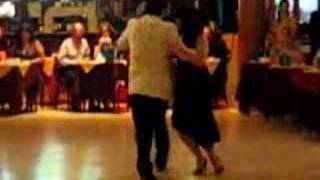 Geraldine y Ezequiel en Confiteria Ideal, April 20082008 · 16,036 views
 La Milonga de Paula y Carlos en la Confiteria Ideal2014 · 13,716 views
 Gerardo Portalea - La Confiteria Ideal2009 · 13,082 views
What we don't know yet3 of 4 known
Events held here.
Data: recordings, facts and sources
In other catalogues2
OpenStreetMap · way/667631388
Single sourceNotes3
The Confitería Ideal, at Suipacha 384, has run since 1912 in its original two-storey building and was founded that year by the Galician immigrant Manuel Rosendo Fernández1912
Single sourceIn the 1970s the owners' descendants closed most of the first floor to turn it into a hall for milongas; it later became a tango salon favoured by presidents, until its sale in 20161970–1979
Single sourceAddress: Suipacha 384
Single sourceOpen from1
Open from 1912
Single sourceDates1
Took place at Nuevo1970
Single sourceBelle-époque confitería whose first-floor salon became one of downtown's best-known milongas, and a set for Saura's 'Tango'.
- Where
- Suipacha 384
Connected
From TangoTube's videos · our data
Within
Listen
No recordings to play yet.
Ask Tangopedia
Answers only from cited facts, each with its source.