Venue
Paris
Paris: Paris: in 1954 Piazzolla and his wife left their two children with his parents and travelled to Paris, where (after winning a composition prize) he studied; the stay led him back to tango and to the nuevo tango ensembles, Paris: in 1977 Piazzolla played a memorable concert at the Olympia in Paris with a new formation of his Conjunto Electronico (after the Teatro Gran Rex concert in Buenos Aires in December 1976), Paris: by the end of 1913 the dance teachers who had introduced the tango to Paris were banished from the city, because of its perceived sexual overtones, and Paris: in 1913 a second Argentine expedition to Europe, led by the pianist Celestino Ferrer with the bandoneonist Vicente Loduca and the violinist Eduardo Monelos and the dancers Casimiro Aín (el Vasquito) and Martina, took the name Murga Argentina; their adventures are the subject of Enrique García Velloso's play El tango en París.††† 1913: Paris: in 1913 a second Argentine expedition to Europe, led by the pianist Celestino Ferrer with the bandoneonist Vicente Loduca and the violinist Eduardo Monelos and the dancers Casimiro Aín (el Vasquito) and Martina, took the name Murga Argentina; their adventures are the subject of Enrique García Velloso's play El tango en París.† 1913: Paris: by the end of 1913 the dance teachers who had introduced the tango to Paris were banished from the city, because of its perceived sexual overtones.† 1954: Paris: in 1954 Piazzolla and his wife left their two children with his parents and travelled to Paris, where (after winning a composition prize) he studied; the stay led him back to tango and to the nuevo tango ensembles.† 1977: Paris: in 1977 Piazzolla played a memorable concert at the Olympia in Paris with a new formation of his Conjunto Electronico (after the Teatro Gran Rex concert in Buenos Aires in December 1976).†
Danced here
9 of 267 filmed performances
 Jonathan Saavedra & Clarisa Aragón & Adam Cornett & Andres MolinaMilonga El Garrón · 2019
 Jonathan Saavedra & Clarisa AragónMilonga El Garrón · 2018
 Jonathan Saavedra & Clarisa Aragón & Adam Cornett & Andres MolinaMilonga El Garrón · 2019
 Sebastián Achaval & Roxana SuárezMilonga El Garrón · 2019
 Brenno Marques & Fatima CaracochMilonga El Garrón · 2025
 Carlitos Espinoza & Noelia HurtadoMilonga El Garrón · 2017
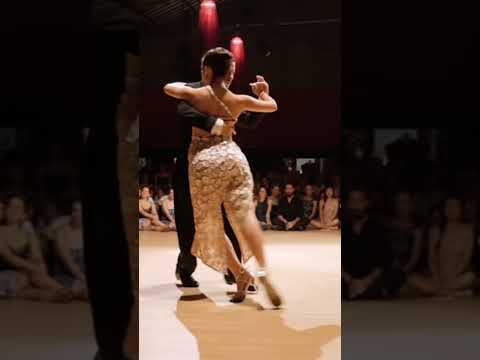 Neri Piliu & Yanina QuinonesTango Roots Festival · 2018
 Andres Molina & Natacha Lockwood & Edwin Espinosa & Alexa YepesTango Roots Festival · 2018
 Marko Miljevic & Maja Petrović2017
The music danced here
The recordings most danced here, on film. The bar is how often each is still danced everywhere we index.
- 1940
- 1939
- 1939
- 1957
- 1952
- 1940
- 1938
- 1943
- 1956
- 1956
- 1941
- 1938
- 1940
- 1944
- 1939
- 1941
- 1959
- 1938
- 1939
- 1938
What we don't know yet1 of 2 known
A description.
Data: recordings, facts and sources
Held at2
Tango Roots Festival — held at Paris
Single sourceMilonga El Garrón — held at Paris
Single sourceLocated in2
Tango Roots Festival — located in Paris
Single sourceMilonga El Garrón — located in Paris
Single sourceNotes4
Paris: in 1954 Piazzolla and his wife left their two children with his parents and travelled to Paris, where (after winning a composition prize) he studied; the stay led him back to tango and to the nuevo tango ensembles1954
Single sourceParis: in 1977 Piazzolla played a memorable concert at the Olympia in Paris with a new formation of his Conjunto Electronico (after the Teatro Gran Rex concert in Buenos Aires in December 1976)1977
Single sourceParis: by the end of 1913 the dance teachers who had introduced the tango to Paris were banished from the city, because of its perceived sexual overtonesOct 1913–Dec 1913
Single sourceParis: in 1913 a second Argentine expedition to Europe, led by the pianist Celestino Ferrer with the bandoneonist Vicente Loduca and the violinist Eduardo Monelos and the dancers Casimiro Aín (el Vasquito) and Martina, took the name Murga Argentina; their adventures are the subject of Enrique García Velloso's play El tango en París1913
Single sourceDates4
Guardia Nueva — took place at Paris1920, 1925
Single sourceTook place at Revival1999
Single sourceTook place at Electronic and festival era2001
Single sourceTook place at Nuevo1981
Supported · 2Connected
From TangoTube's videos · our data
Events here
- Milonga El Garrón165 videos
- Tango Roots Festival89 videos
- Mala Junta3 videos
- Sensation Milonga1 video
- la Milonga du Chat
- Argentino Ledesma's 1960 European tour
- Enrique Saborido's 1913 European tour
- Folktango Osullivans Champs Elysees
- Sexteto Mayor's 2004 tour
- Milonga Infrarouge Ultraviolet
- Milonga du Marche Vaugirard
- Milonga Pascote
- Milonga Danse avec moi
- Milonga la Sincopa
- Practica Tango Clasico
- Fortissima Gioia Bateau Concorde
- Le Colectivo
- Bal Caminito
- Slow Halloween Tango Zouk Fusion et Tango a 3
- La Mono Bicicleta Maurice Ravel
- Milonga Piscine de La Star
- La Gioia au Bateau Concorde
- La Cosy du 15eme
- Sexteto Tango's 1987 European tour
Listen
No recordings to play yet.
Ask Tangopedia
Answers only from cited facts, each with its source.